
August 12, 2026 - PBS News Hour full episode
8/12/2026 | 57m 46sVideo has Closed Captions
August 12, 2026 - PBS News Hour full episode
August 12, 2026 - PBS News Hour full episode
Problems playing video? | Closed Captioning Feedback
Problems playing video? | Closed Captioning Feedback
Major corporate funding for the PBS News Hour is provided by BDO, BNSF, Consumer Cellular, American Cruise Lines, and Raymond James. Funding for the PBS NewsHour Weekend is provided by...
August 12, 2026 - PBS News Hour full episode
8/12/2026 | 57m 46sVideo has Closed Captions
August 12, 2026 - PBS News Hour full episode
Problems playing video? | Closed Captioning Feedback
Where to Watch PBS News Hour
PBS News Hour is available to stream on pbs.org and the PBS app.
Providing Support for PBS.org
Learn Moreabout PBS online sponsorshipWILLIAM BRANGHAM: Good evening.
I'm William Brangham.
Amna Nawaz and Geoff Bennett are away.
On the "News Hour" tonight: A slew of primary elections yield mixed results for the moderate and progressive wings of the Democratic Party, as well as for Trump-backed Republicans.
Spain charts a different approach to immigration than much of the world by planning to give migrants legal status.
VLADIMIR REVELO, President, Asociacion Ruminahui (through translator): Without this work force, the construction, service, and hospitality sectors, as well as the agricultural and parcel delivery sectors, would grind to a halt.
WILLIAM BRANGHAM: And federal judges speak out against the increased threats of violence that they are facing.
JUDGE ESTHER SALAS, U.S.
District Court of New Jersey: We need to all start toning down the rhetoric.
If you want to criticize us on the merits, by all means, appeal us and criticize us on the merits.
But that's not what DHS is doing.
(BREAK) WILLIAM BRANGHAM: Welcome to the "News Hour."
We are getting a clearer picture of who will be on November's ballots and the direction of the country's political parties.
That's after some key primary races were decided in six different states last night.
In the Midwest, voters weighed in on party establishment candidates, insurgencies, and a pair of celebrities.
Meanwhile, in the Southeast, questions surrounding political succession and Trump's influence remain unresolved for now.
The vote count lasted late into the night in Wisconsin, where the Democratic primary for governor turned into a battle over the party's direction.
Milwaukee County executive David Crowley narrowly upset state representative Francesca Hong, a Democratic Socialist who'd led in the polls leading up to Election Day.
DAVID CROWLEY (D), Wisconsin Gubernatorial Candidate: It's not about the establishment versus progressives.
It's about building something bigger than any one campaign.
WILLIAM BRANGHAM: Crowley had dropped out of the race last month before reentering 10 days later with the support of outgoing Democratic Governor Tony Evers.
(CHEERING) WILLIAM BRANGHAM: Before the race was decided, Hong called for supporters to unite.
FRANCESCA HONG (D), Wisconsin Gubernatorial Candidate: No matter who wins this primary, we're going to continue to fight for each other.
We are going to collectively reject despair, and we are going to unite.
WILLIAM BRANGHAM: Crowley will now face the Republican nominee, Congressman Tom Tiffany, this fall.
(CHEERING) WILLIAM BRANGHAM: In neighboring Minnesota, a progressive candidate for Senate notched a big win.
Lieutenant Governor Peggy Flanagan won the Democratic nomination to replace retiring U.S.
Senator Tina Smith, beating moderate Congresswoman Angie Craig by nearly 20 points.
Flanagan overcame a nearly 5-1 fund-raising disadvantage.
LT.
GOV.
PEGGY FLANAGAN (D-MN), Senatorial Candidate: I have been telling You that this campaign was about the many versus the money.
(CHEERING) LT.
GOV.
PEGGY FLANAGAN: Well, guess what?
The many just won.
(CHEERING) WILLIAM BRANGHAM: Flanagan will now face Republican nominee Michele Tafoya, who's a former NFL sideline reporter.
And in South Carolina, a special election to replace the late Senator Lindsey Graham on this November's ballot isn't over yet.
Graham's sister, Darline, was appointed to fill his seat until January and is running to keep it in the family next year.
SEN.
DARLINE GRAHAM (R-SC): I have buried my precious brother.
I have taken on the role of a United States senator.
And I have had this brutal campaign schedule.
And I'm still standing.
If that doesn't tell you I'm a strong person and a fighter, nothing will.
WILLIAM BRANGHAM: Graham has President Trump's backing.
FRANK OWENS, South Carolina Republican Voter: I think I would have gone with Darline either way, but it's always nice that they're able to work with the president.
WILLIAM BRANGHAM: Graham faces conservative Ralph Norman in an August 25 run-off.
REP.
RALPH NORMAN (R-SC), Senatorial Candidate: I asked for the president's endorsement and didn't get it.
But anybody would want the endorsement.
But he chose who he did, and that's fine.
South Carolina is going to decide the next senator.
(CHEERING) WILLIAM BRANGHAM: So, for more on last night's results, we are joined now by political strategists from both sides of the aisle.
Republican Liam Donovan previously worked for the National Republican Senatorial Committee.
And Democrat Joel Payne currently works for the progressive group MoveOn.
Gentlemen, thank you both so much for being here.
Joel, to you first.
Let's talk about Wisconsin and the Democratic primary for governor there.
Francesca Hong was up by double digits, I believe it was, in the polls just weeks before this election.
But Crowley ends up squeaking out a win.
When you look at what went down there, how do you assess what happened last night?
JOEL PAYNE, Democratic Strategist: Well, what I see when I look at Wisconsin last night is that the folks who were uncomfortable with Francesca Hong all finally had a candidate to unite around.
Before, in the race, there was the current lieutenant governor, there was the former Lieutenant Governor Mandela Barnes.
There were others in the race.
That field cleared out and it became very clear that Crowley was the alternative to hong.
Hong's numbers were always pretty consistent, in the high 30s, 40 percent, which is about where she landed last night.
It was that undecided vote and that vote that was dispersed among others that never quite came together.
Well, it came together behind David Crowley.
And a lot of that support was in the African American community in big areas like Milwaukee, Madison, Racine, where you see big numbers of African American voters in Wisconsin stacking up.
Crowley was able to do that.
And I think Democrats overall feel more buoyant about their opportunity to defeat Tom Tiffany in November now that Crowley is the nominee, instead of Francesca Hong, because of some of Hong's previous statements and some positions that feel maybe a bit out of the mainstream.
WILLIAM BRANGHAM: I mean, Liam, as Joel is saying, Republicans clearly wanted to run against Hong because of these statements like wanting to cancel Thanksgiving and to perhaps abolish the police.
So they don't have that foil now, and now they have to run against Crowley.
How do you see that unfolding?
LIAM DONOVAN, Republican Strategist: I think, number one, I mean, Francesca Hong was not a great candidate that was very, very ripe for Republicans.
They were certainly rooting for it.
I think, if you're looking at the initial polling, though, Crowley is matching up similarly against Tiffany in the general election.
It is still a tough matchup.
And it's going to be coming down to I think the environment and how Crowley shows me -- this is a guy who not in the race a month ago, so how he shows on the campaign trail, very impressive comeback.
I think, to Joel's point, the collective action problem that Democrats managed to solve, I think they saw the race flash before their eyes with the experience in Michigan.
And so the way that Hong comported herself on that past week prompted the governor to go out and do a full-court press.
And so I think it the establishment sort of won that battle.
But if you look at the war that played out across the country last night, the establishment is taking on the chin in places like Connecticut, in places like Minnesota.
And so I think there is still a lot of this sort of green Tea Party yet to come in this cycle.
WILLIAM BRANGHAM: That's right.
Joel, let's switch to the Minnesota Senate primary.
And as Liam is saying, progressive Dems took it on the change in there.
But they did score this win in Minnesota with Lieutenant Governor Peggy Flanagan beating Congresswoman Angie Craig by double digits.
How much energy do you think is in the Democratic Party right now on this progressive wing, that side of the party?
JOEL PAYNE: Look, I think for sure the energy, the kind of guaranteed energy that you really want at your back going into an election cycle, it is certainly coming from the left flank of the party.
Some of that is frustration with the establishment, both in the Democrat and the Republican Party.
And then some of it is just because of new fresh ideas and fresh candidates.
Peggy Flanagan would be a historic candidate.
She'd be the first woman Native American in the United States Senate.
And I think an issue that really took center stage in Minnesota was ICE.
Of course, Minnesota was ground zero of some of the biggest conflagrations between ICE and between citizens over the last year.
That was a very prominent issue here.
Peggy Flanagan talked about a kind of a maximalist approach to abolishing ICE, Angie Craig a little bit more nuanced, and I think ultimately that was part of the storyline and part of the soundtrack as to why Flanagan was able to beat Craig by a pretty impressive number.
I mean, a 20-point spread in a race like that, that is pretty significant, and I think just adds to the momentum behind the progressive wing of the party.
WILLIAM BRANGHAM: Liam, in the in that same state, for the -- in the Republican gubernatorial primary, Republican Lisa Demuth beat Mike Lindell, the famous MyPillow guy, longtime Trump ally, famous for all of his election-denying shenanigans.
He is one of a handful of these Trump-backed candidates that have not fared, seemingly because Republican voters get a little bit nervous about how they might fare statewide.
How do you see how that one played out?
LIAM DONOVAN: I think Mike Lindell has become kind of a sideshow and a punchline in a lot of ways.
And so, irrespective of the president's support, I think that was pretty clear to the voters of Minnesota.
But I think this has been a state that should have shifted toward Republicans in the Trump era, and for a lot of reasons hasn't.
Part of that has been putting up the right kind of candidates.
So getting some -- moving away from the Mike Lindell model and the Royce White move, moving towards people like Demuth, people like Michele Tafoya, who comes from an outsider background, has sort of an apolitical sports entertainment bent, these are the sorts of people that in a neutral environment put these races in play.
And you got to be encouraged.
It's sort of a similar to the Wisconsin dynamic, Democratic voters taking the choice and making the choice that doesn't take a race off the board.
And so that's what Republicans have to hope in Minnesota.
WILLIAM BRANGHAM: Staying with you, Liam, let's talk about South Carolina quickly.
Newly appointed Senator Darline Graham, sister of Lindsey Graham, had the president's full endorsement.
She was already the incumbent, with all the benefits that accrue to them, but she couldn't quite clear this 50 percent mark.
What challenges do you think she's going to face in this run-off?
LIAM DONOVAN: I think the biggest issue is, Ralph Norman comes in with the ability to self-fund.
So, in an abbreviated timetable where her name residual name I.D.
just being a Graham is good, but, remember, Lindsey Graham has always faced primary challenges in his previous races.
Just most recently, I think there was something like a third of the electorate that voted for an alternative candidate.
So the challenge for Norman will be to spend enough money to consolidate the people who are not sold on another Graham.
The good news is that Darline Graham has the president's backing.
And the other piece is, the president is not so fond of Ralph Norman.
Despite Norman being a strong backer of the president and would back his agenda, he backed Nikki Haley in a way that the president and the White House don't like.
So the idea is I think that the Republican allied groups coming in her favor.
You're seeing some consolidation.
Senator Tim Scott coming out for her today.
So we will see if the party aligns behind her.
Either way, that seat stays Republican, and it's going to be a Trump-aligned voice.
But to your question of, does the president's picks, do they succeed, I think that will be an open question, but she's got a good start with that 30-some percent.
WILLIAM BRANGHAM: Liam Donovan and Joel Payne, thank you both so much for being here.
LIAM DONOVAN: Thanks.
WILLIAM BRANGHAM: We start the day's other headlines with more on that elaborate plan that secretly flew President Trump out of Turkey last month and the nature of the reported threat from Iran that made the move necessary.
Speaking to reporters last night, President Trump confirmed that he was whisked away from Air Force One in a catering truck at the Secret Service's direction.
He downplayed the risk to those he left on the original plane while he flew on a separate one.
DONALD TRUMP, President of the United States: I go by Secret Service and the military.
They wanted me to go in a different flight, a different plane, equal safety, but they wanted me to do it, so I do it.
I do what they say.
I guess there was a threat out there.
I didn't really ask too much about it.
I get a lot of threats.
WILLIAM BRANGHAM: The New York Times reports that credible threats against the president included someone spotted near the NATO summit with a shoulder-fired surface-to-air missile, and that the Iranians even knew which floor of the hotel President Trump was staying on.
In Colombia, the hope of finding survivors is diminishing now more than two days since a powerful 7.4-magnitude earthquake devastated parts of the country.
Rescuers consider the first 48 to 72 hours critical to save people.
And victims are still being found alive.
(CHEERING) WILLIAM BRANGHAM: Applause rang out today after rescue teams retrieved one woman who had been trapped for a day-and-a-half.
But many have not been saved.
The disaster has killed at least 180 people, and nearly 2,600 have been injured.
Still, many first responders say they are not giving up.
CAMILO CANO, Bogota Fire Department Official (through translator): At this moment, we're focusing more on the removal of debris, and we are still continuing to try and find victims alive.
We still have hope until at least four days after the earthquake has passed.
WILLIAM BRANGHAM: The earthquake has tested the new government of President Abelardo de la Espriella, who was sworn in last Friday.
More than 4,000 people are believed to be missing.
More severe storms swept across the Midwest today, just one day after tornadoes and flash floods wreaked havoc on the region.
Street lights flickered as straight-line winds blasted through backyards like these in Indiana.
State officials say a 4-year-old boy was killed by a falling tree.
Today, Governor Mike Braun said his state is accustomed to isolated tornadoes, but yesterday's weather was far more widespread.
GOV.
MIKE BRAUN (R-IN): This is just one of those straight-line wind events that's covering probably nearly a third of our counties.
Normally, a tornado will be on one or two.
WILLIAM BRANGHAM: In Portage, Indiana, officials are investigating if this House explosion, which killed one person, was related to the storms.
And in neighboring Ohio, officials say at least one other person was killed in floodwaters that inundated homes and cars.
Nearly 700,000 customers remain without power tonight from the Chicago area all the way to West Virginia.
White House Press Secretary Karoline Leavitt says she will soon leave her job to spend more time with her family.
At 28 years old, Leavitt is the youngest person ever to hold that position.
She just recently returned to work after taking a brief leave for the birth of her second child in May.
Announcing the news, President Trump called Leavitt one of his most trusted aides and added that she would continue to serve as an outside adviser.
Leavitt will depart at the end of this month.
In sports news, the Los Angeles Lakers are being sold for the second time in just over a year, this time to two big names in business, former Disney CEO Bob Iger and venture capitalist Josh Kushner, who is also the younger brother of Jared Kushner, President Trump's son-in-law.
The price, reportedly a record-shattering $12.5 billion.
The team has been owned since 2025 by Mark Walter, the majority owner of the L.A.
Dodgers.
Ultimately, the NBA must approve the deal before the sale is final.
Inflation cooled slightly in July, according to new Labor Department data.
Falling gas prices are what primarily drove that drop, but costs overall still remain high.
July's 3.4 percent inflation remains well above the 2.4 percent from before the Iran war.
Concerns about rising costs did not spill over onto Wall Street today.
The Dow Jones industrial average notched a negligible loss, but the Nasdaq had a half-a-percent gain, and the S&P 500 had its first positive day since Friday.
A British driver who was actually the first to break the sound barrier in a car has set a new world record for speed.
Blazing across the salt flats in Utah, Andy Green, a retired Royal Air Force pilot, reached a top speed of 406 miles per hour yesterday in a hydrogen-powered car.
That's a record for that type of engine.
And millions across Europe witnessed a rare total solar eclipse today, when the perfect alignment of the sun, moon, and Earth briefly turned day to dark.
Sky-gazers in Spain had not seen a total eclipse in more than a century.
Others from Portugal to Greenland were also treated to the celestial spectacle.
Here in the U.S.
and elsewhere, observers saw the moon cover much of the sun in a partial eclipse.
NASA says another total eclipse will occur next August in parts of Spain and North Africa.
Still to come on the "News Hour": we speak to two federal judges about rising threats to themselves and their colleagues; and musician Andrew Bird on bringing his eclectic compositions into an orchestral space.
As most Western countries tighten their borders, Spain's left-wing Prime Minister Pedro Sanchez has enacted a plan aimed at giving legal status to undocumented immigrants.
It's called regularization.
But late last month, when tens of thousands of migrants tried to illegally cross into the Spanish territory of Ceuta, which borders Morocco, that incident put Spain's immigration policy under the microscope.
Stephanie Sy has more.
STEPHANIE SY: Before most of Madrid wakes up, Carlos Aroca is already at work.
For hours each morning, he collects garbage in one of Europe's busiest capitals.
It's essential work done by an invisible worker.
CARLOS AROCA, Ecuadorian Migrant (through translator): We can work in jobs that many people no longer want to do, jobs in cleaning, fruit picking, farmwork, eldercare, and construction.
STEPHANIE SY: It wasn't his dream job either.
Aroca came to Spain from Ecuador to pursue an MBA.
After a year of study, he lost his legal status and was forced to find jobs willing to hire undocumented immigrants.
CARLOS AROCA (through translator): When it comes to working irregularly, it does hit us pretty hard since we don't have the benefits that the law provides a regular job.
They're not going to pay us the same as someone who's on contract.
STEPHANIE SY: Carlos is among an estimated 600,000 undocumented migrants that now have the opportunity to come out of the shadows.
The royal decree he approved in April provides temporary and renewable legal status to undocumented immigrants who have lived in Spain for the last five months and have no criminal record.
VLADIMIR REVELO, President, Asociacion Ruminahui (through translator): These more than one million immigrants were working.
But they were working in the informal sector.
What this regularization has done is bring them into the formal system so they can now make contributions and have Social Security, access to public health care.
STEPHANIE SY: Vladimir Revelo is the president of a migrant advocacy group in Spain.
The nonprofit has spent decades helping migrants navigate the immigration system.
He's helped Aroca and hundreds of people like him, who are working, paying rent and raising families, but unable to fully participate in the country many now consider home.
CARLOS AROCA (through translator): My first reaction was one of doubt.
I couldn't get my hopes up too much.
Once the law was passed, of course, you could say it was a dream come true.
STEPHANIE SY: Today, foreign workers make up roughly one of every six workers in Spain.
Revelo says the reforms are a pragmatic response to Spain's economic challenges, an aging population, low birth rates and persistent labor shortages.
VLADIMIR REVELO (through translator): Spain and the European Union will need around 60 million workers by 2050 because they need to collect Social Security contributions to maintain pensions for native citizens.
Spanish businesses need this work force.
Without this work force, the construction service and hospitality sectors, as well as the agricultural and parcel delivery sectors, would grind to a halt.
STEPHANIE SY: But not everyone sees the policy as an economic necessity.
Opposition leader Alberto Nunez Feijoo argues Spain lacks the housing, public services and infrastructure to absorb more migrants.
ALBERTO NUNEZ FEIJOO, President, Popular Party (through translator): This regularization has harmful consequences for Spain and therefore for all of Europe, because it will put pressure on public services, further strain the housing market, and create problems in the community.
STEPHANIE SY: And, last month, the immigration debate exploded overnight.
More than 350 miles south of Madrid, Spain's tiny North African territory of Ceuta was confronted with a wave of people.
Tens of thousands of migrants attempted to cross into Ceuta from neighboring Morocco.
The chaotic scenes quickly spread across TV screens and social media, families sleeping on beaches, people washing clothes in the sea and lining up for aid.
More than 100 people died, either drowning or crushed by the crowd.
For many who thought they'd made it, the crossing represented years of hope distilled into a single desperate attempt.
AHMED HAROUN, Sudanese Migrant: I have many dreams.
And the first dreams to me, just I want to help my lost family.
Why I said lost?
Because I lost a lot of them, and I will fight for them.
I will fight.
I will do anything just to have them.
STEPHANIE SY: Twenty-nine-year-old Ahmed Haroun says he waited four years for the opportunity to escape Darfur, Sudan.
AHMED HAROUN: No, I'm not scared of this life.
I believe everyone here just die one time.
No one can die two times.
STEPHANIE SY: But most migrants who entered Ceuta have since been deported back to Morocco or returned on their own.
What led to the mass attempt to cross into Spanish territory is unclear.
But experts say it was likely not spontaneous.
JEREMY KONYNDYK, President, Refugees International: There was misinformation circulating on social media in Morocco, telling people that they could go to Spain and that they would have a chance to go there and stay.
STEPHANIE SY: Jeremy Konyndyk is the president of Refugees International.
He said the role Morocco played in the chaos deserves scrutiny.
JEREMY KONYNDYK: What we do know pretty definitively is that the Moroccan border guards who would normally have prevented something like this did not obstruct it.
This was a breakdown, potentially a willful breakdown, by the Moroccan government in their border controls, perhaps to put some kind of pressure on Spain, because they knew that there would be this kind of hysteria in Europe over these sorts of images.
STEPHANIE SY: The images gave anti-immigration voices fuel to criticize Spain's immigration reforms, even though Spain has long taken a hard line on the kind of irregular migration that occurred in Ceuta.
Spain's far right party President Santiago Abascal reacted.
SANTIAGO ABASCAL, Vox Party Leader (through translator): We are facing an invasion, and it must be called that.
I think that at this point no one can deny that the arrival of 65,000 people, according to what's being said at the moment, is an invasion.
And we are facing an act of war promoted by Morocco and tolerated and allowed by Pedro Sanchez.
STEPHANIE SY: Twenty-two European Union member states led by Italy and Denmark warned that large-scale regularization programs risk drawing more migrants to Europe.
JEREMY KONYNDYK: The far right immigration narrative in Europe has always been that Europe is going to be overrun by people from around the world if they open their doors and if they treat migrants humanely.
And so, for them, they want to spin this as definitive proof of that.
STEPHANIE SY: Konyndyk says far right anti-migrant sentiment undermines the economic solution that he says more migration offers and that Europe needs.
JEREMY KONYNDYK: They have created for themselves an impossible situation, where their economy desperately needs migration, and their politics will not allow for it.
What we see the Sanchez government doing here in Spain is trying for a more sane and rational migration policy that actually reflects the realities of their country and their economy.
STEPHANIE SY: Carlos Aroca says he's looking forward to having more personal stability and returning to his original dream of working in business.
Carlos, what is your message to people who don't agree with these immigration reforms?
CARLOS AROCA (through translator): We migrants in most cases leave our countries in search of a better life.
What we come here to do is to contribute to the country that welcomes us.
We want to be able to fit into an environment of coexistence through our work and our culture, respecting the traditions they have, but also contributing our own, which are also very valuable.
STEPHANIE SY: For the "PBS News Hour," I'm Stephanie Sy.
WILLIAM BRANGHAM: Hundreds of federal judges across the country have received threats against themselves and their families this year.
The U.S.
Marshals Service reports security incidents of -- quote - - "significant concern" jumped nearly 60 percent in the 2025 fiscal year and are on track to rise again this year.
This comes amid a litany of verbal and written attacks by President Trump and members of his administration about judges who have ruled against them.
Justice correspondent Ali Rogin has more.
ALI ROGIN: U.S.
District Court Judge John McConnell received an unexpected pizza delivery to his home last year.
While it was certainly strange, McConnell says he was deeply disturbed when he noticed the name on the order, Daniel Anderl.
That's the name of U.S.
District Court Judge Esther Salas' son, who was fatally shot at their family's home in 2020 by a disgruntled lawyer.
Several other judges also received pizza deliveries under Anderl's name.
McConnell says that was just one of multiple death threats he's received.
They began escalating in 2025 when he temporarily blocked the Trump administration freeze on billions of dollars in federal funding.
To discuss, Judge McConnell joins me now, along with Judge Esther Salas.
Thank you both so much for being here.
Judge McConnell, I'd like to start with you.
What was going through your mind when you saw the name on this unsolicited pizza delivery?
CHIEF JUDGE JOHN MCCONNELL: Well, heartbreak originally that some people for political reasons would invoke the name of Judge Salas' beloved son who was murdered when a person was actually attempting to murder her and then ultimately wanting to do the same to Justice Sotomayor.
So it was heartbreak turned to outrage turned to disappointment that we had gotten to that stage in our discourse in the country.
ALI ROGIN: And, Judge Salas, what was going through your mind when you heard that someone had received a pizza delivery under your late son's name, and also to find out there that there have been other cases like this.
JUDGE ESTHER SALAS, U.S.
District Court of New Jersey: Yes, just sadness, but anger too, because Daniel stands for light and love, and he gave his life as an act of love for his dad, Mark, my husband, and me.
And for people to be using and weaponizing his name to inflict fear on judges all throughout this country just tells me where we're at in terms of trying to intimidate the judiciary and trying to really strip the judiciary of its constitutional independence.
ALI ROGIN: The president and members of his administration have launched verbal attacks against judges in the past.
Recently, the general counsel to DHS, James Percival, wrote a list of federal judges on X whom he called the worst of the worst.
We're not going to show that here.
You were on our show last year talking about this and the harmful inflammatory rhetoric that these administration officials are using.
Have things changed, in your opinion?
And, if so, have they gotten better or worse?
JUDGE ESTHER SALAS: I mean, they have gotten a whole heck of a lot more dangerous for judges.
I think we are devolving as a nation with the leadership that chooses to continue to dehumanize judges.
I mean, for general counsel of DHS, who enjoys a certain level of respect for the position, for DHS to be using government Web sites and using official handles to spread disinformation, it's just a sad state.
And I think we need to pump the brakes here, and we need to start coming back to a place where we can agree to disagree.
And we can maybe disagree on the merits, but we have to stop personalizing and villain -- villainizing, rather, judges.
ALI ROGIN: Judge McConnell, this pizza delivery was not the first threat you have received.
Your office has been flooded with calls and e-mails leaving threatening messages.
They really picked up after your ruling to block that freeze on federal funding last year.
We want to play a part of one of those voice-mails.
CALLER: So you better tell little (EXPLETIVE DELETED) Judge McConnell I don't know who the hell he thinks he is.
I double dare you to try to put charges on Donald J. Trump, you (EXPLETIVE DELETED).
And I wish somebody would (EXPLETIVE DELETED) assassinate your (EXPLETIVE DELETED).
ALI ROGIN: It's deeply disturbing to hear.
Do you think attempts to intimidate you like this are a result of the rhetoric coming from the Trump administration?
CHIEF JUDGE JOHN MCCONNELL: There's no doubt in my mind that the fact that certain of our leaders in this country have chosen dog whistles, there is no other way to describe it, when they talk about judges.
Our own new attorney general said that we were at war with the courts.
We have been called traitors.
We have been called all sorts of names and that serve as dog whistles to the population that says that judges are fair game for going after, for attacking.
We know that, when these personal attacks on judges are said by our governmental leaders that the threats against judges go up.
I can attest to that specifically.
They started.
And they doxxed my daughter.
My wife got threatened.
The comments made that dehumanized myself and others -- I'm not the only judge.
Judges across this country have been subjected to what I have been subjected to.
ALI ROGIN: And, Judge McConnell, have you had to change the way you do anything within the confines of your work or your life more generally?
CHIEF JUDGE JOHN MCCONNELL: The answer is yes.
I'm certainly not going to go into it, for security reasons, et al, but the work is the work.
And, as Judge Salas and I both, as do the hundreds of District Court Courts of Appeals judges throughout the country, our North Star is the rule of law.
We follow that regardless, but it sure does make it a lot harder to safely live in this world and do our jobs when we're continually under dehumanizing attack from government leaders and the executive from the top on down.
ALI ROGIN: And right at the top, Judge Salas, we have seen Supreme Court Justices Barrett and Kagan testify about the need for increased security budgets.
Justice Barrett memorably recounted how her son saw her put on a bulletproof vest.
So what do you think can and should be done with larger security budgets to protect judges?
And, also, what do you think the balance is between the need for more security measures, but also the need to tone down the rhetoric?
JUDGE ESTHER SALAS: You know, I first of all, think that the worst of the worst series that was launched by the general counsel of the DHS came just weeks after these two justices historically testified to Congress about the threats to the Supreme Court.
It doesn't seem to matter, I mean, whether it's a judge that's appointed by a Republican president or a justice that's appointed by or nominated by a Democrat president.
We're seeing that this type of rhetoric just gives people license to take matters into their own hands.
The person who killed my Danny, the person who came to my home and murdered my only child felt emboldened, if you will, to take matters into his own hands.
And so what needs to happen is, our leaders need to lead by example, and we need to all start toning down the rhetoric.
If you want to criticize us on the merits, by all means, appeal us and criticize us on the merits.
But that's not what DHS is doing.
It's irresponsible.
It is not true leadership.
And I would ask our leaders, let's start leading in a responsible way.
ALI ROGIN: Judge John McConnell, Judge Esther Salas, thank you both so much for joining us and sharing your... CHIEF JUDGE JOHN MCCONNELL: Thanks so much, Ali.
JUDGE ESTHER SALAS: Thank you so much, Ali.
WILLIAM BRANGHAM: From playing classical and jazz standards on his violin to singing folk and rock, Andrew Bird is constantly weaving together different styles and genres.
Special correspondent Mike Cerre caught up with Bird as he performed with the San Francisco Symphony.
It's part of our arts and culture series, Canvas.
MIKE CERRE: A classically trained violinist since he was 4, Andrew Bird has been improvising with his violin and his music ever since.
ANDREW BIRD, Singer-Songwriter and Violinist: Since the violin is generally one note at a time, I discovered this technology that could allow me to play pizzicato parts and then layer on both parts, and you're kind of creating this skeleton of a song.
MIKE CERRE: Never intending to replace a band or orchestra he couldn't afford early in his career, his onstage recorded music loops with his violin, singing and whistling became his live performance signature, a one-man orchestra of the imagination.
ANDREW BIRD: The classical music is part of my roots, the -- but also all these other things.
And it all just kind of steers in there and comes out as it does.
MIKE CERRE: Tell me about over the years your kind of love-hate relationship with symphony orchestras.
Why didn't you want to go that route with your classical musical training?
ANDREW BIRD: I quickly realized that I wasn't cut out for it.
I was too -- I think too -- a little too individualistic.
(CHEERING) MIKE CERRE: This year, he's going full circle, playing with major orchestras like the San Francisco Symphony, making his millennial fan base and ever supportive and patient parents very happy.
ANDREW BIRD: No matter what I was doing, my dad was like, you sure you don't want to try to go play the Bruch Concerto with the Dubuque Symphony or something like that?
(MUSIC) ANDREW BIRD: Come back, Chicago.
MIKE CERRE: While growing up in the Chicago area and studying classical violin at Northwestern, he gravitated more to playing pickup sessions at Irish pubs, jazz clubs, and joining a punk ska band.
ANDREW BIRD: I was just really interested in absorbing, say, gypsy -- Hungarian gypsy music or early jazz or Irish music or anything, anything exotic or different.
MIKE CERRE: His music culture immersion led to 18 very different albums over the years.
His amalgam of different music genres still challenge the digital music algorithms, the Grammys, and even his fan base to categorize.
MAN: I would put him in the folk category.
WOMAN: He's a very talented multi-instrumentalist, and I leave it at that.
MAN: He crosses a lot of boundaries.
There's a little bit of electronic in there.
WOMAN: Indie folk, indie, yes.
MAN: He's touched on jazz, a lot of that New Orleans sound.
MAN: I don't think it can be categorized, and I think that's the greatest thing about it.
You can't.
Every time, it's something different.
ANDREW BIRD: I learned early on that staying in one place too long in a genre, it just becomes a drag if you're ready to move on and you get stuck in that genre.
MIKE CERRE: Some of his improvisations have been inspired by his focus on acoustics and his field recordings in what he calls echolocations, like Utah's Coyote Gulch Canyon and the aqueducts along the Los Angeles River.
ANDREW BIRD: So I would make these field recordings and then play the field recording and then start improvising and looping to that in the studio.
MIKE CERRE: You have been nominated for an Emmy for your best original song for "The Pitt," very popular series.
ANDREW BIRD: They send me the scene, which is this very emotional scene where finally everyone stops and reflects on the passing of their beloved character.
That, to me, is like an ideal use of what I have to offer.
It's like taken me a whole lifetime to be able to write that song that took an hour to write.
MIKE CERRE: Instead of a medley of his hits and soundtracks, Andrew Bird's symphony performances focus on the 20th anniversary of his first concept album, "The Mysterious Production of Eggs."
He originally composed it while on a career reset in 2001 on his family's farm in Western Illinois.
ANDREW BIRD: I didn't bring any of my record collection with me, and I was just drywalling this barn trying to turn it into a studio.
And I was extremely isolated, and I had this little looping pedal, and I just experimented all day long for weeks and weeks on end.
And I challenged myself to write songs that had only two chords or only three notes in the melody, like stripping away all that genre stuff.
That's why it's kind of cool to come back all these years later and do this particular album, because there's so many parts and interweaving parts and details that I could never do solo.
MIKE CERRE: San Francisco Davies Symphony Hall is a long ways from that Illinois barn and performing as a one-man orchestra.
Andrew Bird's "The Mysterious Production of Eggs" and his diverse body of work are on full display, with a symphony orchestra for a change, with the recorded sound loops not as essential.
(CHEERING) MIKE CERRE: For the "PBS News Hour," I'm Mike Cerre in San Francisco.
WILLIAM BRANGHAM: We will be back shortly.
But, first, please take a moment to hear from your local PBS station.
It's a chance to offer your support, which helps keep programs like ours on the air.
For those staying with us, we take another look at how the rising cost of living is making it especially hard for older Americans to make ends meet.
As Paul Solman tells us in this encore report, that's forcing many retirees to unretire.
CHRISTINE DRINKS, Office Manager: How are you doing?
PAUL SOLMAN: Seventy-one-year-old Christine Drinks, the first phase folks see in a veteran support group just outside Atlanta.
Did you ever expect to be working at this age?
CHRISTINE DRINKS: No, no, no, absolutely not.
PAUL SOLMAN: Never even thought of it.
CHRISTINE DRINKS: No, no, not at all.
PAUL SOLMAN: Do you feel put upon that you have to work?
CHRISTINE DRINKS: Yes.
Yes.
PAUL SOLMAN: You think it's unfair?
CHRISTINE DRINKS: It is, most definitely.
I mean, you work all your life, so this is what you look forward to, retirement.
And you're thinking that you're going to be OK.
You had called and needed help with... PAUL SOLMAN: Drinks retired in Maryland a couple of years ago to come down to Georgia to care for her 96-year-old mom.
CHRISTINE DRINKS: From back in my mom's day, you were OK because they got to retire at a very early age.
And they got to retire and enjoy their life.
That's not like that anymore.
PAUL SOLMAN: Social Security doesn't cover the new cost of living.
So I asked: Do you have savings?
CHRISTINE DRINKS: Yes.
Yes.
PAUL SOLMAN: Are you drawing it down?
CHRISTINE DRINKS: Yes.
Yes.
Oh, am I. PAUL SOLMAN: How long before it goes away?
CHRISTINE DRINKS: I don't know.
I'm trying to curtail the best I can.
(LAUGHTER) CHRISTINE DRINKS: Trying.
PAUL SOLMAN: For the elderly, as for most unretirees, financial insecurity is the driver, though folks also return to work for so-called good reasons, like a sense of purpose, but mainly: GEOFFREY SANZENBACHER, Boston College: Right now, when it's hard to find a job, when you have high inflation, you're going to tend to see people unretire for the bad reasons.
PAUL SOLMAN: Moreover, says economist Geoffrey Sanzenbacher: GEOFFREY SANZENBACHER: People who have to unretire for economic reasons can be a lot less choosy.
So they're going to come back to whatever they can find PAUL SOLMAN: Stories of older Americans working all the rage online, like 78-year-old food delivery driver Richard Pulley (ph).
He came out of retirement when his wife lost her job in an economy with inflation at its highest rate since April 2023.
MIRNA COLOMBO, Nurse Aide: I have cut down on buying for anything at all that is not really necessary, like basic things, food, hygiene, cleaning items.
PAUL SOLMAN: Orlando-based Mirna Colombo feels the economic pressure too.
Unretired at age 63, now working as a nurse's aide, she makes between $12 and $16 an hour.
When do you think you will be able to retire for real?
MIRNA COLOMBO: I don't see it.
Number one, I have to be very realistic of the current status.
I don't see it.
PAUL SOLMAN: Ever?
MIRNA COLOMBO: No, I do not see it.
I have to go back to work because medical expenses, bills.
PAUL SOLMAN: Same for Richard Lobinske in Northern Florida, an environmental administrator now making $75,000 a year.
RICHARD LOBINSKE, Environmental Administrator: Health insurance was pretty expensive, and my wife and I both definitely need insurance.
We have got chronic conditions that require regular care.
My father-in-law's health declined, and we spent a considerable amount of money in his end-of-life care.
So, by the time -- after all of that, most of my retirement savings was gone.
So I start -- then I started looking for work.
PAUL SOLMAN: More than half of Americans say they can't afford medications and needed health care,a five-year low, even though Americans have been retiring later.
GEOFFREY SANZENBACHER: There was a long trend towards earlier and earlier retirements as people had pensions and as Social Security came online.
And that started to flip in the '90s.
And so we have seen about a two-year increase since the turn of the century.
PAUL SOLMAN: But landing a job for retirees returning to work, no piece of cake.
CHRISTINE DRINKS: Well, it took me over two years.
Jobs look at you like, you don't have a whole lot of life left for me to hire you.
PAUL SOLMAN: The unretirement rate actually peaked in 2022, in part because of a strong job market post-pandemic.
But says the economist, compared to so much of the recent past: GEOFFREY SANZENBACHER: Now we have a rising cost of living and not necessarily as many job openings.
And that's what's going to be something I'm really keeping an eye on is, can people unretire even if they want to?
Back then, they wanted to, they could.
PAUL SOLMAN: Our final unretiree, 80-year-old Anita Sawyer, a $7.25-an-hour receptionist at the courthouse in Cuthbert, Georgia.
ANITA SAWYER, Receptionist: I was working at a sewing factory up in Cuthbert, made curtains, bed spread.
PAUL SOLMAN: After the factory closed: ANITA SAWYER: I have done different things, really retired in 2005.
PAUL SOLMAN: Why did you go back to work?
ANITA SAWYER: Because I needed the money.
I needed that extra money to survive on.
PAUL SOLMAN: What would you do to the House, for example, if you had more money?
ANITA SAWYER: I'd have a lot done, stuff in like my bathroom and my kitchen.
I would like to be able to go somewhere for a couple of days just to get away, just to have a fun day or just to get out.
PAUL SOLMAN: But you're not thinking of going to like Italy or something?
ANITA SAWYER: No, no.
Uh-oh.
(LAUGHTER) ANITA SAWYER: I don't want to go over there, no.
PAUL SOLMAN: What about another state?
ANITA SAWYER: Well, Alabama.
PAUL SOLMAN: Back in Northern Georgia, I asked Christine Drinks to sum up.
CHRISTINE DRINKS: A lot of people want to be just retired, but they can't.
And I know people who are doing some really strenuous jobs, like in the factory, doing things that they haven't done before.
PAUL SOLMAN: How hard is it on them physically?
CHRISTINE DRINKS: They go to work, and when they come home from work, they fix their dinner and they go to bed.
And then they're up in the morning doing the same thing all over, five days a week.
PAUL SOLMAN: Drinks consoles one elderly friend in particular.
What does she say to you on the phone when you talk?
CHRISTINE DRINKS: She cries a lot.
PAUL SOLMAN: Crying about the fact that she has to work in a factory?
CHRISTINE DRINKS: Yes, that she's really upset.
She's exhausted.
So we talk, and I try to pep her up and, because, honey, I said, you're not the only one.
There's a lot of people going through this.
PAUL SOLMAN: And more every day, it seems, in what's becoming a cliche, an America harder and harder for so many to afford.
For the "PBS News Hour," Paul Solman.
WILLIAM BRANGHAM: Sam Roberts has written some 1,600 obituaries as a reporter for The New York Times.
His new book "Are They Dead Yet?"
details the art of obituary writing, what his work has taught him about life.
Geoff Bennett spoke to Roberts for the latest episode of our PBS News podcast "Settle In."
GEOFF BENNETT: You start the book with this wonderful contradiction.
You have spent more than a decade writing about death, but you say you have been afraid of death for most of your life.
So how does someone who has had this lifelong aversion to death end up on the obit desk?
SAM ROBERTS, Author, "Are They Dead Yet?
: The Art of the Obit": Well, I wouldn't say afraid of death as much as coming from a family growing up in Brooklyn that -- where death was denied at all the time.
I remember, when my dad died, about six months later, his sister, my aunt, was asked by a neighbor how he was, and she at best could reply, so-so.
That was the kind of culture I came from.
And I wasn't particularly pleased when The Times asked me to write advanced obituaries to help reduce the backlog of people we should have been doing advances of.
But then I realized that obituaries are not about death.
Death is mentioned in one sentence, and, in fact, they are about people's lives, what made them interesting, why they were transformational, what they were emblematic of in terms of transformation and the impact on society.
And they're mini-biographies, and that's what makes them so fascinating.
Most of the people I have written about at The Times and mentioned in the book are people I had never heard of.
Obviously, we do obituaries of celebrities and prominent people and politicians, but there's so many interesting, quirky people who you would just never know had existed.
Those are the people I love writing obituaries about the most.
GEOFF BENNETT: How long did it take you to realize and when did you realize that writing obituaries might be one of the greatest jobs in journalism?
SAM ROBERTS: It didn't take long.
Some people think of obituary writing as a dead end at the end of a career or something for neophytes at the beginning.
I think it is one of the most coveted positions in journalism.
We now have nine reporters at The New York Times writing obituaries, and they get on line to be hired for that department.
They are mini-biographies.
They are stories about people's lives, what makes them interesting.
And one of the things I discovered, Geoff, in doing this assignment is, there really are no ordinary lives.
People have impact each in his or her own way.
After 9/11, when we did our series of portraits of grief of the victims of the World Trade Center attack, and during COVID, when we wrote about those we have lost, we did little obits on people who might ordinarily be considered routine, who we never would have done obituaries of.
And the impact they had on people's lives was substantial.
As one obituarist said, who would you miss more, your mayor or your mailman?
Well, we take a lot of people for granted, and these ordinary people really do have an impact on our own lives.
Thomas Carlyle, who is the originator of the Great Man theory of history, said himself, who is more important, Hannibal, who drove his elephants across the Alps, or some poor anonymous character who invented the spade?
Well, I would go with the spade man, who probably had a much greater impact over centuries than Hannibal did.
So these are important things to take into consideration, that everyone is intrinsically interesting in his or her own way, and that the -- collectively, those obituaries reflect what our culture cares about, what we value in people.
WILLIAM BRANGHAM: You can watch that full episode wherever you get your podcasts.
And that is the "News Hour" for tonight.
I'm William Brangham.
Thank you so much for joining us.

Andrew Bird takes eclectic compositions to symphony stages
Video has Closed Captions
Andrew Bird takes eclectic compositions to symphony stages (6m 21s)

Democratic, Republican strategists on direction of parties
Video has Closed Captions
Democratic and Republican strategists on the direction of both parties (7m 24s)

Federal judges describe threats amid attacks from leaders
Video has Closed Captions
Federal judges describe violent threats amid 'dehumanizing attacks' from political leaders (9m 3s)

News Wrap: Trump confirms he was whisked away in Turkey
Video has Closed Captions
News Wrap: Trump confirms he was secretly whisked away from Air Force One in Turkey (6m 30s)
Primaries yield mixed results for moderate, progressive Dems
Video has Closed Captions
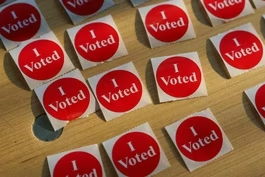
Latest primaries yield mixed results for moderate and progressive Democrats (3m 14s)

Sam Roberts joins Geoff Bennett on 'Settle In'
Video has Closed Captions
Sam Roberts and Geoff Bennett discuss the art of obituary writing on 'Settle In' (4m 25s)

Spain's plan to give undocumented migrants legal status
Video has Closed Captions
A look at Spain's plan to give undocumented migrants legal status (8m 7s)
Providing Support for PBS.org
Learn Moreabout PBS online sponsorship New Episode
- News and Public Affairs

Today's top journalists discuss Washington's current political events and public affairs.

- News and Public Affairs

FRONTLINE is investigative journalism that questions, explains and changes our world.
 New Episode
 New Episode
 New Episode
 New Episode
 New Episode

 New Episode
 New Episode
 New Episode
 New Episode
Support for PBS provided by:
Major corporate funding for the PBS News Hour is provided by BDO, BNSF, Consumer Cellular, American Cruise Lines, and Raymond James. Funding for the PBS NewsHour Weekend is provided by...