Northwest Profiles
February 2026
Season 39 Episode 4 | 26m 46sVideo has Closed Captions
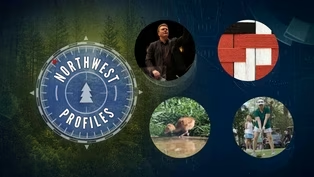
Conductor James Lowe, artist Kimber Follevaag, The Wilder Institute, and golfers the Canyonettes.
We’ll embark on a musical journey with James Lowe and the Spokane Symphony. Watch Kimber Follevaag, local fiber artist, create amazing designs. Learn about The Wilder Institute and their conservation efforts, and meet the Canyonettes, a ladies golf league that’s redefining the game.
Problems playing video? | Closed Captioning Feedback
Problems playing video? | Closed Captioning Feedback
Northwest Profiles is a local public television program presented by KSPS PBS
Production funding provided by ICCU
Support provided by:

Northwest Profiles
February 2026
Season 39 Episode 4 | 26m 46sVideo has Closed Captions
We’ll embark on a musical journey with James Lowe and the Spokane Symphony. Watch Kimber Follevaag, local fiber artist, create amazing designs. Learn about The Wilder Institute and their conservation efforts, and meet the Canyonettes, a ladies golf league that’s redefining the game.
Problems playing video? | Closed Captioning Feedback
How to Watch Northwest Profiles
Northwest Profiles is available to stream on pbs.org and the free PBS App, available on iPhone, Apple TV, Android TV, Android smartphones, Amazon Fire TV, Amazon Fire Tablet, Roku, Samsung Smart TV, and Vizio.
Providing Support for PBS.org
Learn Moreabout PBS online sponsorshipGood evening and welcome to an all new edition of North West Profiles for February 2026.
I'm your host, Tom McArthur.
Good to be with you again.
Have you ever wondered what it takes to become a symphony conductor?
We sat down with James Lowe, music director of the Spokane Symphony, to explore what first sparked his passion for music, what really happens inside a rehearsal and why music matters here in our community.
Join us as we begin a musical journey.
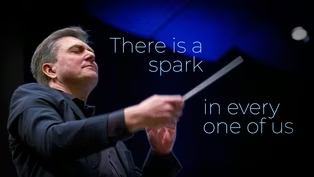
There is a spark in every one of us.
There is a little fire burning, and the world kind of tries to put it out in us as we get older, and I think the musicians and artists are the people who've kept that flame alive in themselves, and our job is to pass that spark on to other people.
James Lowe is the music director and conductor of the Spokane Symphony.
His journey has taken him far and wide, conducting orchestras all over the world.
And now, feels at home in Spokane.
Can we try that cue one more time?
We're going to try something different, and we'll see which we prefer.
Winds, can we go, please, before theme C, just under Keith, please, forty one, and... His interest in music started at a young age, on the other side of the Atlantic Ocean.
I come from England from a pretty normal background.
I mean, we weren't in poverty, but we certainly weren't wealthy.
At the age of 13, I suddenly had the desire to play a musical instrument.
So I chose the violin and they didn't have any, so I ended up with the viola.
My world exploded in that moment when I first opened that viola case and I knew somehow music was going to be what I did.
So one of the great things about playing viola when you're a kid is that most youth orchestras really need viola players.
So within a year of starting, I was in my local youth orchestra, the Nottingham Orchestra, and more and more I started looking at the conductors I was working with and thinking, “I wonder what would it be like to do that job?” And then I had a gap year between high school and university.
I was playing in an amateur orchestra and the conductor of that orchestra very kindly, a guy called Duncan Lloyd said, “Why don't you just take a rehearsal next week, see how it goes.” And that, for me, was a really transformative moment.
After James finished high school.
He studied music at the University of Edinburgh in Scotland.
During that time, James found himself conducting orchestras more and more, and after finishing school, he began traveling the world doing what he loves.
I was in a music festival in the south of France and a flute player who originally comes from Coeur dAlene said, “I hear that the Spokane Symphony are going to be looking for a new music director soon.
I think you'd be a good fit.” And so when the job came open, I applied for it.
And here we are, I got it.
One of the main functions of the conductor is to help each musician know their part, and ensure even the smallest details are accounted for.
Just two things.
Be a little bit careful Something squirrely happens around K. Oboes, I love your enthusiasm, you still want to slightly push your fugue theme.
The middle of the note doesn't need to be louder, otherwise it'll just obliterate.
I'll come off stage at the end of the the Walton Bach.
I'll take a bit of time.
Then I'll come back and I will talk to the audience.
For the bass drum, the half measure, these guys have got bom pom.
So they have an upbeat to you.
So you're a little bit early.
Upbeat on nine after the start of variation M. One, and... For me the Spokane Symphony is a really special orchestra, having an orchestra that is super engaged and super excited, who really leans into the music.
The conductor's job really is to try and make everybody come together in a unified way.
The hour coming up to a performance, weirdly, I have a huge energy drop.
I feel extremely tired and I generally don't think I can get through the performance.
But then something strange happens.
There's a moment of total silence where it's just me in the wings, and in that moment I feel this huge surge of energy and excitement.
And I go into the hall, and then for me, it's almost like then it's kind of dream state.
That is something different from what you experience in everyday life.
I think there are many, many reasons why symphony orchestra is important.
There's the art, of course.
There's this thing of being on stage and seeing this incredible organism.
It connects you to yourself and to each other.
So there's the artistic side.
There's also the economic side.
You know, can you imagine what downtown Spokane would be like without the Fox Theater, the restaurants, the bars, what's going on around this place?
The hum that it brings to downtown, I think is hugely important.
But for me, I think that the single most important thing really is this idea of community.
We've really expanded our educational outreach.
So we now have the Lullaby Project, which works with newborn children and their families.
And on the other end of the spectrum, we have a dementia program, which uses the power of music to really impact and reconnect people suffering from dementia to a kernel of something inside that is still there, but somehow diminished by that illness.
These are just a few examples of how music is making a difference in our community.
Just imagine for a minute the world without music.
Imagine going into a restaurant with no music.
Imagine going to a bar with no music.
Imagine your life without music.
Every human culture that we've ever discovered has some kind of music in it.
Music is central to who we are.
It defines and expresses who we are as humans.
And I think for me, that element is vastly underrated.
So often in our society, I get to work with these incredible musicians.
I get to live my life exploring some of the greatest minds of humanity.
I get to spend my waking hours working in this incredible realm of positively giving something to people.
I can't imagine anything better.
James believes classical music is for everyone, and that the symphony welcomes audiences of every background to experience the shared power of live performance at the Martin Wilson Theater at the Fox.
To learn more about upcoming concerts and events, visit FoxTheaterSpokane.
Org.
The Canyonettes have gathered every Tuesday evening since 2014 not just to play nine holes, but to share encouragement, creativity, and joy.
What began as a simple idea has blossomed into something lasting.
A community where access opens doors, Confidence takes root, and every success, big or small, is celebrated.
Here, the game is more than golf.
[Lisa] We were literally sitting around one night that first year, and we gooflingly said should we call ourselves something?
And we, people were throwing around ideas and then, and and somebody actually said Canyonettes.
[Shelly] How about the Canyonettes?
[Lisa] Like the Rockettes.
[Shelly] Never made that connection.
Since 2015, this ladies league has been doing golf their own way.
[Brigid] If I had to describe the Canyonettes' league in three words, I would say fun, community, and variety because we try to make it something that you look forward to every single week.
It's not going to look the same.
And you're going to make friends while you're doing it.
Instead of weekly friendly competitions, the Canyonettes mix things up!
[Brigid] Each week we have a different game and the idea behind the games is, is it kind of levels the playing field so that if you're a newer golfer or you're an experienced golfer, you have a chance to win the game each week.
[Debby] One might be as simple as longest drive.
Some of the games are a little bit more complicated.
Like, snake in my cart.
And whoever, had the highest number of putts got the snake.
At the end of the of the round, whoever had the snake the most actually won.
[laughs] And often, lot of the games are going to go to those who are better players.
But then we throw in, a snake in my cart and... all bets are off.
[Yes!]
[Lisa] We never really intended for the games to, entice other people join.
We didn't really even think about that.
We were just having too much fun.
And I think that kind of atmosphere, other friends, told other friends about it.
and we had people who just wanted to, to join in the fun.
There signature event is a themed scramble.
Where costumes, creativity, and camaraderie take center stage.
[Shelly] You know, we did Caddyshack onces and... [Lisa] Mhmm.
[Shelly] Harry Potter [Lisa] Pirates.
[Shelly] Pirates.
[Lisa] A luau.
[Shelly] Yes, yes!
Last years theme?
Prom night!
[Shelly] So much fun!
[Shelly] I got prom queen.
[Lisa] Yes, you did.
[laughs] [Lisa] It is hard to, ah, ah, golf in a dress, I'll tell you that.
[laughs] [Brigid] Everyone got to dress up however they wanted.
They could go find a thrifted prom dress.
They could pull out their prom dress from the closet.
They could go get a costume off of Amazon.
They could decorate their cart.
So we had a lot of fun with it.
And I just like that everyone leans in and, this year's scramble really made me feel like this is what we are looking for in this league.
This is the type of, engagement that we want around the themes that we do, so.
I look forward to that tournament every year.
But beyond the silliness, the Canyonettes serve a bigger purpose.
[Lisa] When it's your first time coming to a golf course, it can be a little bit intimidating if you haven't played or if you didn't start playing when you were younger, if you started playing as an adult, like a lot of our Canyonettes have, it can be intimidating to walk into the Pro Shop and to feel like you belong.
And to the Canyonettes, kind of is an avenue to let women, give golf a chance and see about taking up a new sport and make them feel welcome in the process.
[Shelly] The worst thing is when you get paired up somewhere, somewhere with a really good golfer.
[laughs] And then it really is interesting how you just get so tense and, you know, you feel like you're on a job interview or something, and its really, it's just not nearly as fun.
[Lisa] It's hard to work on your game and get better when you are feeling stressed.
[Shelly] Uh-Huh.
[Lisa] Many times, throughout the seasons, you'll be on, a hole and you will hear somebody on several holes over, some hooting and hollering and some ladies just cheering at the top of their lungs or laughter.
And I think golf is such a mental game that it helps to be around people that, you know, are just happy that you're there.
And its just that simple.
All skill levels are welcome.
[Brigid] A lot of leagues do require you to establish a GHIN, a handicap, and we don't have that as part of our league.
We, try to make it so that, if you are just beginning, you're just starting out, and you maybe you've never even been on a golf course, you can come join our league.
Or if you do have an established handicap, you can play.
We do have GHIN flights as part of our league, so we try to make it, a fit for everyone if you're trying to lower your handicap this year.
And, that is something that you track, great.
If you have no clue what a handicap even is, great, you can still be a part of this.
[Lisa] If you're nervous about trying golf, if you're nervous about joining any group, the Canyonettes is the place for you.
We are going to make sure you feel welcome.
We are not going to have any expectations, other then just come here to have a good time and, we'll help you learn the game of golf.
The Canyonettes remind us that growing the game isn't about lowering scores.
It's about lifting people up by creating a space that welcomes everyone theyre shaping both players and community.
To learn more about the league, visit Canyonettesgolf.com.
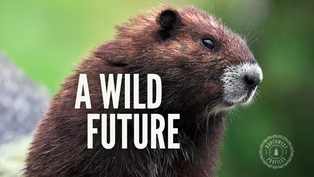
As human expansion reshapes landscapes around the world.
Wildlife is often pushed aside or disappears altogether.
One organization in Canada is working to change that story.
The Wilder Institute, based in Calgary, has become a leading voice in conservation, advancing innovative efforts that protect species and restore habitats with measurable success.
My name is Grainne McCabe, and I'm the Chief Conservation Officer here at the Wilder Institute.
the Wilder Institute is a conservation organization.
our focus is really on community conservation.
we just felt like having a different brand, a different identity for conservation work that we have been doing 30, 40 years, bringing it more into the public spotlight?
And also, how do we work more broadly outside of Western Canada, where we've been really focused to date?
so we were quite excited to launch, in November 2021, with a big display on the Calgary Tower here in Calgary with some of the animals that we work with, displayed, quite large, conservation is complicated.
it affects a lot of people in a lot of industries.
And one of the most important things for us, for conservation to be successful is to make sure you have all the right voices at the table.
And we call this inclusive conservation within the conservation sector.
And so if you're working in an area where there is, say, the oil and gas industry or the energy sector or ranching, we need to make sure we have those people there just as much as we need to make sure we have conservation professionals because once people feel involved and feel their voice has been heard, it's so much more sustainable.
Long term.
Community conservation for us is really about empowering and building or strengthening capacity within local communities So we're building skills not just in watching wildlife and monitoring wildlife, but also in program governance, in leadership, in finance and all the things you need to do to successfully run a conservation program and that's been really successful for us so far.
And we've found some really good partnerships with local communities, with local NGOs all across, the places where we work.
we have about 40, conservation professionals.
And then for the Canadian programs, we have this facility, the Archibald Biodiversity Center, just outside of Calgary.
we are responsible for the care for several Canadian endangered species, including the Vancouver Island marmots, whooping cranes, northern leopard frogs, and burrowing owls.
for three of those programs we have permanent residents.
And so those are breeding animals that we housed throughout their life.
And their offspring go to reintroduction efforts for their specific species.
Burrowing owls is our exception.
They are a head started program.
So we have a different cohort of burrowing owls that we've taken to care for ten months.
They are coming in in the fall and then they're released the following spring.
we specifically chose a place that we have room to grow and develop new programs as species are identified and in need of support.
So my team have actually developed a process to review species at risk here in Canada, where we can really look at the feasibility.
So will it be successful?
So we work on the Vancouver Island marmot, Canada's most endangered mammal.
we have a program down in Waterton Lakes National Park, with the curiously isolated hare streaked butterfly, which is a newly described species We have programs in southern Alberta on the burrowing owl.
We work, across the range of the whooping crane.
we're actually just about to launch a program on water turtles in Ontario with our very first partnership with an indigenous nation here in Canada.
But then we also work in Africa.
So we work in Kenya on the Mountain Bongo And then a long term project in Ghana where we are working to conserve the habitat of the hippopotamus.
There's only about 180 hippos in Ghana, and we work very closely with local communities there to establish a women's cooperative.
2000 women from 20 different villages actually work on that cooperative.
We are fortunate to belong to an association called the Association of Zoos and Aquariums, and we've had some excellent feedback from our colleagues there about the conservation work we're doing and how they would love to hear more so they could see if some of them could could follow in their footsteps.
And of course, that sounds amazing.
We'd love to help in any way we can.
we're quite excited about a new upcoming initiative that Wilder Institute has, which is called the Wilder Canada Action Plan.
So this is a national plan that we have to help restore species across the country.
we've started to really prioritize them based on which ones are most feasible to help.
And now we are starting a ten year initiative to work for hoping, with 30 to 60 different species across the country, to really start dedicated conservation action for those species, community conservation.
And translocations are really our areas of expertise.
So translocations are really about the deliberate movement of animals and you might want to do that if, one population is very small and another one is larger.
And so you just want to be able to help balance it out or exchange animals to maintain genetic diversity.
The other one is called head starting.
So we're seeing some success and population growth there.
And then the last one is actually having a population under human care, like some of our programs here, the whooping crane for example, where we have birds that are permanently under human care, but their chicks will be released to the wild.
in the whooping cranes were down to about 20 individuals left at all in the world.
Now we have over 800, So we're quite excited about that success.
a lot of these species are keystone species or umbrella species.
They're really important to the healthy functioning of their ecosystem.
And if we lose them, it actually has a knock on effect to the rest of the habitat.
And a lot of people rely on those healthy habitats, you know, people who are fishermen or they're hunting and trapping in a sustainable way, people who rely on trees, all of us really rely on, elements of nature with maybe without even realizing it.
And almost all parts of our economy are tied to nature as well.
a couple of years ago, there was a report that was published that said there's over a million species at risk of extinction.
Last year, there was a follow up report and said it's actually closer to 2 million.
So the rate is accelerating.
And that's the problem because as the habitats change, as the environment changes too quickly, species can't adapt fast enough.
And then we just start to see more and more being lost at a faster rate.
And the problem will be much, much more difficult to handle as it grows bigger.
saving animals takes a long time and it takes a lot of patience, but we've seen some really positive signs.
You have to be an optimist if you're in this field.
And because I do see organizations, particularly grassroots organizations, small communities, that are making a real difference in their local area.
And you do start to see governments and multilateral organizations that are understanding this.
It's slow, it takes time and we have to be patient with it.
But we are seeing these things that are really positive for us and keep us going.
The Wilder Institute shares a simple vision, a future where people and wildlife thrive together.
If today's story inspired you, you can be part of that future because every action matters.
Visit Wilderinstitute.org to learn more.
Transforming fiber into intricate designs takes patience, skill, and imagination.
And our next profile that artistry reaches new heights as yarn is layered with precision and care, building striking works that captivate and invite a closer look.
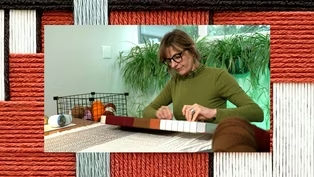
Threaded through a needle, tightly stretched yarn is weaved inside itself in a process that artist Kimber Follevaag of has perfected and refined into an exquisite form of fiber art.
Over and under.
She creates patterns with lines and colors that complement each other in a routine.
She has spent years perfecting.
I veer more to the textural, component of artwork, it just is a feeling.
It's a feeling that just kind of like, oh, I should try that.
I look at and follow and look, I'll look through books and it's kind of, an intuitive thing.
I try to stay really open, and I can tell when something lights me up.
Most of my artwork right now involves taking a frame, then I wrap the frame one way, just, just wrapping it with yarn one way different color segments, and then after and I tie it all off, and then I come back the other way and I weave it that way.
And that's how you get the different designs and patterns And you have to pull really tight is physical.
It's I have done very large pieces and they're just really hard physically to do.
They do not happen overnight.
They are weeks and weeks or months even process to make one.
I think it's very simple, but it looks complicated.
Kimber surmises her artistic talent was born from her past in the world of dance.
Once a ballerina, she spent 17 years in ballet that she thinks primed her for her foray into the art world.
I believe it all started with my mom.
She had a fabric store, and she was a seamstress.
And I think the textiles and materials just kind of infiltrated at a very young age.
It's a very intuitive process.
I'm like, oh, I want this color now, or I want this, try this pattern in this.
And for some of the artwork, which is very mathematical, I do a lot of counting because there's some colors are increasing, other colors are decreasing.
So it gives this, you know, three dimensional look to it.
So and those are I call those the prismatic series.
You'll see those in the studio.
a lot of counting is happening.
A lot of math.
I follow a lot of fiber artist.
And there was somebody doing, on a loom that same kind of prismatic series where you're increasing and decreasing colors and taking them in different patterns.
And I saw that, oh, if she can do that on a loom, I bet I can do that on a frame.
I would look at that and then kind of ebb and flow and evolve it to my how I do artwork.
Conventional or not, Kimbers work is a form of tapestry, one that she has developed into her own style of fiber art.
People have been doing tapestry forever.
And so if I really want an intricate pattern, I look through books, old books, of tapestry weaving and look at their patterns.
And then I make it my own, with my own colors and my own technique of how I create artwork.
Fiber art is really having a moment.
Right?
It has evolved from craft to fine art.
You'll see it in museums now where it just really wasn't.
I have with this artist outlet to be creative, but I believe we're all creating our lives.
I mean, we're we're creating this life, you know?
And if you don't know that, you should you should take a deeper look, that you are creating your path in your life by all the choices you're making.
I just happen to have the creative outlet of art.
And there was a time when I was raising children.
I wasn't focused on my art.
you know, it just there was a time and a place, and now I have the time.
it is a good thing.
I love this time of my life.
Kimber's creative journey has spanned many forms, but her work continues to evolve.
She embraces change and experimentation, and not surprisingly, fiber remains a constant thread woven through each new artistic expression.
From the Northwest Profiles team.
Thank you for choosing public television this evening.
You've just seen the kinds of stories we share here.
We're always looking for new ones.
Find us online at ksps.org to share your story ideas for a future program.
I'm Tom MacArthur.
See you again next month.
Bye for now.
 New
NewThe Canyonettes: Spokane’s Most Welcoming Women’s Golf League
Video has Closed Captions
Clip: S39 Ep4 | 4m 50s | Spokane’s Canyonettes make golf welcoming, fun, and open to every skill level. (4m 50s)
Video has Closed Captions
Preview: S39 Ep4 | 30s | Conductor James Lowe, artist Kimber Follevaag, The Wilder Institute, and golfers the Canyonettes. (30s)
 New
NewThe Wilder Institute: Saving Species Through Community Conservation
Video has Closed Captions
Clip: S39 Ep4 | 7m 32s | The Wilder Institute restores endangered species through science and community conservation. (7m 32s)
 New
NewThe Conductor: James Lowe and The Spokane Symphony
Video has Closed Captions
Clip: S39 Ep4 | 6m 50s | James Lowe, the Conductor for the Spokane Symphony, details his journey through music. (6m 50s)
 New
NewVideo has Closed Captions
Clip: S39 Ep4 | 4m 14s | Spokane fiber artist Kimber Follevaag stretches yarn into amazing designs. (4m 14s)
Providing Support for PBS.org
Learn Moreabout PBS online sponsorship













Support for PBS provided by:
Northwest Profiles is a local public television program presented by KSPS PBS
Production funding provided by ICCU