Living St. Louis
Jefferson Barracks Bicentennial
Clip: Season 2026 Episode 13 | 5m 32sVideo has Closed Captions
Jefferson Barracks is celebrating 200 years of military history.
As America celebrates its 250th anniversary in 2026, Jefferson Barracks is celebrating 200 years of military history. It is the longest-running operational military facility this side of the Mississippi. The barracks have been involved in every US war from the 1830s until the end of World War II.
Problems playing video? | Closed Captioning Feedback
Problems playing video? | Closed Captioning Feedback
Living St. Louis is a local public television program presented by Nine PBS
Support for Living St. Louis is provided by the Betsy & Thomas Patterson Foundation.
Living St. Louis
Jefferson Barracks Bicentennial
Clip: Season 2026 Episode 13 | 5m 32sVideo has Closed Captions
As America celebrates its 250th anniversary in 2026, Jefferson Barracks is celebrating 200 years of military history. It is the longest-running operational military facility this side of the Mississippi. The barracks have been involved in every US war from the 1830s until the end of World War II.
Problems playing video? | Closed Captioning Feedback
Where to Watch Living St. Louis
Living St. Louis is available to stream on pbs.org and the PBS app.
Providing Support for PBS.org
Learn Moreabout PBS online sponsorship♪♪ On June 6th, Jefferson Barracks welcomed many St.
Louis area historical groups to the park to share more about their organizations with the public.
Jeffrey Edison, a museum educator with St.
Louis County Parks, says it's one of the many ways Jefferson Barracks is celebrating throughout the year for its bicentennial.
Jeffrey Edison, St.
Louis County Parks, "Everything that we're kind of doing has its own 200th spin where we're doing historical tours that kind of showcase the entire history of Jefferson Barracks.
We're adding a few more programs, but it's also America 250.
So we're kind of throwing in some of those early years as well.
Built in 1826, Jefferson Barracks is the oldest operating military installation west of the Mississippi.
Fort Bell Fountain in Old Jamestown was actually the first fort west of the river.
But around 1820, the U.S.
government wanted a military facility closer to St.
Louis, which led to the founding of Jefferson Barracks.
They began looking and this land that we're on now was a donated tract of land by the community members here.
So the government accepted free land, and that's how we get Jefferson Barracks.
It was meant as kind of a training facility for the infantry here, but it was a school of the soldier practice where they were learning all those basic skills, and then it becomes something even bigger where you get the cavalry units here, and then shortly after, then you get the artillery units as well.
So it's a 1,700 acre worth of land here, but it has become so much more than just a basic training camp.
- The site was named after Thomas Jefferson, since he purchased the land west of the Mississippi while he was president.
And the facility had an active role in US history.
It was involved in every war since the Black Hawk War in the 1830s until the end of World War II.
We had over 200 Civil War generals come through Jefferson Barracks at any given point.
So think of Ulysses S. Grant, Robert E. Lee, Jefferson Davis, Tecumseh Sherman.
All of those like really gigantic names that we all learn about in grade school were all here at some point in Jefferson Barracks' lifetime.
As much of U.S.
history, though, Jefferson Barracks' is complicated.
Some of the early wars the barracks' military personnel participated in involved the removal and genocide of Native Americans.
And for decades, the hospitals and troops were segregated.
But hundreds of thousands of military personnel passed through these barracks and made their mark on U.S.
history, until the site was decommissioned in 1946.
The federal government kind of did a survey on what military bases that they really wanted to have after World War II.
So Jefferson Barracks was kind of on that early chopping block there.
But they realized that this space is kind of a strategic power, and so we see the Missouri National Guard move in later on where they're the Army and Air National Guard now.
So they occupy where Jefferson Barracks were.
So those brick buildings that you see on the north side of the cemetery, that's all still an active military base with the Missouri National Guard.
Jefferson Barracks is now divided into many parts, including the military base, walking trails and the National Cemetery, which started in 1827, just one year after Jefferson Barracks was established.
The federal government gave us the northern half of Jefferson Barracks as a way to keep a historical park.
They wanted to tell the military history of Jefferson Barracks, so they commissioned the north side of Jefferson Barracks as a historical park.
And then that blossoms into having all these trails.
We have three miles worth of trails now.
We connect to the Greenway system.
It's also full of military monuments and museums that operate out of repurposed spaces.
So the county parks, we operate two of our museums out of old powder magazines.
And so we have the oldest one that was built in 1851, then we have one that was built in 1857.
There's also the Missouri Civil War Museum, the POW and MIA Museum, and the Telephone Museum, which are run by other nonprofit groups.
Visitors this year will be able to experience the other celebrations marking the park's bicentennial, and the largest of those is in October and is in collaboration with the National Guard.
- So you can expect military vehicles will be there doing some historical lessons.
There might be some walking tours.
There's going to be bands.
They're going to have a lot of the men and women in formations.
And so it's going to be great.
This is kind of a groundbreaking history here.
Men and women who were at Joyce and Barracks have touched many lives.
They've served in different theaters of war.
So we just kind of want to showcase that there's 200 years of history here and it doesn't end just with one individual story.
 New
NewVideo has Closed Captions
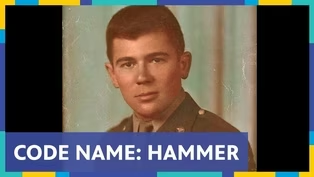
Clip: S2026 Ep13 | 13m 27s | A few years before his death, a St. Louis native revealed he had been an assassin in WWII. (13m 27s)
 New
NewProgram Helps Refugee Women Learn to Drive
Video has Closed Captions
Clip: S2026 Ep13 | 5m 25s | A program that helps refugee women in St. Louis gain independence by learning to drive. (5m 25s)
Providing Support for PBS.org
Learn Moreabout PBS online sponsorship













Support for PBS provided by:
Living St. Louis is a local public television program presented by Nine PBS
Support for Living St. Louis is provided by the Betsy & Thomas Patterson Foundation.