
March 4, 2026
Season 4 Episode 335 | 26m 30sVideo has Closed Captions
Lawmakers may require universities to address Kentucky's physician workforce shortage.
Lawmakers may require universities to address Kentucky's physician workforce shortage. Five universities could get $150 million in state funds to bolster their research. A committee advances measures to reverse some requirements for teachers. A bill that would overhaul the Public Service Commission gets pushback. New information emerges about the U.S. soldiers killed in Kuwait.
Problems playing video? | Closed Captioning Feedback
Problems playing video? | Closed Captioning Feedback
Kentucky Edition is a local public television program presented by KET
March 4, 2026
Season 4 Episode 335 | 26m 30sVideo has Closed Captions
Lawmakers may require universities to address Kentucky's physician workforce shortage. Five universities could get $150 million in state funds to bolster their research. A committee advances measures to reverse some requirements for teachers. A bill that would overhaul the Public Service Commission gets pushback. New information emerges about the U.S. soldiers killed in Kuwait.
Problems playing video? | Closed Captioning Feedback
How to Watch Kentucky Edition
Kentucky Edition is available to stream on pbs.org and the free PBS App, available on iPhone, Apple TV, Android TV, Android smartphones, Amazon Fire TV, Amazon Fire Tablet, Roku, Samsung Smart TV, and Vizio.
Providing Support for PBS.org
Learn Moreabout PBS online sponsorshipmusic >> What are the different pieces of the puzzle that we can put together to better serve the Commonwealth in the delivery of health care?
>> What can Kentucky do to get more doctors to serve rural areas?
[MUSIC] As the fighting continues in the Middle East, the perspective from Kentucky's senior U.S.
Senator and four candidates for the U.S.
House.
>> We know that kids learn through play, and we want policymakers and other advocates to feel like they're a kid again.
>> And how Children's Advocacy Day did just that.
[MUSIC] >> Production of Kentucky Edition is made possible in part by the KET Millennium Fund.
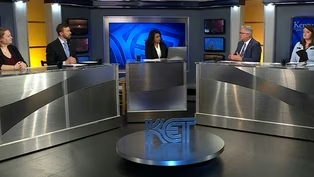
>> Good evening and welcome to Kentucky Edition for this Wednesday, March the 4th, I'm Renee Shaw and our KET studios in downtown Louisville, and we thank you for winding down your Wednesday with us.
65% of primary care physicians in Kentucky practice in urban counties, according to the University of Kentucky.
Senate President Robert Stivers says that leaves too many areas underserved.
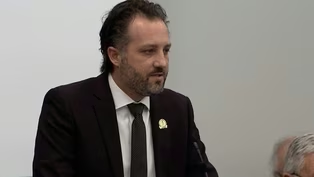
He's the sponsor of Senate Joint Resolution 116, which would mandate three of Kentucky's universities to search for solutions to the physician workforce shortage.
In the next year.
The resolution was heard in committee this morning.
Our Mackenzie Spink brings us more in tonight's legislative update.
[MUSIC] >> The University of Kentucky and University of Louisville graduate physicians every year, and Eastern Kentucky University will soon do the same with its osteopathic medicine school.
Senate President Robert Stivers says that's why they're the right institutions to find answers for the state's health care challenges.
>> To me, they would be the people, since they are the teaching schools for our physicians to look at this and should know whether it is, you know, loan forgiveness, scholarships, recruitment technology and what what are all the different assets we could use?
What are the different pieces of the puzzle that we can put together to better serve the Commonwealth in the delivery of health care?
>> A lack of physicians in rural areas can lead to worsening health outcomes, and be a financial burden on patients who have to travel to seek health care.
President Stivers says he's seen the benefit of having a hospital in his rural hometown.
He says solving the physician shortage isn't just a health care issue, but an economic one, too.
>> Thinking of the health care that we have access to, that very, very few small towns have is wonderful.
But then thinking of the economic engine that it is for my hometown is really quite unbelievable.
And when we have these deserts unserved or underserved area, this is not just a health care issue.
It is both health care and economic development in places that are woefully underserved in both.
>> He can't recruit a hospital, or can't recruit an industry to a county that doesn't have a hospital.
So that's part of our challenge, too.
If we're going to lift the economy of Kentucky, we have to make sure we have a foundation throughout Kentucky to support health care and education.
>> One of the issues, Senate Joint Resolution 116, aims to find solutions for is medical students studying in Kentucky, but leaving to practice in other states.
Louisville Democrat Senator Karen Berg, a physician herself, is supportive of the resolution but says the legislature should look in the mirror to see why health care professionals may leave the state.
>> First, we have to identify how many of our best and our brightest can we accommodate.
Where do we train them, and how do we keep them?
And that is an issue that I think we need to discuss in this legislature at some point, because a lot of my colleagues do not feel that this legislature is friendly to physicians, and they leave because they have a lot of options.
So there's multiple issues here.
>> Senate Joint Resolution 116 passed the Senate Health Services Committee unanimously and will next head to the Senate floor for a vote there.
For Kentucky edition, I'm Mackenzie Spink.
>> Thank you so much, Mackenzie.
If the measure passes, the University of Kentucky, University of Louisville, and Eastern Kentucky University would have until the start of 2027 to deliver findings to the Kentucky General Assembly.
Senator Stivers is also looking to invest in Kentucky's research infrastructure.
Today, he outlined Senate Bill six for the Senate Appropriations and Revenue Committee.
The bill would direct $150 million to an endowed research fund for five of Kentucky's public universities.
Senate Bill six builds on the framework established by Senate Bill one from 2024.
That bill created the fund and laid the groundwork for long term collaboration among universities.
Senator Stivers says by investing in research, the General Assembly can strengthen Kentucky's economy and help the universities remain competitive.
>> Research in what areas?
Health care, engineering, aerospace, agriculture, all the above.
Anything can go.
It's just limited only by people's imagination and the direction we want to go.
And this nation wants to go, which is, I think, is where this whole world is going in the way of engineering, technology, research for whatever realm you want to believe in.
>> This is exciting to me, and I think it's a demonstration of what can happen.
I mean, we could talk on and on and all about this, obviously, but what happens when you envision something and you invest in it?
You can get an outcome.
We can't even see what's going to happen on the other side.
That's what's exciting about it.
>> Senate Bill six passed the committee unanimously.
It now heads to the full Senate for consideration by the membership.
Now turning to K through 12 education today, a committee advanced measures to roll back some requirements for teachers.
Our June Leffler has more about this.
>> Several lawmakers say they've received complaints about new guardrails on virtual communication between students and teachers.
>> Just a couple days ago, I received a phone call from one of my teachers at at Henderson County High School, and she was really upset because they were late coming back from a field trip.
She had 60 students on a field trip, and the bus location pick up was in a different area.
Couldn't find some students.
She.
She just wished she could have called them and said, you know, meet at this particular location.
The locations changed.
Instead, she couldn't or felt like she couldn't.
>> This Henderson lawmaker and educator proposes a fix.
House Bill 67.
>> So this bill clarifies that in that situation, she most certainly, most certainly could.
>> Last year, lawmakers passed Senate Bill 181 to prevent inappropriate private chats between teachers and students.
Senator Lindsey Tischner sponsored that bill last year, alongside a mom who found out a teacher was discussing emancipation options with her daughter.
Tischner also filed a cleanup bill this year in the Senate to ease some of those guardrails.
>> So I want to clarify real quick.
So I'm youth youth director at my church, youth leader.
So this bill will now allow me to contact my kiddos outside the school setting, you know, talking about a church event or a youth youth event.
I'm allowed to do that now without filing something at their schools.
Is that correct?
>> Correct.
As long as you disclose that as the employee, you say, I'm a youth pastor at such and such church, then yes, that would would allow you to have those communications.
>> The House Primary and Secondary Education Committee passed this bill along with others.
House Bill 1159 aligns requirements for what are known as options to becoming a teacher.
These are for people who may have a college degree but do not have a teaching degree yet.
>> The main thing that this bill does is create consistency among each of those options, and says the content expertise is a bachelor's major or minor, or graduate content degrees.
>> This former educator proposes House Bill 685.
It would welcome teachers back that have left the profession before retirement.
>> And we have a lot of teachers in the state of Kentucky that oftentimes get out of the profession for various reasons.
They may get out to raise a family.
They may get out to try another profession.
Maybe they've gotten burned out, and then they either have the opportunity or the realization they want to go back into the profession.
And right now, they are required to complete six hours of graduate coursework.
And this bill would allow a one time exception and waiver the six hour requirement.
If a superintendent requests that the candidate certificate certificate be renewed.
>> All measures advanced out of the House Primary and Secondary Education Committee Wednesday.
These bills now head to the House floor for Kentucky Edition.
I'm June Leffler.
>> Thank you so much.
June.
Now, in other education news, this time relating to the littlest of learners, Kentucky is a step closer to rewarding child care providers and parents when students are kindergarten ready.
Senator Danny Carroll, a Republican from Paducah, filed Senate Bill 191.
It proposes a $2,000 payment to providers and parents for each child assessed as being ready for kindergarten.
The University of Kentucky would oversee a pilot project.
Senator Carroll talked about the bill during our discussion about child care on Monday night's Kentucky Tonight, right here on KET, he says a child whose kindergarten ready will be a step ahead for the rest of their educational experience.
>> In addition to affecting kindergarten readiness, which should be the priority, which is a metric we look at and we talk about all the time, this would directly approach that and impact that.
But we looked at, you know, if if more kids come in kindergarten ready.
And I think our overall average right now in the state, when you consider all sources, has dropped to around 46% readiness.
Those kids that go to private centers, they're up 65, 70%.
So there's a wide disparity there.
And I think kids that stay at home, maybe 40%, 43%, if I'm not mistaken.
So it would address those in the kids when they get to school and they're kindergarten ready.
Think about the higher levels of achievement that each child could attain in those first three years that are so critical.
And we know all the metrics.
If a kid can't read by third or fourth grade, where a good likelihood of where they're going to end up when they grow up, and those metrics and those predictions, the data is there.
So it makes perfect sense that we focus on that area.
And that's where we invest our money is is working towards kindergarten readiness.
>> The Senate passed Senate Bill 191 this afternoon by a vote of 35 to 0, in a now move on to the House for consideration there.
The Kentucky General Assembly has an appetite for bringing data centers to Kentucky, and House Bill 593 addresses concerns about ratepayers getting stuck with higher electrical bills.
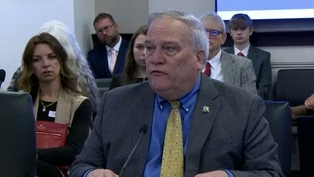
As a result, representative Josh Bray, bill sponsor and House chair of the Artificial Intelligence Task Force, says companies who want to build data centers in Kentucky have three options for energy.
>> You know, we recognize that data centers in Kentucky are important, but we want to make sure that when they come in, they either bring their own generation, which a lot of big tech companies are wanting to do.
They purchase their power on the open market, or they prepay for any generation or transmission cost increases upfront.
In my conversations with the big tech companies that we want Kentucky doing business with, they are absolutely on board with this.
I think it's it walks a very fine line.
>> House Bill 593 overwhelmingly passed the full House today by a vote of 90 to 8.
Now, sticking with energy now we're talking about energy prices.
And Eastern Kentucky senator says Kentuckians need relief from high utility costs.
And his solution is to overhaul the Public Service Commission, the body that regulates the state's utilities and has the final say on how much ratepayers must pay.
But some advocacy groups are concerned the legislation could limit the input of everyday Kentuckians.
Our Emily Sisk explains the debate over one of the Senate GOP's top priority measures.
>> Kentucky needs to let the world know we're open for business.
>> Senator Brandon Smith of Hazard says Kentucky's Public Service Commission needs some major updates to keep up with infrastructure demands and to prevent Kentuckians utility bills from skyrocketing.
The Eastern Kentucky Republican sponsored Senate Bill eight, which would increase the number of public service commissioners from 3 to 5.
Three of those members would continue to be appointed by the governor, but two will be appointed by the state auditor, and no more than three members can be from the same political party, with the possibility of data centers and new developments coming to the state.
Senator Smith says the Public Service Commission needs to be better prepared.
>> We need to have enough employees there to be able to tackle these big projects and have that many eyes on stuff that something doesn't get missed.
We want a diverse board.
We want a board that's not dominated by politics.
We've seen some in the past.
>> Another major change in Senate Bill eight is who can speak before the Public Service Commission to advocate for or against things like new developments and rate increases.
The legislation would make the attorney general the sole advocate for residential consumers.
>> Unlike outside advocacy groups, the attorney general is elected statewide.
>> Any other advocacy groups would have to demonstrate they have a, quote, special and unique interest in the matter.
This line has caused upset for some groups representing environmental interests or low income residents.
A spokesperson with Kentucky's Beyond Coal campaign said, quote, if our state legislature had the best interest of Kentuckians at heart, they would be in favor of more voices speaking out on the public's behalf, not less.
At a time when gas and electric bills are rising for everyday workers and their families, special interests want to keep the public out of the Public Service Commission.
We will not stand by as our leaders attempt to clear the room so that no one can challenge their corporate allegiance, end quote A representative from the Metropolitan Housing Coalition shared a similar sentiment.
>> Senate Bill eight selectively and unfairly targets these advocates for exclusion in PSC cases.
Yet this bill would not prohibit continued intervention in PSC cases by large commercial companies.
>> A Louisville Democrat raised concerns about the bill, questioning if the attorney general could have bias in certain cases.
>> But how does that work in the interest?
Because they also can represent industry or commercial folks as well.
So can you just talk about the potential conflict or if there is an issue, is he representing the people or is he representing the industry?
>> When you look at the record, this AG is has has been siding with the ratepayers, which I think is public knowledge and a lot of the news and stuff like that.
>> Earlier this year, Attorney General Russell Coleman called for the Public Service Commission to reject any utility rate increases for Kentuckians.
Still, however, the PSC approved a 6% rate increase for Kentucky Power, which services about 20 eastern Kentucky counties.
Ultimately, Senator Smith said he isn't trying to stifle citizens from speaking out on utility issues.
He just wants to know who they're really representing.
>> When somebody comes to make an issue with a project in Kentucky, we want the transparency of knowing who's funding you to be there.
Are you there because your citizen's group that cares about it?
Are you a group that's been paid for by an outside country like China or Russia, which we've seen in the past?
I cannot see a case.
And you all know this, that you all will be blocked from coming.
I go to those meetings and protests all the time, so I'd be in the same boat.
I'm not going to push a piece of legislation that would limit that.
>> Senate Bill eight passed out of the Natural Resources and Energy Committee, with Democratic Senator Keturah Herron voting no.
It now heads to the Senate floor for consideration for Kentucky edition.
I'm Emily Sisk.
>> Thank you so much.
Emily also was part of Senate Bill eight.
At least one public service commissioner must be a licensed Kentucky attorney.
And each commissioner must represent a different occupation.
Kids shooting hoops and putting some golf balls.
Now, you don't see that every day at the Kentucky State Capitol.
But that's how hundreds of youth advocates and Kentucky kids spent Children's Advocacy Day at the Capitol in Frankfort.
>> As part of Children's Advocacy Day.
In the blueprint for Kentucky's children, we decided to create an opportunity for policy and play.
The idea behind it is to allow for policy makers, decision makers and other advocates to get to know policy changes and needed action with play and through play, because we know that kids learn through play, and we want policy makers and other advocates to feel like they're a kid again.
At each station, we have a policy priority identified.
So the basketball hoop behind me, those the policy priority there is around the budget and the state budget for kids, and what kind of investments are being included or needs to be included when it comes to kids and families in the state budget.
So it's buckets for the budget.
We're also looking at ensuring that any potential social media settlement dollars that come into the state through a multidistrict litigation comes in and is used for positive youth development.
So that is House Bill 686 with Representative Mosher.
There's also policies related to Jewish settlement dollars, Senate Bill 74 with Senator Richardson.
>> As a student with a learning disability, I know how important it is to advocate for yourself, but also to have mentors and your parents and teachers to advocate for you.
So my purpose here was to really just encourage others to keep our kids in the forefront of their minds as they make decisions, especially during this legislative session.
>> So what we really want is for children and youth in Kentucky to feel welcome in a place like the Capitol Annex, or in a place where there are legislators and decision makers, their voice matters.
Legislators and decision makers can and will hear from them and listen to them about the things that are important to them.
So making it a space that allows kids to feel welcome let out their kids side just like adults, let out their kids side and have a little fun while also creating some opportunity for learning.
>> It was just so great to be here today, surrounded by people who want to see change for Kentucky's kids.
I know as a senior in high school, I've been surrounded by people in Kentucky's kids all my life in a public education from all different backgrounds, with all different perspectives.
This was a really great opportunity to learn from different perspectives and understand how that impacts the legislative process and the decision making.
And I just love being in this environment for change.
>> Youth advocates say they're pushing for a state budget that protects families and focuses on nutrition programs, health care access and support for child care.
[MUSIC] Now, an update on continuing U.S.
military operations in the Middle East.
The U.S.
says it sank an Iranian warship near Sri Lanka.
The U.S.
reports about 1000 dead in Iran, with another 50 dead in Lebanon as a result of the fighting.
The white House says Spain has agreed to cooperate with U.S.
operations in the Middle East, but Spain's government denies that.
We also know more tonight about four soldiers with connections to Fort Knox in Kentucky killed in the fighting.
The four were from Florida, Nebraska, Minnesota and Iowa.
All were members of the 103rd Sustainment Command.
Today in Frankfort.
State Senator Matthew Dineen, who represents Fort Knox and the surrounding communities, provided new details about the soldiers and led the Senate in a moment of silence.
>> The soldiers were assigned to the 103rd Sustainment Command, which is an Army Reserve unit headquartered in Des Moines, Iowa, that is operating under the first Theater Sustainment Command.
The soldiers were not assigned to Fort Knox or permanently assigned to the first Theater Sustainment Command, but they do fall under the umbrella of that headquarters at Fort Knox.
I would like to take a moment of silence as we remember those soldiers, their families, and we convey our condolences to all those impacted.
>> Meanwhile, U.S.
Senator Mitch McConnell says the president had the right to order the bombing of Iran without congressional approval.
He says other presidents have done the same on the U.S.
Senate floor today.
He also said the president needs to explain his actions to the public.
>> President Trump has made a bold and tough decision, one that could transform the region for the better, literally for generations to come.
But there are risks involved, and I hope his administration will work to explain the connection between the Commander in Chief's worthy objectives and the military and diplomatic means to achieve them.
Connecting ends and means is the essence of strategy, and it's important for the administration to explain to the American people how they intend to do so.
In turn, our colleagues in the minority have a responsibility to actually listen and to not reflexively oppose foreign policy decisions of presidents.
There are.
>> Four Democrats running for the U.S.
House from Kentucky.
Sixth district were all critical of the decision to attack Iran.
Here are those four Democrats during a debate last night on Spectrum News one.
>> I propose that we put in place legislation that ties funding of these actions directly to congressional oversight.
This means before we go and take more actions in the Middle East, before we go out and endanger more American lives, we will have people that we have elected in Congress giving oversight and holding the purse strings to hold some amount of accountability, because we can't keep letting the executive do whatever it wants without any kind of oversight from the people.
>> The unfortunate reality is, is that regime change will not happen without boots on the ground.
Airstrikes alone will not do that.
And unfortunately, that's going to put more troops, such as those who were killed, who were stationed at Fort Knox in danger.
We must restore the balance of power first and foremost, and that is if I am elected to Congress, is one of the things that I would work tirelessly to do.
We need to lean into diplomacy, especially in the region, and we also need to ensure that an executive can no longer submit any sort of orders for this type of sweeping action.
>> You know, we've now seen six deaths for military action that no one asked for Knott Congress or the American people.
From all reports, the diplomatic talks were working and we were working toward a solution.
You know, I'm the daughter of a veteran.
And so as a member of Congress, I would be very, very cautious before I ever chose to send any of our men and women into danger and would always be sure that American interests and American lives are of the utmost priority.
>> I'm thinking of when I was an officer training.
We learned about the Powell Doctrine.
The great General Colin Powell, who had the last successful Middle East action we had.
He said you had to have defined goals, a defined exit strategy and a vital national interest.
We have none of those here.
The administration has not advocated any of those.
It's unclear what the goals are, what the end game is, how we get out of this, and if there's any plan behind this whatsoever.
Congress must act to restrain this administration so more American lives are needlessly lost.
>> For candidates, Jimmy Brooks and Cory Edwards are also seeking the Democratic nomination.
The incumbent Republican congressman Andy Barr, is seeking the Republican nomination in this year's U.S.
Senate race.
[MUSIC] That'll do it for us tonight from Louisville.
I hope that I'll see you again tomorrow night at 630 eastern, 530 central for Kentucky edition, where we inform, connect and inspire.
Connect with us all the ways you will soon see on your screen through the social media channels.
Look for us online at Keturah and the PBS video app that you can download on your smart devices.
I'm Renee Shaw, thanks for joining us tonight.
Hope to see you right back here again tomorrow night.
Take good care.
 New
NewBill Aims to Bring More Doctors to Rural Areas
Video has Closed Captions
Clip: S4 Ep335 | 3m 48s | Kentucky senate president proposes plan to get more doctors to serve rural areas. (3m 48s)
 New
NewBill Gives Monetary Incentive to Get Kids Kindergarten Ready
Video has Closed Captions
Clip: S4 Ep335 | 2m 4s | Childcare providers and parents would get $2,000 payment if child is kindergarten ready. (2m 4s)
 New
NewHundreds Attend Children's Advocacy Day in Frankfort
Video has Closed Captions
Clip: S4 Ep335 | 2m 53s | Kentucky children and advocates spend the day with state lawmakers. (2m 53s)
 New
NewMeasure Addresses Concerns About Data Centers
Video has Closed Captions
Clip: S4 Ep335 | 1m 5s | Lawmaker wants to ease ratepayer concerns over data centers. (1m 5s)
 New
NewMeasure Looks to Grow Kentucky's Research Infrastructure
Video has Closed Captions
Clip: S4 Ep335 | 1m 25s | Bill directs $150 million to an Endowed Research Fund for five state public universities. (1m 25s)
 New
NewPlan Would Overhaul Public Service Commission
Video has Closed Captions
Clip: S4 Ep335 | 4m 40s | Proposal to overhaul Public Service Commission gets pushback. (4m 40s)
 New
NewTeacher Requirements Could Change Under New Bill
Video has Closed Captions
Clip: S4 Ep335 | 3m 11s | Measure could ease some guardrails for K-12 teachers. (3m 11s)
Providing Support for PBS.org
Learn Moreabout PBS online sponsorship
- News and Public Affairs

Top journalists deliver compelling original analysis of the hour's headlines.

- News and Public Affairs

FRONTLINE is investigative journalism that questions, explains and changes our world.












Support for PBS provided by:
Kentucky Edition is a local public television program presented by KET