
May 18, 2024 - PBS News Weekend full episode
5/18/2024 | 26m 45sVideo has Closed Captions
May 18, 2024 - PBS News Weekend full episode
Saturday on PBS News Weekend, with nearly 115,000 people waiting for a new organ in the U.S., we look at what can be done to improve the transplant system. Then, why students and teachers are pushing for climate change to be taught in schools. Plus, we examine what’s behind the recent popularity of Japanese comics and animations in America.
Problems playing video? | Closed Captioning Feedback
Problems playing video? | Closed Captioning Feedback
Major corporate funding for the PBS News Hour is provided by BDO, BNSF, Consumer Cellular, American Cruise Lines, and Raymond James. Funding for the PBS NewsHour Weekend is provided by...
May 18, 2024 - PBS News Weekend full episode
5/18/2024 | 26m 45sVideo has Closed Captions
Saturday on PBS News Weekend, with nearly 115,000 people waiting for a new organ in the U.S., we look at what can be done to improve the transplant system. Then, why students and teachers are pushing for climate change to be taught in schools. Plus, we examine what’s behind the recent popularity of Japanese comics and animations in America.
Problems playing video? | Closed Captioning Feedback
How to Watch PBS News Hour
PBS News Hour is available to stream on pbs.org and the free PBS App, available on iPhone, Apple TV, Android TV, Android smartphones, Amazon Fire TV, Amazon Fire Tablet, Roku, Samsung Smart TV, and Vizio.
Providing Support for PBS.org
Learn Moreabout PBS online sponsorshipLAURA BARRON-LOPEZ: Tonight on PBS News Weekend, nearly 115,000 people are waiting for a new organ in the US.
Can more be done to improve the transplant system?
Then, why students and teachers are pushing for climate change to be taught in schools and the growing popularity of Japanese comics and animations in America.
WOMAN: It is not an outsider subject anymore.
Readers have definitely stayed and continued to buy content in a way that shows that they're staying powered.
LAURA BARRON-LOPEZ: Good evening.
I'm Laura Barron-Lopez.
John Yang is away tonight.
There is turmoil within Israel's government.
Benny Gantz, a centrist in Benjamin Netanyahu's war cabinet, is threatening to quit if the government does not adopt a new plan for the war in Gaza by June 8.
It comes as a ceasefire deal remains elusive, and no new hostages have been released since November.
And earlier today, Israeli airstrikes fell in northern Gaza, toppling buildings in Jabalya, the largest of Gaza's refugee camps, killing 15 and wounding dozens more.
Meanwhile, national security adviser Jake Sullivan is in Saudi Arabia tonight to discuss the war with Crown Prince Mohammed bin Salman.
He travels to Israel tomorrow.
Back here at home, deadly storms that killed seven people this week in the Houston area have moved on, but a new threat remains dangerous heat.
Temperatures are expected to go above 90 degrees, and in many places, including Houston, it will feel above 100.
The heat and humidity throughout the weekend could be dangerous for the nearly half a million homes and businesses in the state of Texas that remain without power.
President Biden issued a disaster declaration to make federal assistance available.
Officials say repairs could take weeks.
Temperatures are soaring in other parts of the world, too.
India sweltered today with temperatures above 110 degrees even in the middle of its summer months that's hotter than normal.
The heat wave is expected to last into next week.
In western Afghanistan, flash flooding from unrelenting heavy rains have killed at least 68 people.
Dozens more people are missing.
That's on top of deadly floods last week in northern Afghanistan that killed more than 300 people.
And the man accused of trying to assassinate Slovakia's prime minister, Robert Fico, appeared in court today and was ordered to remain behind bars.
Supporters laid flowers outside Fico's hospital, and he remains in serious but stable condition.
His health minister adds that his prognosis is positive.
Still to come on PBS News Weekend, why young people are pushing for more climate change education and what's behind the recent popularity of Japanese comics and animations in the US.
(BREAK) LAURA BARRON-LOPEZ: Last week, a Massachusetts man who was the first person to receive a genetically modified pig kidney transplant died.
The hospital where he underwent the surgery did not find any indication that his death was linked to the transplant.
But his case again put a spotlight on the organ transplant system and the extraordinary measures being taken to make up for its shortfalls.
Ali Rogin has the latest on what can be done to revamp the nations organ transplant process.
ALI ROGIN: Kidneys topped the list of the most needed organs in the US.
Nearly 115,000 people are currently waiting for a new organ.
But the shortage crisis is nothing new.
Last year, more than 46,000 organ transplants were performed.
But 5,600 people still die each year waiting for an organ.
Barry Friedman is the former executive director of the AdventHealth Transplant Institute.
A hospital specializing in organ donation and transplant.
He's now a part of Guidry and East, an organ transplant consulting firm.
Barry, thank you so much for being here.
What's driving the organ transplant backlog in the US?
BARRY FRIEDMAN, Chief of Strategy, Guidry and East Transplant Consulting: Currently, our wait lists continue to grow.
And as those wait lists grows, we have to ensure that the organs that we are recovering are utilized properly.
In this country right now, the way we distribute organs across the country, we try to get it to the right patient at the right time.
So this may mean putting kidneys on commercial airplanes or charter aircraft to get those kidneys to the patient.
And there truly has been some challenges and delays in getting that done.
We are becoming more efficient.
We're trying to create longer preservation times for these organs so that we can either keep them on controlled ice or machine perfusion.
And there's a lot of technology that has really helped us to improve that.
And I think we'll beginning to see a change in ensuring that we're getting these kidneys transplanted.
ALI ROGIN: And the procurement numbers, though, in this country, don't seem to line up very much with those in other parts of the western world.
In 2020, more than 20 percent of procured kidneys were not transplanted.
So the kidneys were there, but they just didn't make it into bodies.
And those numbers are way higher than those of other countries, particularly in Europe.
So I wonder what explains that disparity.
BARRY FRIEDMAN: When we look at the year 2020 and then the COVID coming on board with kidney allocation, it's critical that we're able to get the right kidney to the right patient.
And we've done a tremendous job increasing the number of organs that are donated in this country, and we're grateful for those donor families and for the staff that work there.
However, we're not able at all times to match the exact kidney to the right patient.
We're getting better at that and some of these kidneys because we really do want to achieve the most number of transplants.
ALI ROGIN: So would you say that is mainly a geographical issue?
I mean, the United States is a big country, and logistically it can be hard to get these organs from point A to point B in a timely manner.
BARRY FRIEDMAN: That's part of the challenge.
We need to move those organs efficiently, and we got to ensure that we are using the right transportation mode, whether it's commercial aircraft or charter aircraft or even occasionally government aircraft, to help support getting these vital organs to the correct hospitals and transplant patients.
ALI ROGIN: There is also a growing body of research and industry opinion that says that the U.S. is actually discarding imperfect organs that still might work well in a transplant.
What do you make of that?
BARRY FRIEDMAN: Again, putting this in the hands of the capable physicians and surgeons that care for these patients is critical.
The challenge that we see is getting the right kidney to the right patient, and we're making better changes in our organ allocation.
We have a very collaborative society in the United States for the 250 plus transplant centers that are equipped to do these organ transplants.
And there is still a learning curve that we're trying to achieve as we see more technology and how we perfuse these organs, how we package these organs until we can get them into the transplant recipient.
So we are making great progress.
ALI ROGIN: And as you mentioned, there are still more reforms to come.
The Biden administration has announced plans to modernize the current transplant system.
They want to break up the responsibilities held by the nonprofit United Network for Organ Sharing, or UNOS, which is the only government contractor to ever operate the US transplant system.
Are those efforts going to help fix things?
BARRY FRIEDMAN: I believe they are, and it's time for improvement.
And I'm hopeful that the lessons we've learned over the last 40 years with the united Network of Organ Sharing, that will take those lessons and incorporate it and bring in the new technologies that are so important.
And the Biden administration, the previous administration, both have been very supportive.
This is a bipartisan issue, and this is one of the areas where I feel our government has done a good job in helping to help fund the necessity of increasing the number of transplants.
ALI ROGIN: What does need to change, in your view?
You said that there was, you know, a lot of margin for improvement.
BARRY FRIEDMAN: So I think as we continue to learn how we can best allocate those organs and get them to the right patient.
What's unique in organ transplant is the physicians and surgeons that have dedicated their careers to doing this.
And this is a fairly young procedure that we're doing.
It really began in the 1960s with kidneys seventies.
We're making tremendous headway in how we can ensure we can get the right kidney to the right patient.
We're doing a much better job in 2024.
Obviously, we still have to work on that number of organs that we're not using.
We try to get away from using the word discard because these families have graciously donated those organs and we're unable to use them, is what we're now saying.
ALI ROGIN: I want to ask also about the racial disparities that seem to persist in kidney donation.
In particular, black people are over three times more likely.
Hispanic people are 1.3 times more likely to have kidney failure than white people.
But white Americans are more likely to have a kidney transplant than either black or Hispanic Americans.
Why is this and what needs to change?
BARRY FRIEDMAN: Obviously, we try to match the genetics.
It's not just the kidney itself.
It's the blood type and the genetic tissue typing that we do, and we try to match that up.
The more blacks, the more Asians, the more that from a racial perspective, we're able to get those kidneys in the pool.
I think we'll see an increase.
We've also learned over the years, as technology has changed, how we diagnose, say, what kidney is acceptable for what patient.
And we're trying to adjust that so we give more points to patients that may be disadvantaged.
ALI ROGIN: That is organ transplant specialist Barry Friedman, thank you so much for joining us.
BARRY FRIEDMAN: Thank you, Ali.
LAURA BARRON-LOPEZ: Last month was the warmest April on record and the 11th straight month of record highs around the world.
Today, nearly a quarter of people globally live in drought conditions.
And forecasters anticipate this year's Atlantic hurricane season will be the most active on record.
All signs that climate change is an accelerating threat to the planet, and young Americans are worried about it.
In fact, 85 percent of generation Z is very or somewhat concerned about climate change, according to a Marist poll from earlier this year.
In response, states like California, Connecticut, and New Jersey are now teaching kids about climate change in the classroom.
One of the educators at the forefront of this is Lauren Madden, professor of elementary science education at the College of New Jersey.
How do you go about incorporating climate change into a classroom curriculum?
LAUREN MADDEN, The College of New Jersey: So in New Jersey, it's a little bit simpler than it is in some other places because we have standards that are required to be taught at all grade levels in all subject areas.
So they're really developmentally appropriate and they're good tools for teachers to use to think about ways that they can connect to climate in things they're already doing in the classroom.
LAURA BARRON-LOPEZ: Could you give examples of how lessons about climate change may change from, say, first grade to 9th or 10th grade.
LAUREN MADDEN: Yes, that's really important to be developmentally appropriate, especially when we're talking about working with young children.
So in the early years, it's really about understanding what lives around you, what's supposed to be here when things happen seasonally.
And some of the differences between weather and climate.
It's not a tough concept for a young child to understand that weather is day to day changes, while climate happens over long periods of time.
Whereas by the time we're in 9th or 10th grade, especially if we've built this foundation of weather and climate, and how our weather and climate are changing over time, then we can start to unpack some of the more nuanced mathematical relationships.
LAURA BARRON-LOPEZ: Why do you think it's a necessary subject to teach students?
LAUREN MADDEN: So I think it's really important that we don't lie to children, especially young children.
Our children are seeing the effects of climate change in unprecedented ways.
They're experiencing changes in their day to day lives that none of us have seen before.
So, for example, last spring here in New Jersey and across the east coast, we experienced dust in the air from Canadian wildfires.
And that was something that affected children, all children, their ability to play outside, their ability to go about their day to day life.
And we need to be clear with kids and let them know that something is happening.
And this isn't just a bunch of surprise things that are going on and scientists know what's going on.
But the other more important piece is that our economy is going to change what the future looks like and what the industries are that will be employing our children in the future will be around climate.
LAURA BARRON-LOPEZ: We also spoke with a high school art teacher in New Jersey about the impact of working climate change into her art lessons.
CAROLYN MCGRATH, Hopewell Valley Center High School: I feel that it's very important for students to know about the realities of the circumstances that they're living through.
And as educators, I think we also have an obligation to teach students and guide students through the difficulties of not only understanding this, but also emotionally processing the severity of the situation.
LAURA BARRON-LOPEZ: How can teachers like that one, Carolyn McGrath, help students navigate anxiety and stress about climate change?
LAUREN MADDEN: First of all, we need to be honest with them and we need to be truthful, and we need to let them know that the scientists have really good predictions out there and we have a good sense of what kinds of things are going to be happening into the future.
But I think to ease anxiety, aside from being honest and making sure that our children are well informed, we need to tell them about the types of solutions that exist already and foster their creativity and imagination to help them consider what kinds of solutions can be built in the future.
And I think the best way to ease anxiety is to foster positive actions and also thoughts about large scale solutions that they can contribute to as children and in the future.
LAURA BARRON-LOPEZ: We've seen pushback in primarily conservative states when it comes to teachings about the history of racism or LGBTQ studies.
Does teaching climate change receive similar pushback from some parents, and are those parents seeking to restrict what their kids may be able to learn?
LAUREN MADDEN: So I understand in many parts of the country there is pushback about teaching about climate change from politicians as well as from some parents.
From my experience, I did a research study not too long ago where we surveyed parents in New Jersey, and what they really wanted was tools for helping mitigate student climate anxiety, as well as information that they can make sure they were having a consistent conversation with their children at home and supporting what teachers were doing.
But across the country, I don't know that story is necessarily the same.
LAURA BARRON-LOPEZ: I mean, in states like Florida, they're seeing rising sea levels and record temperatures.
But Governor Ron DeSantis recently signed a bill that deletes most mentions of climate change in state law.
What do you say to educators in states like Florida about how to teach climate change when they may be dealing with elected leaders who reject that it exists?
LAUREN MADDEN: So I've certainly heard from science educators at national conferences who've been working with teachers in Florida who are personally choosing to learn more about how to integrate climate change into their classrooms.
And there's a lot of fear.
I was at a conference session where were asked not to take pictures of anything for fear of disclosing who the teachers were.
I think teachers are our nation's greatest asset, and they are naturally innovators and creative people.
So I know many teachers in Florida are doing things like talking about climate solutions without calling them climate solutions, talking about green innovation and things like that.
But we owe it to children, especially children who are facing sea level rise, droughts, extreme heat, to know what it is that's happening around them and also to know what some of the things are they can do to mitigate those changes.
LAURA BARRON-LOPEZ: Professor Lauren Madden, thank you so much for your time.
LAUREN MADDEN: Thank you.
LAURA BARRON-LOPEZ: Over the last few years, Japanese animation and comic books have seen an explosion of popularity in the United States.
From Netflix adaptations to Macy's Thanksgiving Day floats to a win at this year's Oscars, the genre has seen an increasing amount of visibility in American culture.
Ali Rogin is back with a look inside the world of anime and manga.
MAN: My spirit trembles, my heart is ablaze.
ALI ROGIN (voice-over): It's an art form that's having a moment.
MAN: Come on within me, come to my aid.
ALI ROGIN (voice-over): Anime, Japanese animation and manga Japanese comics Ale Guevara is one of many who discovered the genre during the pandemic.
ALE GUEVARA: I couldn't go to college.
I couldn't find a job, so I was in a pretty dark time.
ALI ROGIN (voice-over): Stuck at home with little to do.
Guevara's cousins recommended they watch One Piece, animated pirate adventure show based on a manga of the same name.
ALE GUEVARA: Since were uncertain about how long were going to stay home, they were like, One Piece is long.
It's so entertaining.
Even though they never told me it was like a thousand episodes, One Piece fans kind of do that.
They trick you into watching it.
ALI ROGIN (voice-over): The volume and variety of content, from fantasy and horror to romance and dramas, is part of the appeal.
ALE GUEVARA: Anime takes you to like, a whole other level.
It shows you, like, how artistic people can be, how like, different people grew up, or like how different the world looks through, like, animation.
SHANNON DEVITO, Barnes & Noble, Inc: We couldn't fill the stores fast enough.
ALI ROGIN (voice-over): Barnes and Noble senior director of books Shannon DeVito.
SHANNON DEVITO: The readers in the space are so voracious.
It's a good thing that the series are so long and so beautifully drawn, because not only do they look for 10 other series to read, once they finish one, they go back and reread.
ALI ROGIN (voice-over): Manga sales in the US quadrupled from 2019 to 2022, with a peak of 28.4 million copies sold.
It is now the fourth largest fiction category overall in the United States, behind romance, thrillers, and fantasy.
SHANNON DEVITO: It's one of our top ten subjects any day.
During the pandemic, it was in our top five pretty consistently.
ALI ROGIN (voice-over): The boom has been helped along by a number of other factors, new apps with low subscription fees that allow American readers to access unlimited content without long waits for translated copies, and new interest among American audiences as streaming platforms like Netflix introduce viewers to more foreign movies and TV shows.
In 2022, anime film, "Dragon Ball Super: Super Hero," debuted at number one at the box office in the U.S. and grossed nearly $87 million worldwide.
And in 2023, "Everything Everywhere All at Once," an action comedy inspired by anime won best picture at the Oscars.
But it's not a totally new phenomenon.
We went to anime convention in Virginia to see what's behind the loyal fandom.
ALI ROGIN: There are more than 100 gatherings just like this one all over the country every year, and it's a chance for anime and manga fans to get together and celebrate this art form.
ALI ROGIN (voice-over): This annual convention has been going on since 1999.
For many, it's about more than entertainment.
JANELLE KRUZA: As someone who is on the is a bit on the spectrum, this is kind of where I kind of developed and learned how to really talk to people, go out and talk to people and really develop more of my social skills.
NOELANI ROBERTS: Having us all here as a family really brings us closer together.
ALI ROGIN: Noelani Roberts and her brother Kahlel started watching anime in their early teens.
Then their mother became interested.
MICHELLE MURRAY-ROBERTS: My kids were like, mommy, come and see this show.
You got to check it out.
And I sat down, started watching the anime shows with them.
Next thing you know, I got hooked.
ALI ROGIN (voice-over): Like many at the convention, they came in cosplay, the term for dressing up as characters from a favorite series.
MICHELLE MURRAY-ROBERTS: I started out as a closet cosplaying, and I started just embracing it and started telling people, this is what I do.
ALI ROGIN (voice-over): From intricate costumes to everyday clothes.
It's a genre that attracts a range of people and personalities.
MIRELLE: If you asked an average person on the street what anime fan looks like, they would probably say someone cringe, someone who maybe didn't take care of themselves and just sits in their room all day.
People who love anime can be anyone as long as they have, you know, an active imagination.
ALI ROGIN (voice-over): That sense of imagination is part of why today's public pop culture is full of references to anime, from Grammy award winning rapper Megan Thee Stallion to sneaker collaborations.
MAN: What this shoe means to me is your response to adversity.
Respond cool, calm, and collective.
ALI ROGIN (voice-over): Even actor and director Jordan Peele's blockbuster film "Nope" references a 1988 anime film, Akira.
GITA JACKSON, Co-founder, Aftermath: The mainstreaming has happened slowly but surely, but I think especially within the black community and the hip hop community.
ALI ROGIN (voice-over): Journalist Gita Jackson says anime and manga appeal specifically to a generation that loves antihero.
GITA JACKSON: They don't want to hear that the good guys are good and the bad guys are bad.
They want to hear that it's kind of hard to be an adult, but that everyone has to deal with these difficult emotions.
That kind of heightened reality, just in general appeals to young people.
MAN: I will become the God of this new world.
ALE GUEVARA: Anime doesn't just show you things he innocently watches.
Anime actually shows you dark things or like sad things and like, it makes you feel things more deeply.
ALI ROGIN (voice-over): Another part of the appeal is the art.
KAHLEL ROBERTS: Honestly, I just really love seeing like, artists rendition of different things and seeing the worlds that they could create.
It kind of lets me, like, get lost in their creation.
ALI ROGIN (voice-over): Unlike western comics, where artists and writers typically work in collaboration, manga, even ones that run for decades, like the gory hit Berserk, is often the work of a single creator's unique perspective.
GITA JACKSON: Some of these things that I've read, like the deluxe editions of Berserk, you can really see how he just takes every single item and illustrates every single leaf and every single droplet of blood as different characters get their heads exploded.
There's a lot of imagination in it, and that will always impress me.
ALI ROGIN (voice-over): And it inspires many fans to produce their own art.
DAVID LOEBMAN, Artist: Me and my sister, we'd watch a lot of shows together.
So that kind of got the artistic sparks flowing and inspired a lot of the work that I do.
ALI ROGIN: David Loeman is an illustrator, one of dozens of artists selling their work at the anime convention.
DAVID LOEMAN: Everybody has their own unique relationship with the characters.
They mean something different to everybody who watches the show.
So when they see their favorite characters on the wall again, it has that moment of sparking joy, that moment of enthusiasm they see themselves in the artwork.
ALI ROGIN: Sales have dipped from the pandemic's record high, but Shannon DeVito says the genre is here to stay.
SHANNON DEVITO: It is not an outsider subject anymore.
Readers have definitely stayed and continued to buy content in a way that shows that they're staying power.
ALE GUEVARA: Before, I used to make fun of people who actually like anime, and now it's like, you know, anime, you're cool.
You're my best friend now.
ALI ROGIN (voice-over): Gaining viewers and readers one character at a time.
For PBS News Weekend, I'm Ali Rogin.
LAURA BARRON-LOPEZ: And that's our program for tonight.
I'm Laura Barron-Lopez.
For all of my colleagues, thanks for joining us.
See you tomorrow.
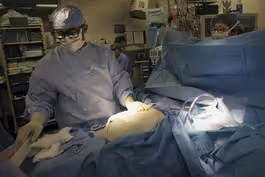
Improving the U.S. transplant process
Video has Closed Captions
Clip: 5/18/2024 | 6m 55s | How America’s organ transplant system can be improved (6m 55s)
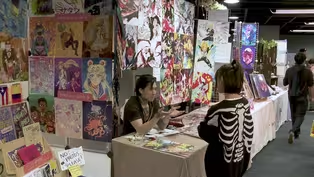
Popularity of Japanese comics and animations in U.S.
Video has Closed Captions
Clip: 5/18/2024 | 7m 26s | What’s behind the growing popularity of Japanese comics and animations in U.S. (7m 26s)

Young Americans push for climate change education
Video has Closed Captions
Clip: 5/18/2024 | 6m 47s | Why young Americans are pushing for climate change to be taught in schools (6m 47s)
Providing Support for PBS.org
Learn Moreabout PBS online sponsorship
- News and Public Affairs

FRONTLINE is investigative journalism that questions, explains and changes our world.

- News and Public Affairs

Today's top journalists discuss Washington's current political events and public affairs.












Support for PBS provided by:
Major corporate funding for the PBS News Hour is provided by BDO, BNSF, Consumer Cellular, American Cruise Lines, and Raymond James. Funding for the PBS NewsHour Weekend is provided by...