State of Affairs with Steve Adubato
Sen. Jon Bramnick (R) – NJ; Mayor Steven Fulop (D) - NJ
Season 8 Episode 1 | 26m 44sVideo has Closed Captions
Sen. Jon Bramnick (R) – NJ; Mayor Steven Fulop (D) - NJ
Sen. Jon Bramnick (R) - NJ, 21st Legislative District, joins Steve Adubato to examine Governor Murphy’s 2025 budget address, the future of the Republican party, and his campaign to be the next governor of NJ. Mayor of Jersey City, Steven Fulop (D) - NJ, joins Steve Adubato to discuss representative democracy, improving the school funding formula, and goals for his 2025 gubernatorial campaign.
Problems playing video? | Closed Captioning Feedback
Problems playing video? | Closed Captioning Feedback
State of Affairs with Steve Adubato is a local public television program presented by NJ PBS
State of Affairs with Steve Adubato
Sen. Jon Bramnick (R) – NJ; Mayor Steven Fulop (D) - NJ
Season 8 Episode 1 | 26m 44sVideo has Closed Captions
Sen. Jon Bramnick (R) - NJ, 21st Legislative District, joins Steve Adubato to examine Governor Murphy’s 2025 budget address, the future of the Republican party, and his campaign to be the next governor of NJ. Mayor of Jersey City, Steven Fulop (D) - NJ, joins Steve Adubato to discuss representative democracy, improving the school funding formula, and goals for his 2025 gubernatorial campaign.
Problems playing video? | Closed Captioning Feedback
How to Watch State of Affairs with Steve Adubato
State of Affairs with Steve Adubato is available to stream on pbs.org and the free PBS App, available on iPhone, Apple TV, Android TV, Android smartphones, Amazon Fire TV, Amazon Fire Tablet, Roku, Samsung Smart TV, and Vizio.
Providing Support for PBS.org
Learn Moreabout PBS online sponsorship- [Narrator] Funding for this edition of State of Affairs with Steve Adubato has been provided by Horizon Blue Cross Blue Shield of New Jersey.
Here when you need us most.
Veolia, resourcing the world.
RWJBarnabas Health.
Let’s be healthy together.
NJM Insurance Group.
Serving New Jersey’s drivers, homeowners and business owners for more than 100 years.
IBEW Local 102.
Lighting the path, leading the way.
Operating Engineers, Local 825.
The Turrell Fund, a foundation serving children.
Eastern Atlantic States Regional Council of Carpenters.
And by New Brunswick Development Corporation.
Promotional support provided by NJ.Com.
Keeping communities informed and connected.
And by ROI-NJ.
Informing and connecting businesses in New Jersey.
[INSPRATIONAL MUSIC] - Hi everyone.
Steve Adubato.
We kick off this program with State Senator John Bramnick, who is from the 21st Legislative District, and also an official candidate for Governor of the State of New Jersey.
Folks are gonna see the graphic, "NJ's Next Governor, Decision 2025."
Good to see you, Senator.
- Thanks for having me, Steve.
- Is it too early to be talking about that race?
Not from a political point of view or a horse race point of view, 'cause that frankly is kind of boring.
But from a policy point of view, too early, Senator?
- Not for me.
I've been talking about it for 20 years.
I'm gonna continue talking about the same things I've spoken about.
Nothing's gonna change.
- Let's prioritize.
Let's talk about New Jersey's fiscal situation.
The governor, as we're doing this program toward the end of March 2020, for the governor introduced his budget.
A sound fiscal plan for New Jersey, Senator?
- I don't think you can look at a plan at one year only.
In the last few years, billions of dollars have gone to special projects, and now yesterday, we voted for a new gas tax.
Well, instead of spending money in specific legislative districts politically, take that billion dollars and don't raise the gas tax.
So, you can't look at a budget in one year.
And when they ask Republicans, "Well, what are you gonna do?"
Well, I wouldn't have spent that much money during the last five years.
- Yeah, but Senator, let's be fair about this.
That gas tax that the Democrats voted for, and as we do this program, it's likely the governor will sign that legislation that increases the gas tax over the next several years, that wasn't just the gas tax for the sake of hiking the gas tax.
It's two cents over the next five years each year.
It is for the Transportation Trust Fund.
Getting past the Trenton State House lingo, that is for a stable source of funding for roads and bridges.
Why wouldn't we raise the gas tax to do that, to have safer roads and bridges?
- See, this is the argument that's always used.
"Well, are you not in favor of infrastructure?
"You know, isn't it important to have a dedicated fund?"
Of course it is, but how did you get there?
You got there because you spent money in other places as opposed to projects, worthwhile projects such as infrastructure.
So the question really isn't 100% accurate.
It is a global question, not a question as whether I support infrastructure.
We all do.
- So, another question of having to do with transportation.
I'll move off in a second.
The corporate business tax.
The governor proposed in his budget address a corporate business tax.
This is to support an increase, this is an increase in taxes for companies that have profits over $10 million annually.
This money would go specifically to support New Jersey Transit, mass transit in the state.
New Jersey Transit is in trouble financially, on a fiscal cliff, if you will, potentially about to fall off, which would be devastating for commuters across this state and the region.
Why shouldn't we have this corporate business tax for companies that are making $10 million or more, Senator?
- Same answer.
You know, this is really a situation where people go, "Well, why wouldn't you wanna tax corporations?
"You know, it doesn't really affect you.
"Why don't we help out New Jersey Transit?"
Same answer.
If you're gonna spend money and you're gonna increase budgets by billions of dollars, by 11 or 12%, and then you come to me and go, "Okay, now let's raise these other taxes."
I said, "Well, wait a minute now.
"Why did we spend all this other money "on we'll call 'em Christmas tree items or pork items, "and now all of a sudden you come to me and you go, "'Oh, oh, by the way, "don't you support New Jersey Transit?'"
I do, but I also support smart budgeting in the last four or five years so you can limit the impact on corporations, you can limit the impact on people driving cars.
It's not a question as to what to do now.
It's a question as what have you done in the last five years?
- Senator, switch gears.
Every time we've had you on, we've talked about the Republican party, Trump's party, if you will.
No debate there.
As we speak, he's the Republican nominee.
He's leading in the polls right now, but again, we don't do horse race polls.
We try to look at policy.
But we also question the tone and tenor of candidates and the impact it has on our representative democracy and the way elections are held.
It's hard to keep track of what Donald Trump says publicly that is viewed by many to be inflammatory, but he recently said, if he loses this race for president in 2024, there will be a bloodbath.
Those of us who question that, particularly after January 6th in the media, many Republicans who support Trump, long-winded question I know, said, "Hey, you're taking it out of context.
"He didn't mean a bloodbath in the street.
"He meant some other sort of bloodbath "in terms of a policy issue, the economy, "whatever he was talking about."
Rhetoric that is dangerous, Senator?
- Dangerous rhetoric that also hurts our chances of winning elections.
We have been losing the legislature in the last few years, despite the prediction of a red wave.
We lost a gubernatorial election against Phil Murphy first time in decades, and we're gonna continue to lose if we're the party of Trump.
And let me say this, in 2026, when I'm the governor, right, Trump's not gonna be there to veto some of these extreme policies of the Democrats.
If you want to have two-party rule and balance in Trenton, then you have to understand that the Trump candidates are going to lose the general election, and you will continue to have one-party rule.
Bloodbath, saying that January 6th criminals are hostages, that will cause us to lose.
Now, I understand the need of Republicans to endorse Donald Trump.
I never did it, I never will do it, and that's why I can win a general election.
- Will you be voting for Trump or Biden?
- I won't be voting for Trump, and unlikely I'll vote for Biden.
I'll probably write in somebody else, but I'm not voting for Trump, I can tell you that.
- Back to policy.
Senator, a longstanding initiative we've been involved in, and we've asked you many times about childcare or Reimagine Child Care initiative, which is being expanded to a new initiative called the First 1,000 Days NJ, dealing with issues that impact children and families.
If you were governor, top two priorities for children and families in this state that would make it not just more affordable, but healthier for those who are particularly struggling in the state right now, families and children?
- I would make sure that health insurance companies provided under their policies the necessary tools for people to get the coverage they need and make sure doctors get paid, and the approval system, which is now a nightmare, is reduced.
The most important, most important is access to coverage, access to health insurance so people don't have to worry that they can't afford to take their child to the doctor, can't afford to go to a hospital.
We must provide coverage.
Everyone's entitled to health coverage, end of story.
- Another important issue.
Senator, what is your greatest concern?
And we're gonna be having your colleague, excuse me, State Senator Teresa Ruiz, who's been involved in this issue, as is your other colleague, Senator Vin Gopal, who's the chair of the Senate Education Committee.
Talk about the state funding formula for public schools.
State funding.
You're smiling already, Senator.
What is the biggest problem?
Because schools are funded by property taxes and state funding going to local schools.
What's the biggest concern and problem you have with the current formula that the state uses to provide dollars directly to over 600 school districts, if you will please?
- 150 school districts got cuts.
You know, if you support education, don't cut funding to schools, 150 schools.
Especially a lot of it is, in my judgment political decision-making.
- How so?
- You gotta cut- How?
Well- - Yeah, how is it political?
- A governor has the absolute right to increase funding in his budget outside of the school formula.
And Governor Murphy or any other governor, including me, would make sure that there would be no cuts.
You know, Toms River, for example, lost over the last couple years 10% or close to $20 million in support from the state.
That shouldn't happen.
Let's make sure, if you wanna increase funding to certain schools, make sure everyone else doesn't get a cut.
You know, they're trying to get their budgets now in April.
They don't even know how much money they're gonna get in June, but they should all understand, no cuts to any schools, especially based on political decision making.
- Senator, the immigration situation is serious.
New York City has a very serious problem.
It's not the only city or community in this nation with a problem.
New Jersey's affected as well.
As governor, what, if anything, could or would you do to deal with the immigration problem?
Even though it's a congressional and a federal issue, it has state implications.
Please, Senator?
- Well, we know that most of the people coming in come across the border and they seek asylum.
There should be a very strict limit, a very small limit at this stage on the people that actually are permitted to get asylum.
Right now it's unlimited.
That has to be limited.
There was a bill in Congress that had a cap.
The cap was probably a little too high, but you must limit the number of people coming in, and you can do that.
Congress can limit it to 500 people a day.
Now you have hundreds of thousands coming in.
So you have to limit- - Senator, I'm sorry for interrupting you, but your Republican colleagues in the House, when President Biden and the White House coordinated with conservative Republican senators to create an immigration bill that would've improved the situation, your Republican colleagues in the House voted against it, many argued because Donald Trump was pushing against them and said, "Don't do anything now "because we don't wanna address this problem.
"I want it to be worse."
Is that an exaggeration on my part to describe it like that?
- No, I think that's- - Why didn't it happen?
- That, I think that's what happened.
And as I said before, I've never endorsed Donald Trump.
I don't intend to endorse Donald Trump.
I intend to be the governor, and we have a two-party system.
So, no, I agree with you.
The bottom line is a Congress should be dealing with this and they're not, so it's a very bad situation, and it can be controlled.
You need legislation.
- Senator John Bramnick representing the 21st Legislative District.
You've been in that legislature for how long, John?
- 20 years.
- 20 years, and running for governor in 2025.
Part of our series, "New Jersey's Next Governor, Decision 2025."
Senator, great seeing you.
We'll continue the policy-oriented conversation.
All the best.
- Thank you, Steve.
- Stay with us.
We'll be right back.
(grand music) - [Announcer] To watch more State of Affairs with Steve Adubato, find us online and follow us on social media.
- We continue our conversation on who will be New Jersey's next governor in 2025.
The election, 2025.
Take office in '26.
'Decision 2025' with the Mayor of Jersey City, Steve Fulop.
Candidate for governor.
Good to see you, Mayor.
- Good to see you, Steve.
- It is the 19th of March that we're taping.
This will be seen later, potentially after the June 4th primary for the United States Senate.
You originally endorsed the First Lady, Tammy Murphy.
And then said literally, within the last 24 hours as we're doing this, you know what?
I got that wrong.
I'm endorsing Andy Kim now, Congressman Kim.
Why the change and what does it have to do with policy?
- Well, look, I think that it's never easy to admit when you made a mistake, and it's embarrassing at times.
But I think I'm afforded the trust of our constituents here in Jersey City and hopefully beyond that one day.
And, you know, part of growth is admitting when you make a mistake.
I was early to support Tammy Murphy.
I knew her.
I should have been more patient to listen to the entire landscape of candidates.
But, you know, over the last six months, you've seen a steady deterioration of democracy at the conventions.
County after county has gotten progressively worse.
You've seen a lack of a message around why she's the better candidate.
And at the same time, you see the grassroots swelling by, you know, hundreds, if not thousands, towards Andy Kim.
And basically saying they want change in New Jersey.
And I think what this has brought to light is that change is necessary, and I agree.
So, you know, I'm listening.
And I think I'm advising our residents to do the right thing, which is support Andy Kim.
- Okay.
Move away from the politics.
And let's talk about democracy.
It's connected to what you just said, Mayor.
- Yeah.
- The question in New Jersey of the bracketing of candidates, I'll try to make this simple.
The line.
The Democratic party line.
The party chairs, the bosses of the party saying a certain candidate will be on that line.
You're not on that line, the bosses don't pick you, you're in a place that's otherwise known as 'ballot Siberia.'
Can't find you.
Translation, what does the line in New Jersey, New Jersey the only state in the nation that has this practice, not a law, it's a practice, What does it have to do with representative democracy, Mayor?
- Yeah, well, I mean, it's an indirect tax on residents.
And it impacts them every day of their life, even though they may not vote, or they may not know what the line is.
If you think about over the last year, you've seen a steady deterioration in democracy and representation in New Jersey, whether it's campaign finance rules that have been watered down last year, despite the outcry of hundreds, if not thousands of activists, to the open public records rules that are right now under attack in New Jersey.
If you had a process that legislators are only accountable to the voters, as it should be, they probably wouldn't be making those decisions.
But when you have a small group of people, four or five decision makers in New Jersey, that control these lines that have disproportionately votes and it's the only way, historically, that a legislator can get elected, you see them listening to those power brokers instead of listening to the voters.
And so what inevitably will happen if the lines are gone, is you will have better representation in Trenton, better representation in local government.
Listening more closely to what their constituents want, which I think is helpful for democracy.
- Thank you, Mayor.
Let's get into some public policy issues.
- Yeah, sure.
- If you were a governor, you might not say exactly what Governor Murphy said when he was elected that he will fix New Jersey Transit if it kills him.
And it just might, he said.
What do you believe either the solution or some remedies that would help New Jersey Transit move from the fiscal cliff that it is hanging over?
Remember, rail?
- Yep.
- Buses, fair hike, trying to find new sources of revenue.
The governor's proposed it.
I don't know what your view is on that so-called corporate taxes on companies that earn over $10 million a year, corporations.
What would you do if you're a governor as it relates to New Jersey Transit?
- So, I'm running for governor not only to be elected, but to be a transformational governor and move the state forward, much like we did in Jersey City.
And that means that being substantive on policy is important.
Every month we've put out a policy paper on a core issue facing New Jersey.
And it's more detailed and robust than probably any gubernatorial candidate does in the entire country.
We think voters deserve that.
So last summer, we put our transportation policy, and the CBT dedicating it to New Jersey Transit was something that we initially.
- Corporate business tax.
- The corporate tax being dedicated to New Jersey Transit was something we actually initiated as a core solution for New Jersey Transit's policy problems.
The governor pushed back when we released it at the time last summer.
The advocates supported me.
Slowly over the last year, you saw legislative leaders down in Trenton get on board, and now the governor's on board.
So, I could take some credit for being the first one to push for a real tangible solution for New Jersey Transit.
I also talk in that paper about how we would change the bus routes to make them more reliable.
How we would change the structure of New Jersey Transit overall with regards to how they function, how they flow, how transportation encompassed in New Jersey overall.
And, you know, I think we have some detailed solutions there.
And we actually, importantly, say how we're gonna pay for it.
So, StevenFulop.com.
Anybody could download the paper.
It's strong, but it's worth the read.
- So, let's deal with another issue.
You talk about how to pay for it, how to pay for our schools.
State funding of our public schools.
I believe there are over 600 school districts in the state of New Jersey.
The state school funding formula.
Our schools are paid for by property taxes and state funding to those local schools.
- Yeah.
- So many folks argue that the formula, Mr. Mayor, as it relates to how much the state will send to a school district, is all screwed up.
That it doesn't make sense.
That over 150 school districts are losing state revenue into their school districts, which causes them to either increase property taxes, lay off teachers, God knows what else they have to do to balance a budget.
What do you believe needs to be done to, if not fix, improve the state funding formula for our public schools if you were governor?
- Yeah, so let me start by saying that we're releasing our education paper next month.
So by the time this airs, probably people can download that as well.
I think education is actually one of the things that New Jersey does very, very well, traditional K through 12.
And Governor Murphy has made a commitment there and he's followed through on it and deserves credit on it.
There's no question that the school funding formula is dated.
It was implemented under Governor Corzine.
The landscape has certainly shifted.
How we deal with special education is a place that we could obviously reform.
And that was initially intended to be changed in 2006.
And neither Governor Murphy or Governor Christie leaned into that.
That could have a significant impact to local municipalities.
I also think there's a lot of money when you look about education around higher education.
It's more than half a billion dollars.
You look at how New Jersey uses tuition assistant grants, which is something that we use to supplement lower income families.
And actually becomes something to supplement the universities that aren't actually performing.
And there's a lot of reform around there as well.
So that's on the education side.
I do think New Jersey needs to take a wholesale look on our tax system.
What are the brackets that we tax needs to be revisited, how we're funding our schools from a property tax standpoint versus.
- Sorry for interrupting, Steve, Mayor, would you raise the income tax on the state?
- No, I don't think it's necessary to be raising the income tax.
I think we need to revisit the different tax structures and take a fresh look at how we are taxing our residents.
I mean, I do think that affordability is a big conversation here.
But it's not only taxes, it's also housing supply when people talk about affordability because there's a lack of housing, which leads to mortgages that you maybe can't afford, or rent that you maybe can't afford.
- Mayor, let's do this.
We've been involved in a public awareness initiative around childcare a few years called 'Reimagine Childcare.'
- Yep.
- It's expanding into this initiative called 'First 1000 Days NJ,' which looks at important issues impacting families and children.
You've talked about some of them already.
- Yep.
- But an area that you haven't touched on, impacting children and families, that you believe would be a key, would be a cornerstone of your governorship if elected, what is that?
- You're asking about early?
- What is the number one area for you as it relates to children and families?
- So, our health policy comes out coincidentally this week, actually on the 25th is the press rollout.
It speaks to a robust plan around the first year of childcare.
I have three kids under five years old, and I'm certainly familiar with the challenges around childcare.
And there's a robust plan on how we supplement daycare centers differently in New Jersey.
That's a problem and challenge number one that needs to be addressed.
And then secondly, how do you expedite the dollars that families are entitled to so that way they can get access to that at the birth of the child instead of going through the bureaucracy that actually takes time?
So I think those are two parts of early childhood.
If I was saying the three areas, if you ask me, I would say K through 12 is very good.
Let's not really focus on that as much as special needs, higher education, and the first year of after birth.
- And we're talking about first 1000 days, is pregnancy to age two.
Is that an issue?
You'll see more programming down the road on that.
Real quick before I let you go, we've got a minute left.
Immigration crisis in the state, in the nation.
You don't have a solution.
No one does.
What would you do to improve the situation in the state?
- In the state?
Look, I mean, Jersey City has been a welcoming place.
It's a diverse place.
I mean, clearly we have our responsibility that when, you know, we have a diverse city like Jersey City, it's something that's made us stronger and better.
We need to be thoughtful about how we approach it.
We are the first and only city in the country that has a federally accredited immigration office within city hall, helping people get citizenship and navigate the process.
I think you obviously need some border reform.
That's obvious.
And I think that, you know, President Biden and Congress is moving forward on some thoughtful plans that hopefully the Republicans support.
- We'll stay on top of that.
Mayor Steven Fulop is mayor of Jersey City and a candidate for governor of the great state of New Jersey.
Mayor, thank you so much for joining us.
We appreciate it.
- Thank you.
- I'm Steve Adubato.
We'll see you next time.
- [Narrator] State of Affairs with Steve Adubato is a production of the Caucus Educational Corporation.
Celebrating 30 years in public broadcasting.
Funding has been provided by Horizon Blue Cross Blue Shield of New Jersey.
Veolia, RWJBarnabas Health.
Let’s be healthy together.
NJM Insurance Group.
IBEW Local 102.
Operating Engineers, Local 825.
The Turrell Fund, a foundation serving children.
Eastern Atlantic States Regional Council of Carpenters.
New Brunswick Development Corporation.
And by these public spirited organizations, individuals and associations committed to informing New Jersey citizens about the important issues facing the Garden State.
And by Employers Association of New Jersey.
Promotional support provided by NJ.Com.
And by ROI-NJ.
(Sounds of Water) - (Narrator) Most people don’t think of where there water comes from.
But we do.
Veolia, more than water.
Resourcing the world.
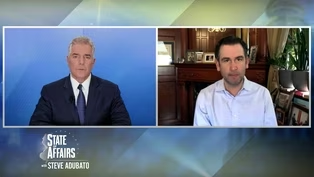
Mayor of Jersey City's Goals for 2025 Gubernatorial Campaign
Video has Closed Captions
Clip: S8 Ep1 | 12m 43s | Mayor of Jersey City's Goals for 2025 Gubernatorial Campaign (12m 43s)
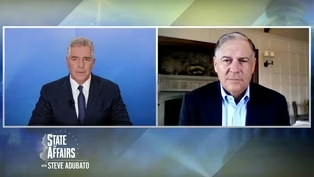
Sen. Jon Bramnick On His Campaign To Be Governor of NJ
Video has Closed Captions
Clip: S8 Ep1 | 13m 34s | Sen. Jon Bramnick On His Campaign To Be Governor of NJ (13m 34s)
Providing Support for PBS.org
Learn Moreabout PBS online sponsorship
- News and Public Affairs

Top journalists deliver compelling original analysis of the hour's headlines.

- News and Public Affairs

FRONTLINE is investigative journalism that questions, explains and changes our world.











Support for PBS provided by:
State of Affairs with Steve Adubato is a local public television program presented by NJ PBS