Northwest Profiles
The Conductor: James Lowe and The Spokane Symphony
Clip: Season 39 Episode 4 | 6m 50sVideo has Closed Captions
James Lowe, the Conductor for the Spokane Symphony, details his journey through music.
James Lowe, the Conductor for the Spokane Symphony, details his journey through music. We’ll learn about the moment that first sparked his passion for music and why he believes the Symphony is an essential element of the Spokane community.
Problems playing video? | Closed Captioning Feedback
Problems playing video? | Closed Captioning Feedback
Northwest Profiles is a local public television program presented by KSPS PBS
Funding for Northwest Profiles is provided by Idaho Central Credit Union, with additional funding from the Friends of KSPS.
Support provided by:

Northwest Profiles
The Conductor: James Lowe and The Spokane Symphony
Clip: Season 39 Episode 4 | 6m 50sVideo has Closed Captions
James Lowe, the Conductor for the Spokane Symphony, details his journey through music. We’ll learn about the moment that first sparked his passion for music and why he believes the Symphony is an essential element of the Spokane community.
Problems playing video? | Closed Captioning Feedback
How to Watch Northwest Profiles
Northwest Profiles is available to stream on pbs.org and the free PBS App, available on iPhone, Apple TV, Android TV, Android smartphones, Amazon Fire TV, Amazon Fire Tablet, Roku, Samsung Smart TV, and Vizio.
Providing Support for PBS.org
Learn Moreabout PBS online sponsorshipThere is a spark in every one of us.
There is a little fire burning, and the world kind of tries to put it out in us as we get older, and I think the musicians and artists are the people who've kept that flame alive in themselves, and our job is to pass that spark on to other people.
James Lowe is the music director and conductor of the Spokane Symphony.
His journey has taken him far and wide, conducting orchestras all over the world.
And now, feels at home in Spokane.
Can we try that cue one more time?
We're going to try something different, and we'll see which we prefer.
Winds, can we go, please, before theme C, just under Keith, please, forty one, and... His interest in music started at a young age, on the other side of the Atlantic Ocean.
I come from England from a pretty normal background.
I mean, we weren't in poverty, but we certainly weren't wealthy.
At the age of 13, I suddenly had the desire to play a musical instrument.
So I chose the violin and they didn't have any, so I ended up with the viola.
My world exploded in that moment when I first opened that viola case and I knew somehow music was going to be what I did.
So one of the great things about playing viola when you're a kid is that most youth orchestras really need viola players.
So within a year of starting, I was in my local youth orchestra, the Nottingham Orchestra, and more and more I started looking at the conductors I was working with and thinking, “I wonder what would it be like to do that job?” And then I had a gap year between high school and university.
I was playing in an amateur orchestra and the conductor of that orchestra very kindly, a guy called Duncan Lloyd said, “Why don't you just take a rehearsal next week, see how it goes.” And that, for me, was a really transformative moment.
After James finished high school.
He studied music at the University of Edinburgh in Scotland.
During that time, James found himself conducting orchestras more and more, and after finishing school, he began traveling the world doing what he loves.
I was in a music festival in the south of France and a flute player who originally comes from Coeur dAlene said, “I hear that the Spokane Symphony are going to be looking for a new music director soon.
I think you'd be a good fit.” And so when the job came open, I applied for it.
And here we are, I got it.
One of the main functions of the conductor is to help each musician know their part, and ensure even the smallest details are accounted for.
Just two things.
Be a little bit careful Something squirrely happens around K. Oboes, I love your enthusiasm, you still want to slightly push your fugue theme.
The middle of the note doesn't need to be louder, otherwise it'll just obliterate.
I'll come off stage at the end of the the Walton Bach.
I'll take a bit of time.
Then I'll come back and I will talk to the audience.
For the bass drum, the half measure, these guys have got bom pom.
So they have an upbeat to you.
So you're a little bit early.
Upbeat on nine after the start of variation M. One, and... For me the Spokane Symphony is a really special orchestra, having an orchestra that is super engaged and super excited, who really leans into the music.
The conductor's job really is to try and make everybody come together in a unified way.
The hour coming up to a performance, weirdly, I have a huge energy drop.
I feel extremely tired and I generally don't think I can get through the performance.
But then something strange happens.
There's a moment of total silence where it's just me in the wings, and in that moment I feel this huge surge of energy and excitement.
And I go into the hall, and then for me, it's almost like then it's kind of dream state.
That is something different from what you experience in everyday life.
I think there are many, many reasons why symphony orchestra is important.
There's the art, of course.
There's this thing of being on stage and seeing this incredible organism.
It connects you to yourself and to each other.
So there's the artistic side.
There's also the economic side.
You know, can you imagine what downtown Spokane would be like without the Fox Theater, the restaurants, the bars, what's going on around this place?
The hum that it brings to downtown, I think is hugely important.
But for me, I think that the single most important thing really is this idea of community.
We've really expanded our educational outreach.
So we now have the Lullaby Project, which works with newborn children and their families.
And on the other end of the spectrum, we have a dementia program, which uses the power of music to really impact and reconnect people suffering from dementia to a kernel of something inside that is still there, but somehow diminished by that illness.
These are just a few examples of how music is making a difference in our community.
Just imagine for a minute the world without music.
Imagine going into a restaurant with no music.
Imagine going to a bar with no music.
Imagine your life without music.
Every human culture that we've ever discovered has some kind of music in it.
Music is central to who we are.
It defines and expresses who we are as humans.
And I think for me, that element is vastly underrated.
So often in our society, I get to work with these incredible musicians.
I get to live my life exploring some of the greatest minds of humanity.
I get to spend my waking hours working in this incredible realm of positively giving something to people.
I can't imagine anything better.
 New
NewThe Canyonettes: Spokane’s Most Welcoming Women’s Golf League
Video has Closed Captions
Clip: S39 Ep4 | 4m 50s | Spokane’s Canyonettes make golf welcoming, fun, and open to every skill level. (4m 50s)
Video has Closed Captions
Preview: S39 Ep4 | 30s | Conductor James Lowe, artist Kimber Follevaag, The Wilder Institute, and golfers the Canyonettes. (30s)
 New
NewThe Wilder Institute: Saving Species Through Community Conservation
Video has Closed Captions
Clip: S39 Ep4 | 7m 32s | The Wilder Institute restores endangered species through science and community conservation. (7m 32s)
 New
NewVideo has Closed Captions
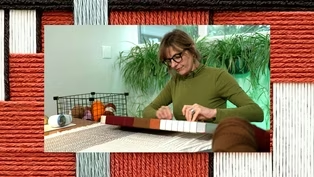
Clip: S39 Ep4 | 4m 14s | Spokane fiber artist Kimber Follevaag stretches yarn into amazing designs. (4m 14s)
Providing Support for PBS.org
Learn Moreabout PBS online sponsorship













Support for PBS provided by:
Northwest Profiles is a local public television program presented by KSPS PBS
Funding for Northwest Profiles is provided by Idaho Central Credit Union, with additional funding from the Friends of KSPS.