Northwest Profiles
The Wilder Institute: Saving Species Through Community Conservation
Clip: Season 39 Episode 4 | 7m 32sVideo has Closed Captions
The Wilder Institute restores endangered species through science and community conservation.
The Wilder Institute in Calgary protects endangered species through community conservation, translocations, and breeding programs. From whooping cranes and Vancouver Island marmots to global partnerships in Africa, the organization works with local communities and Indigenous partners to restore wildlife and strengthen ecosystems at a critical time for biodiversity.
Problems playing video? | Closed Captioning Feedback
Problems playing video? | Closed Captioning Feedback
Northwest Profiles is a local public television program presented by KSPS PBS
Funding for Northwest Profiles is provided by Idaho Central Credit Union, with additional funding from the Friends of KSPS.
Support provided by:

Northwest Profiles
The Wilder Institute: Saving Species Through Community Conservation
Clip: Season 39 Episode 4 | 7m 32sVideo has Closed Captions
The Wilder Institute in Calgary protects endangered species through community conservation, translocations, and breeding programs. From whooping cranes and Vancouver Island marmots to global partnerships in Africa, the organization works with local communities and Indigenous partners to restore wildlife and strengthen ecosystems at a critical time for biodiversity.
Problems playing video? | Closed Captioning Feedback
How to Watch Northwest Profiles
Northwest Profiles is available to stream on pbs.org and the free PBS App, available on iPhone, Apple TV, Android TV, Android smartphones, Amazon Fire TV, Amazon Fire Tablet, Roku, Samsung Smart TV, and Vizio.
Providing Support for PBS.org
Learn Moreabout PBS online sponsorshipMy name is Grainne McCabe, and I'm the Chief Conservation Officer here at the Wilder Institute.
the Wilder Institute is a conservation organization.
our focus is really on community conservation.
we just felt like having a different brand, a different identity for conservation work that we have been doing 30, 40 years, bringing it more into the public spotlight?
And also, how do we work more broadly outside of Western Canada, where we've been really focused to date?
so we were quite excited to launch, in November 2021, with a big display on the Calgary Tower here in Calgary with some of the animals that we work with, displayed, quite large, conservation is complicated.
it affects a lot of people in a lot of industries.
And one of the most important things for us, for conservation to be successful is to make sure you have all the right voices at the table.
And we call this inclusive conservation within the conservation sector.
And so if you're working in an area where there is, say, the oil and gas industry or the energy sector or ranching, we need to make sure we have those people there just as much as we need to make sure we have conservation professionals because once people feel involved and feel their voice has been heard, it's so much more sustainable.
Long term.
Community conservation for us is really about empowering and building or strengthening capacity within local communities So we're building skills not just in watching wildlife and monitoring wildlife, but also in program governance, in leadership, in finance and all the things you need to do to successfully run a conservation program and that's been really successful for us so far.
And we've found some really good partnerships with local communities, with local NGOs all across, the places where we work.
we have about 40, conservation professionals.
And then for the Canadian programs, we have this facility, the Archibald Biodiversity Center, just outside of Calgary.
we are responsible for the care for several Canadian endangered species, including the Vancouver Island marmots, whooping cranes, northern leopard frogs, and burrowing owls.
for three of those programs we have permanent residents.
And so those are breeding animals that we housed throughout their life.
And their offspring go to reintroduction efforts for their specific species.
Burrowing owls is our exception.
They are a head started program.
So we have a different cohort of burrowing owls that we've taken to care for ten months.
They are coming in in the fall and then they're released the following spring.
we specifically chose a place that we have room to grow and develop new programs as species are identified and in need of support.
So my team have actually developed a process to review species at risk here in Canada, where we can really look at the feasibility.
So will it be successful?
So we work on the Vancouver Island marmot, Canada's most endangered mammal.
we have a program down in Waterton Lakes National Park, with the curiously isolated hare streaked butterfly, which is a newly described species We have programs in southern Alberta on the burrowing owl.
We work, across the range of the whooping crane.
we're actually just about to launch a program on water turtles in Ontario with our very first partnership with an indigenous nation here in Canada.
But then we also work in Africa.
So we work in Kenya on the Mountain Bongo And then a long term project in Ghana where we are working to conserve the habitat of the hippopotamus.
There's only about 180 hippos in Ghana, and we work very closely with local communities there to establish a women's cooperative.
2000 women from 20 different villages actually work on that cooperative.
We are fortunate to belong to an association called the Association of Zoos and Aquariums, and we've had some excellent feedback from our colleagues there about the conservation work we're doing and how they would love to hear more so they could see if some of them could could follow in their footsteps.
And of course, that sounds amazing.
We'd love to help in any way we can.
we're quite excited about a new upcoming initiative that Wilder Institute has, which is called the Wilder Canada Action Plan.
So this is a national plan that we have to help restore species across the country.
we've started to really prioritize them based on which ones are most feasible to help.
And now we are starting a ten year initiative to work for hoping, with 30 to 60 different species across the country, to really start dedicated conservation action for those species, community conservation.
And translocations are really our areas of expertise.
So translocations are really about the deliberate movement of animals and you might want to do that if, one population is very small and another one is larger.
And so you just want to be able to help balance it out or exchange animals to maintain genetic diversity.
The other one is called head starting.
So we're seeing some success and population growth there.
And then the last one is actually having a population under human care, like some of our programs here, the whooping crane for example, where we have birds that are permanently under human care, but their chicks will be released to the wild.
in the whooping cranes were down to about 20 individuals left at all in the world.
Now we have over 800, So we're quite excited about that success.
a lot of these species are keystone species or umbrella species.
They're really important to the healthy functioning of their ecosystem.
And if we lose them, it actually has a knock on effect to the rest of the habitat.
And a lot of people rely on those healthy habitats, you know, people who are fishermen or they're hunting and trapping in a sustainable way, people who rely on trees, all of us really rely on, elements of nature with maybe without even realizing it.
And almost all parts of our economy are tied to nature as well.
a couple of years ago, there was a report that was published that said there's over a million species at risk of extinction.
Last year, there was a follow up report and said it's actually closer to 2 million.
So the rate is accelerating.
And that's the problem because as the habitats change, as the environment changes too quickly, species can't adapt fast enough.
And then we just start to see more and more being lost at a faster rate.
And the problem will be much, much more difficult to handle as it grows bigger.
saving animals takes a long time and it takes a lot of patience, but we've seen some really positive signs.
You have to be an optimist if you're in this field.
And because I do see organizations, particularly grassroots organizations, small communities, that are making a real difference in their local area.
And you do start to see governments and multilateral organizations that are understanding this.
It's slow, it takes time and we have to be patient with it.
But we are seeing these things that are really positive for us and keep us going.
 New
NewThe Canyonettes: Spokane’s Most Welcoming Women’s Golf League
Video has Closed Captions
Clip: S39 Ep4 | 4m 50s | Spokane’s Canyonettes make golf welcoming, fun, and open to every skill level. (4m 50s)
Video has Closed Captions
Preview: S39 Ep4 | 30s | Conductor James Lowe, artist Kimber Follevaag, The Wilder Institute, and golfers the Canyonettes. (30s)
 New
NewThe Conductor: James Lowe and The Spokane Symphony
Video has Closed Captions
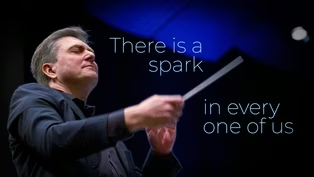
Clip: S39 Ep4 | 6m 50s | James Lowe, the Conductor for the Spokane Symphony, details his journey through music. (6m 50s)
 New
NewVideo has Closed Captions
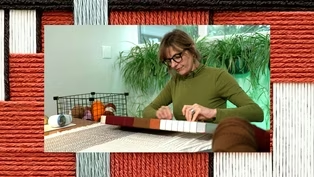
Clip: S39 Ep4 | 4m 14s | Spokane fiber artist Kimber Follevaag stretches yarn into amazing designs. (4m 14s)
Providing Support for PBS.org
Learn Moreabout PBS online sponsorship













Support for PBS provided by:
Northwest Profiles is a local public television program presented by KSPS PBS
Funding for Northwest Profiles is provided by Idaho Central Credit Union, with additional funding from the Friends of KSPS.