State of Affairs with Steve Adubato
Asm. Al Barlas (R) - NJ; Keith Strudler, PhD
Season 10 Episode 10 | 27m 18sVideo has Closed Captions
Asm. Al Barlas (R) - NJ; Keith Strudler, PhD
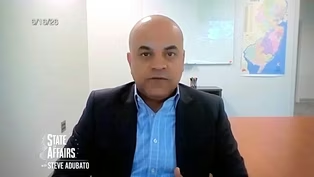
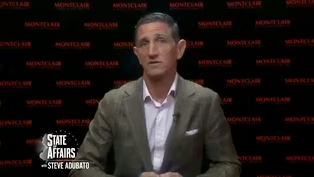
Asm. Al Barlas (R) - NJ of the 40th Legislative District speaks about affordable child care, the school funding formula, and state budget support for nonprofits. Keith Strudler, PhD, Dean of the College of Communication and Media at Montclair State University, talks about the future of NJ PBS and how it will shape opportunities for students, the university, and audiences statewide.
Problems playing video? | Closed Captioning Feedback
Problems playing video? | Closed Captioning Feedback
State of Affairs with Steve Adubato is a local public television program presented by NJ PBS
State of Affairs with Steve Adubato
Asm. Al Barlas (R) - NJ; Keith Strudler, PhD
Season 10 Episode 10 | 27m 18sVideo has Closed Captions
Asm. Al Barlas (R) - NJ of the 40th Legislative District speaks about affordable child care, the school funding formula, and state budget support for nonprofits. Keith Strudler, PhD, Dean of the College of Communication and Media at Montclair State University, talks about the future of NJ PBS and how it will shape opportunities for students, the university, and audiences statewide.
Problems playing video? | Closed Captioning Feedback
Where to Watch State of Affairs with Steve Adubato
State of Affairs with Steve Adubato is available to stream on pbs.org and the PBS app.
Providing Support for PBS.org
Learn Moreabout PBS online sponsorship- [Narrator] Funding for this edition of State of Affairs with Steve Adubato has been provided by The Turrell Fund, a foundation serving children.
The Burke Foundation RWJBarnabas Health.
Learn More at RWJBH.org.
NJM Insurance Group.
Serving New Jersey’s drivers, homeowners and business owners for more than 100 years.
IBEW Local 102.
Lighting the path, leading the way.
The Adubado Center for Media Leadership.
Because media matters more than ever.
United Airlines.
Operating Engineers, Local 825.
And by Eastern Atlantic States Regional Council of Carpenters.
Promotional support provided by NJ.Com.
Keeping communities informed and connected.
And by New Jersey Globe.
[INSPRATIONAL MUSIC] - Hey everyone, Steve Adubato, we kick off the program with State Assemblyman Al Barlas from the 40th Legislative District.
Good to see you, Assemblyman.
- Thank you Steve, happy to be here.
- There's a whole bunch of topics I wanna talk about, and I also wanna make it clear we're taping on the 16th of June.
Some of this stuff's gonna feel dated, but the issues are just as important.
Can we do childcare first?
- Sure.
- There's an initiative called Start Strong NJ, public awareness around the importance of quality, accessible, affordable childcare.
How high a priority is that for you as a member of the state legislature?
- Well, it's very important and I'll tell you why.
First of all, personally it's important for me 'cause my kids are seven and five, right?
So I've gone through the whole daycare childcare thing and I will tell you that a lot of times it felt like either myself or my wife were working to pay for childcare just to go to work.
And we're blessed to live in a great town and we're blessed to do fairly well, financially.
But there are a lot of people who are struggling now.
And if your choice is what do I do with my child during the day or earning a paycheck to help pay for my child?
I mean, those are some Hobson's choices you have to make.
- And which is why a big theme in our programming is the connection between childcare and the economy.
Assemblyman, let me follow up on a different issue.
You've talked a lot about school funding.
I'm not gonna get into the details of the school funding formula, which is complicated.
Check out our interviews with State Senator Vin Gopal, who heads up the Senate Education Committee.
From your perspective, what is wrong with the current way the state funds our public schools and what would you change about it?
- So I think first of all, the fact that we are out of this S2 Process and now we have this arbitrary cap that Governor Murphy put in place last year, which says that no district shall receive no more than a 6% increase and no less than a 3% decrease still leaves 176 school districts without funding this year.
They're getting cut to the total of about $55 million.
And when you've got a budget that is 60.7 billion is up 3% from last year, the fact that we don't have $55 million to at least bring everybody to zero, is a problem.
- Hold on, but help everyone understand when a school district gets cut in state funding, what the potential implications are for the students, teachers, and the school district itself.
- Well, you're talking about services, you're talking about programs, you're talking about perhaps teachers' aids, you're talking about teachers themselves.
I mean, the potential impact, depending upon the dollar amount, can run the gamut of a little bit to a lot.
And when you're a young child and you're a family who lives where they live and wants their kids to receive the best education possible, every little bit of a cut is a big deal.
- Speaking of finances, what the heck is "Budget Bites" "with Assemblyman Al Barlas?"
It's a Facebook series?.
- It's just.
- But what is it?
- A little video series we did.
It just takes and highlights some of the things that are going on in this budget that we think are a problem.
Again, you've got a $60.7 billion budget, but yet, Governor Sherrill has proposed cutting $250,000 for the Wynona Lipman House for Battered Women.
You're talking about a $1.3 million cut to the Boys and Girls Club for at, in risk.
You're talking about a $325,000 cut to the ALS Foundation.
You're talking about $455,000 cuts to Tourette Syndrome.
I mean, these are cuts that, yes, it's a tough budget year, but we are increasing spending by $1.9 billion.
The fact that you can't find a couple of million dollars for these types of causes, which have far greater impact on people's lives than anything else, to me is a problem.
- But Assemblyman, when we had the governor, check out our interview with the governor, she talked about these so-called Christmas tree items.
And Assemblyman knows that as a former state legislator on my end, I served on the appropriations committee in the legislature in the mid-'80s, and I remember trying to get items into the state budget that helped the seven towns in my district.
The governor says that we need to cut back dramatically, if not reduce and eliminate these so-called Christmas tree items, what you just described, if I'm not mistaken, Assemblyman, those are Christmas tree items.
- Well, I would dispute that because I think to me, a Christmas tree item is what you talked about, Steve, it's money for a little league program in your district, or it's money for a ball field in a town in your district.
- Okay.
- When you're talking about $250,000 to help a battered women's shelter or 1.3 million to help at risk youth, the impact of that money is far wider than just bringing home the bacon to your district so you can get reelected the following year.
- But at the same time, I'm not saying it's a Christmas tree item.
What I'm saying is if it's included in to the state budget, if a state legislator attempts to put an item into the budget and someone says, well, that's a Christmas tree item, that's a gift to your district or a gift to the non-profit that you support, you're saying each individual appropriation of state dollars needs to be considered separately, correct?
- Absolutely.
I mean, everything should be weighted on its merits.
And what is the impact of that?
Do you want money for a infrastructure project that could potentially prevent flooding that impacts two, three, four communities in your district and thus has a far wider beneficial impact to potentially hundreds or thousands of people versus a ball field, which is a very noble cause, nobody's denying that.
But you gotta sort of weigh what has a far greater societal benefit.
- Talk about economics, again, we're taping in the middle of June, World Cup started over at, what do we call it?
New York, New Jersey, New York Stadium this week.
- Yes.
- You are calling for hearings and you've proposed legislation that creates a five member commission of fiscal integrity of future attractions having to do with events like this.
Why is that important?
Isn't it a positive economic impact?
Isn't there a positive economic impact to New Jersey?
Or do we not know?
- I mean, we don't know that yet.
I mean, when you look at some of these reports of towns and states that host Super Bowls, World Cups, major events like that, a lot of times they end up, Olympics is another one.
You look at Atlanta, they spent all this money years ago.
An Olympic village I think has been either totally demolished and rebuilt on, or sat vacant and empty for 15, 20 years.
So you hear stories about ultimately at the end of the day having a net negative impact financially.
So I think it's yet to be determined if we will have a positive financial impact from the World Cup.
But my bigger problem was as this unfolded over the last couple of months, all this FIFA information coming out, the fact that they were gonna shut Penn Station for certain hours during the day when fare prices were gonna be potentially $155 a person, it seemed like a lot of us were not aware of what was going on and what the details were.
So the purpose of this bill is that it's a five member body.
It's the governor, it's the Senate president, the speaker, the minority leader in the Senate and the minority leader of the assembly.
Those five who are briefed by the governor in public about what is being proposed for any major event like a World Cup, like a Super Bowl, like a Grand Prix.
So we're not talking about Taylor Swift at MetLife.
We're talking about these types of major attractions to see is there a actual cost benefit to the state and its taxpayers for putting out this money and making this investment?
- We'll follow that legislation, see where it goes.
State Assemblyman Al Barlas from the 40th legislative district.
Thank you, Assemblyman.
- Thank you Steve, appreciate it.
- You got it.
Stay with us, we'll be right back.
(grand music) - [Announcer] To see more State of Affairs with Steve Adubato programs, find us online and follow us on social media.
- We are honored to be joined by our good friend up at Montclair State University, Dr.
Keith Strudler, who is the Dean of the College of Communication Media at MSU, my alma mater.
Good to see you, Keith.
- It's great to be here, thanks for having me.
- You got it, we're taping on the 16th of June.
Things are moving quickly.
As we speak, Montclair State University has been selected by the state of New Jersey, the New Jersey Public Broadcasting Authority, to be the operator of NJ PBS.
It's a big deal after many years of our colleagues over at WNET operating NJ PBS.
Why is it so significant?
And talk to us about the vision at MSU for public media in the state, Keith.
- Sure, I mean, there's so many reasons why it's significant.
I think, from a statewide perspective, I say two things.
One is we are hoping to help transform the trajectory of public media and have New Jersey be at the national forefront of that.
And as you know better than I, it's challenging times, certainly for media in general and public media specifically.
So, we think we have an opportunity, particularly as NJ PBS is housed here at the college to be part of a transformation.
So, really great ideas come out of universities, particularly one as innovative as the college I get to be a part of.
And we think that there's an incubator opportunity to not only continue to run NJ PBS, which I know is critical for folks in the state of New Jersey.
And wouldn't it have been a shame if we were the only state in the country that didn't have a PBS station, a public television station?
But I think more importantly is we're looking at how we can help lead the way for a much more sustainable future for PBS nationally, and really recognizing that there's a whole generation of folks out there that get their information very differently.
We have kids, and yeah, and they walk around with those things, right?
And they use apps that we are trying to stay current on.
And I think it's really important for us to not use a top-down approach of what public television is supposed to be, but rather to do a whole lot of listening, and transform, and meet that moment.
The second thing I'd say is WNET has been a wonderful steward of NJ PBS, but I think a lot of folks are happy to see it come back to the Garden State.
And so, we're really thrilled to have a... Truly to have this back in New Jersey and housed in New Jersey.
And so, we think there's a lot of good that can come from that.
And lastly, I'll say one last thing.
- Hold on one second.
Hold on one second, Keith.
I also wanna just make clear, we are still, the Caucus Educational Corporation, two things to disclose.
One, we're we're still colleagues and partners with WNET.
Our programming is seen there.
And also, Dean, I do need to share this, that Montclair State University's proposal that was... Or bid, however anyone chooses to describe it, that was selected by the State of New Jersey, includes the Caucus Educational Corporation, our media production company, and our programming, State of Affairs, "One-on-One," "Think Tank," Remember Them.
It's all in that proposal, just to be very clear.
Pick up your point, Dean.
Sorry.
- Well, and I'd like to follow up on that.
I think not only will all that be here on New Jersey PBS, but I think there's a lot, and we've talked a lot about this, there's a lot more that we can do now.
And so, I think there's a lot of conversations we're gonna be having about media leadership that will be new and innovative, and we're excited, Steve, that we're gonna be working with you on that.
But, kind of in that vein, boy, how exciting... Look, there's an opportunity and really an imperative to prepare the next generation, both to be literate media consumers, but also to be kind of the drivers of what media will be moving forward, right?
And you can call it workforce development.
You can call whatever you want, right?
But having this housed at Montclair State University, who will be working, we will be working with universities all across the state.
In fact, we were talking with Rowan recently about what if they have kind of a bureau operation down there, like... And all publics and privates, north, south, east, and west, of all research universities, teaching colleges, all working together.
This is kind of what public media should be doing.
Public media is education.
And we think the opportunity to use kind of the power of public media to also kind of educate and have a two-way conversation with the next generation of media practitioners, consumers, and so forth is really, really exciting.
And states across the country have done it.
I'm a product of one of those universities, and we're excited to kind of be on that vanguard now.
- And the Dean could describe it in a lot of different ways about the future of media and preparing young people at MSU and other colleges and universities across the state for a career in media.
But we call it media leadership, which is why we established a family foundation, the Adubato Center for Media Leadership.
We're gonna be very much connected to MSU.
There'll be scholarships for students going into media who are challenged by the cost of higher education and could use those scholarship supports.
Plus, our "Media Matters Podcast" will be produced in cooperation with MSU and the College of Communication and Media.
But along those lines, Keith, I want to go to this.
Let folks understand, 'cause there've been some who have been critical.
"Hey, why should a public university be doing this?"
It's public, it's not really independent.
Let folks understand that there are other institutions of higher learning, public institutions of higher learning, who are engaged in public media.
This is not an isolated situation, Dean.
- No, I mean, this is kind of standard fare.
And again, I think you know this well, I'm a Gator, and I cut my teeth at University of Florida, University of Florida's public media.
Arizona State- - That's right.
- Does this really well.
I mean, you see NPR stations.
WBUR in Boston University, my wife's alma mater.
We don't like them for hockey, but we like them for everything else.
So there are so many universities that do this well.
But, on that note, I think it's important to understand just how you kind of maintain integrity and editorial independence.
There will be a general manager and a news director, and they run the media news operation, right?
So, the decisions lie with that.
We'll have Codes of Ethics, we'll have a separate Ethics Board.
They're all of these ways in which you can ensure that you are operating with ethics and integrity.
The other thing that gets kind of, I don't know, kind of confused in this whole conversation.
In our world, we are all asking for funds from the state.
That's how New Jersey Public Media operates, right?
And so, that's how everyone, anyone who is gonna operate this.
The question here isn't like, "Well, who's getting money from the state," right?
Because everyone will be getting money from the state to operate this.
The question is, what are the guardrails, and what are the processes you are going to be putting in place to ensure that you're serving the public?
And one of the things I've said all along is you're like, "Well, let's talk about universities."
Is there any place in the country that's better suited to offer freedom of expression, thought, and inquiry than a public research university?
This is kind of what we do.
So we have faculty that do very, I don't wanna say controversial, but challenging research, right?
And that is part of their job, that is their mandate.
And so, I would make the argument that public universities really are the most ideal places to have this kind of free expression.
And I think they're actually... I think it's part of why we see some of the finest public media operations in the country coming from some of our top and particularly public universities.
- So, along those lines, working with Montclair State University's College of Communication and Media, which will... Clear this up for folks, Dean, some people might say, "So the university is the operator."
Yes, the university won the bid, but it is the College of Communication and Media that more specifically will be the folks running it, Dean?
- So, yeah.
So, it will be housed in the college, right?
And so, the station will be housed in the college, and there will be, and we're hiring, if you go to our website, we're hiring an initial staff of 21 people: reporters, technical experts, producers, general manager, news director, fundraisers.
I've heard that's important.
All of those things... (Steve laughing) - Just a little bit.
- It's not... A little bit, a little bit, but we're bringing that staff in.
They are running the network.
Now, we actually have a ton of people here, and we're providing a lot of in-kind support.
We have engineering support, HR support, legal support, and so forth.
But that staff housed in the College of Communication and Media will be running the network.
- When you and Dr.
Koppell, Jonathan Koppell, the President of Montclair State, and others who are engaged in this, and we've been talking offline, to be totally transparent for months about this.
The responsibility of this, the opportunity you're describing.
But real quickly, if we could talk about the level of responsibility, and the pressure, and the challenges that MSU will face in doing this, and to you and Dr.
Koppell and others, to what degree do you feel confident and ready for it?
- Look, it's a big machine, right?
And so I think... Look, from a technical perspective, and can we do this?
I don't think there's anyone more equipped and better suited to do this than us.
I mean, we have production-ready studios, we have incredible engineering capacity.
We have folks here, and you know them, Steve, who have been at the top of this business for decades and are kind of giving us some of their good years here at Montclair as faculty and staff.
So, we're ready to take the... Kind of take the handoff on day one.
I think the bigger question, though, is like: Can we do this not just today, but can we do this for the long term?
And I think the reality is that's kind of the assignment we took on in operating the college, like, looking past just operating PBS.
I don't think you'd go into this business if you aren't critically concerned about the future of the industries that you're kind of the guardians of, or you have the opportunity to steward forward, right?
I mean, like, I... Look, I started my career as a junior high school teacher.
And you kind of become keenly aware that like you are kind of an important piece on kind of the future of what our world's gonna look like, right?
And so, I don't think the pressures of running a public television station are going to be a new daunting thing for us because I think we take the responsibility of kind of preparing the future of this workforce and the future of our industry so seriously, that's why we house the Center for Cooperative Media that's already kind of built.
- Tell folks what that center is.
- Center for Cooperative Media is our grant-funded center run by the fabulous Stefanie Murray.
That essentially is the place that helps to build sustainable journalism practices, including, in particular, hyperlocals, and all the storytellers across the country, across the world, and in particular in New Jersey.
And they do that through grant funding, they do that through education, they do that through content sharing, they do that through technological innovation.
So, they're the ones that are working with the hundreds of content creators, newsmakers, hyperlocals, the folks that are literally sustaining journalism in this state and in this country.
They are the ones that are helping them to move forward.
And we'll then be bringing those folks into the fold with NJ PBS.
So, really, when you look at the Army that's going to be helping to tell stories and report across the state, it really starts with the work that's happening at the center.
- I've often said to you offline that MSU, while MSU will produce a significant amount of original content, that's so much... Even though we're proud to be a part of that operation with our programming, and again, check out our website at steveadubato.org to see our four programs that are currently airing, "One-on-One," "State of Affairs," "Think Tank," and "Remember Them," with my colleague Jacqui Tricarico, who is an alum of MSU.
By the way, every senior or executive producer on our team of all of our series comes out of MSU.
Dean, coincidence?
- I mean, I say not.
I think, like, why look any further, right?
No, look, thank... Steve, we appreciate, obviously, you're our personal workforce development operation, but to be in all seriousness, I think we have conversations with industry.
We talk to people, where our goal is to make sure when they come to you or whomever else is looking for employment, film, television, PR, that it's an easy transition.
- Got it, and by the way, whatever... Where I was about to go with this is that while MSU will create a significant amount of original content, I argue that MSU is also, in many ways, a content aggregator.
- Yeah.
- Meaning you're partnering with us, we're providing content, but we can't do it alone, MSU can't do it alone.
You talked about the Rowan relationship, but there are other folks producing content that is critically important.
It is critically important for MSU, and I'm not telling you how to do your job, but you're gonna be looking at that content to see if there's a place for it on this network.
- Yeah, I mean, look, a couple things to that end.
One is the world's changed, right?
It used to be there were three or four places where you can make stuff, and then they just send it out to the world.
We all know that's not how it is, right?
So there are people now who have production capabilities, who are smart, who are storytelling, who are reporting, they're doing it right, and they're doing it with the technology they might have in their pocket.
It would be a whole lot of hubris to suggest that we, at Montclair, we got it, it's all on our... We can figure this out on our own.
We're just gonna hire 1,000 people at the expense of the state, and right?
This is happening already.
And it's also where the next generation already is, right?
So, they're already consuming this content.
We've all had that moment, Steve, when your kid comes to you, and they bring up a name, and you're like, "Who's that?"
And they're like, "You don't know who that is."
- I know.
- So... - And by the way, Dean, to your point, we're taping on the 16th of June, Knicks just won the championship.
And I was watching John Stewart.
No, was it John?
No, it was Ben.
Who was it who was- - Ben Oliver?
Not Ben Oliver.
- Who was it?
- John Oliver.
- No, no, it wasn't John?
No, we're talking about names.
- Yeah.
- I forgot who it was who had his phone.
And he was literally shooting a documentary with his phone that'll be produced later on, whether it's for HBO, whomever.
But the point I'm making is that... He's there at the game, and you're shooting, and you're going, "You're shooting video for yourself."
No, it's for a production.
So it's a long-winded way of getting to the ways we produced in the past, not the ways we'll produce some content in the future.
Last 30 seconds, why are you bullish on this, Dean?
30 seconds.
- I'll take the first five seconds.
I'm a Rockets fan, this has been a very difficult week for me.
I just need to get that out.
All right, I'll save it- - Don't be a hater.
- I'll save someone north here.
- Don't be a hater, cut it out, go ahead.
- I grew up in Houston.
Why am I bullish on this?
Because I believe, like you, I believe in public media and I believe in universities.
I think they are two of the crown jewels of the American society.
And I think their collective power is remarkable.
And I think the ability to take what we're doing here, like we've seen at other universities across the country, and to reinvigorate a media ecosystem where there are desperate needs and interests, I think the sky's the limit, and I also think that there are gonna be thousands and thousands, and hundreds of thousands, and millions of people that are gonna benefit from this.
- Yeah, and by the way, it was Ben, it is Ben Stiller who took those shots.
Sorry about that.
- Oh, Ben Stiller.
Okay, yeah.
- Ben, yeah, by the way, Keith and I did not have courtside seats for the Garden.
Dr.
Keith Strudler, Dean of the College of Communication and Media at MSU, the new operator of public broadcasting in the state of New Jersey.
Keith, look forward to working together.
All the best to you and the team at MSU.
- Well, thank you, and thank you for your support.
- You got it.
I'm Steve Adubato.
Future of public media in the state, it's gonna be interesting.
See you next time.
- [Narrator] State of Affairs with Steve Adubato is a production of the Caucus Educational Corporation.
Funding has been provided by The Turrell Fund, a foundation serving children.
The Burke Foundation RWJBarnabas Health.
Learn More at RWJBH.org.
NJM Insurance Group.
IBEW Local 102.
The Adubado Center for Media Leadership.
United Airlines.
Operating Engineers, Local 825.
Eastern Atlantic States Regional Council of Carpenters.
And by these public spirited organizations, individuals and associations committed to informing New Jersey citizens about the important issues facing the Garden State.
Promotional support provided by NJ.Com.
And by New Jersey Globe.
- At the Burke Foundation, we know a healthy beginning changes everything.
In the first 1,000 days from pregnancy through age two, the brain builds the foundation for lifelong health and learning.
But in New Jersey, too many families face barriers to prenatal care, postpartum support, and quality childcare.
We work with partners across the state so every family can access the care, connections, and resources they need.
Because when families are supported early, children and communities thrive.
 New
NewAl Barlas talks funding for child care, school, & nonprofits
Video has Closed Captions
Clip: S10 Ep10 | 9m 30s | Al Barlas talks funding for child care, school, & nonprofits (9m 30s)
 New
NewDr. Strudler discusses the future of NJ PBS at Montclair
Video has Closed Captions
Clip: S10 Ep10 | 17m 44s | Dr. Strudler discusses the future of NJ PBS at Montclair (17m 44s)
Providing Support for PBS.org
Learn Moreabout PBS online sponsorship New Episode
- News and Public Affairs

Top journalists deliver compelling original analysis of the hour's headlines.

- News and Public Affairs

FRONTLINE is investigative journalism that questions, explains and changes our world.
 New Episode
 New Episode
 New Episode
 New Episode
 New Episode
 New Episode
 New Episode
Support for PBS provided by:
State of Affairs with Steve Adubato is a local public television program presented by NJ PBS