
Housing Issues in Philadelphia
Special | 25m 39sVideo has Closed Captions
This episode features the UC Townhomes in West Philadelphia, and Elder Abuse in Housing
Part one of this episode explores the activism sparked by residents of the People's Townhomes (formally UC Townhomes) in West Philadelphia to oppose the displacement of seventy families. Part two documents the consequences of neglect in housing for elders at the Brith Sholom House in Wynnefield Heights and the residents mobilizing to demand better conditions.
Problems playing video? | Closed Captioning Feedback
Problems playing video? | Closed Captioning Feedback
WHYY Presents is a local public television program presented by WHYY
Housing Issues in Philadelphia
Special | 25m 39sVideo has Closed Captions
Part one of this episode explores the activism sparked by residents of the People's Townhomes (formally UC Townhomes) in West Philadelphia to oppose the displacement of seventy families. Part two documents the consequences of neglect in housing for elders at the Brith Sholom House in Wynnefield Heights and the residents mobilizing to demand better conditions.
Problems playing video? | Closed Captioning Feedback
How to Watch WHYY Presents
WHYY Presents is available to stream on pbs.org and the free PBS App, available on iPhone, Apple TV, Android TV, Android smartphones, Amazon Fire TV, Amazon Fire Tablet, Roku, Samsung Smart TV, and Vizio.
More from This Collection
A community history project from Scribe Video Center taught video production to Philadelphians embedded in the local neighborhoods to show you what makes them so special.
Video has Closed Captions
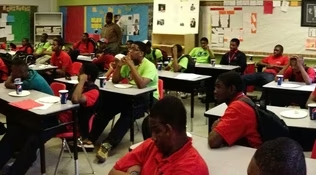
This episode features Simon Gratz High School and West Philadelphia High School. (28m 51s)
Providing Support for PBS.org
Learn Moreabout PBS online sponsorshipMajor funding for this program was provided by-- [INTERPOSING VOICES] --work is around $600,000.
[INTERPOSING VOICES] --60%-- [INTERPOSING VOICES] --here.
[INTERPOSING VOICES] --the community of West Philadelphia.
[INTERPOSING VOICES] --that I have to tell about my community.
People are saying, I'm here.
I'm alive.
I exist.
I live up there.
I live up there.
I live up the street.
I live right there.
I live up there.
[ Music ] [ Noise ] >> Next stop, 40th Street.
This is a story of the people's townhomes.
A legacy spanning four decades and several generations.
Binding together a community of residents and activists who sought, who still seek, to preserve a sanctuary that represents one coalescing instance of the dream of housing justice.
The townhouse was wonderful.
It was a place that everybody wanted to be as far as I'm concerned because everybody that walked past or rode past seeing the development there, people was putting out applications to move there with their children for a good start.
And it was a good start for me.
My kids was able to go out and play and be surrounded by the kids of the neighborhood.
I moved to the townhouses.
It was a safe environment there because it was gated in.
I didn't have to worry about my children.
I didn't have to worry about being on a city block anymore.
You know, I felt more safe when I got to the townhouses.
And then I got to raise my kids without worrying about them all the time or worrying about me.
Like sometimes I'll be like, "Why you with that little kid?
Like she ain't your age."
But it's not about that.
That little kid is looking up to that big person.
And that big person is helping that little kid and taking that kid in to teach them like, "Hey, you can do this.
Let me teach you how to do that.
Do this this way.
Don't do it this way because there's consequences to that."
You know, these kids are literally teaching each other and they're teaching each other in a healthy way because they're creating fun.
So these little kids, when they look up the younger ones, all they see is fun, fun, fun.
So that give them a sense of happiness with inside and some type of groundedness and freeness.
They give them the opportunity to speak on how they feel.
>> Where is the community at?
Like y'all are stripping down houses to put up these, like y'all putting up, y'all not putting, nothing's being put up conducive for anybody in the community.
And that's where you start to see when you don't build for the community, the community disappears.
Because when you start taking away from the community, then what's next?
You go after the community itself, and that's really what's been done in the last two decades.
Look what it's come down to.
They put up all these buildings for the universities and for the people of the university, and then what goes down?
The lesser stuff for the people that have already lived and served this community for multiple years and generations, you see that stuff start to disappear.
First, you see the education start to go.
Then the thriving businesses that people own start to go.
And then you see the communities themselves go after that.
They strip the communities down and then they take the communities away.
And that's really what I've seen the last 20 years, the newness was coming.
And when it hit directly at us, I wanted to make a way to fight it.
And fortunately for me, I was around some good people.
So, you know, the thing that is very beautiful to me about the townhomes fight is that it's resident led, right?
It's, you know, there are people like myself and a few other organizers who are a part of the core, you know, team, right?
And then of course, many hundreds of supporters, but we follow the lead of residents and we've been extremely clear about that.
And that is necessary with this kind of fight.
This is not something for outsiders to come helicopter into.
And so I think, number one, being resident-led is a huge strength of this fight.
Another thing is it's intergenerational.
We have grandmothers, we have great-grandmothers, we have children who are a part of this, we have people who are mothers, we have people who are caregivers, and so I've never been a part of an organizing space that had such deep intergenerational organizing.
The intentions of that building when Mr.
Altman, the father, was to have alternative living and he fought to keep it that way until he died.
It was only when the son took over that that promise was gone, was no longer valid.
I'm down for the college.
I hoped and prayed that my children would have went to college, but they didn't.
One of them did, but the other two didn't.
So I love college.
That's a good thing.
But they just took so much from us, like living there.
It just hurts.
I really feel like crying a little bit right now.
But we know we don't own the townhomes.
They could be sold anytime, whatever.
We don't have documentation saying we can live here forever, no.
But it was our community.
It was... I don't understand.
If greed is that way, if money is that way, I don't want it.
But yeah, I think the coming into consciousness was really just over the decades of working at Penn and seeing how much harm is done by a university that's this wealthy in the surrounding areas and then kind of coming to a head in the summer of 2020 with all of the uprisings and then learning about this really amazing community of several hundred multigenerational families who are about to lose their home.
It was something that's happening in the backyard here at the university and it just got to the point where I didn't feel like I could sit by and let this happen.
So I just got more involved with the townhomes.
No, because I'm on a fixed income.
And this area, we were living so good here on fixed incomes.
And then they said that they wasn't going to renew, you know, HUD's lease.
So I know we had to go.
Well, we had protests.
We had, you know, the council people.
We were down city hall.
We really tried hard.
A lot of people really tried hard, but it didn't materialize.
Coming home, a feeling that never gets old, to come home to the town homes, where together we formed a community of resistance, of determination, of recognizing that together we could, with our collective will, stand up to displacement, where together we all declared, "We ain't going nowhere."
[Music] Well, to begin with, I'm a former resident, and I am a member of the Resident Council, which is an outgrowth of coming together of then residents before we vacated the premises to form a body that in conjunction and with the support of the organizers, there are a core number of organizers and general supporters, came together to advocate for the retention of the complex and the retention of the units as affordable housing units as they were.
Unfortunately, we lost that battle.
What we did come away with was more time for people to vacate the premises, which is pretty important, especially in light of the fact that many persons, it took a while for many of the former residents to get their housing vouchers and to transfer to somewhere that was then satisfactory.
To the extent that one can claim it as a victory, essentially a fifth of the property being retained with the commitment to put affordable housing units, the same number because it was 70 units, in Albeit a smaller space, but the important thing being the facilitation of those units for people who need them.
My most direct role was as the editor of what has been submitted for viewing as a part of the Precious Places project.
The effort was spearheaded and principal photography was done by Quiche and I worked in conjunction with them from time to time.
The period that cemented the campaign was when we mounted an encampment during the better part of July 2022.
We got the notification that we were being evicted in 2021.
We had a year.
And the support that we got from members of the student body, from Penn, some from Drexel, others from probably other institutions, because we are at 40th and Market.
There was an extended period that causes the five trolley routes to be diverted, where 40th and Market becomes a boarding.
There was an assemblage of folks using those routes every evening, so they would venture over because they saw that this was happening.
One of the important component factors of that particular location and that particular community is that for two and a half generations, families have grown there and many persons who grew up there and left have come back because it was intergenerational.
People were together from the sandbox to the graduation gown.
That's not a small thing, you know what I mean?
And so a lot of folks, even if they haven't themselves lived there or had family who lived there, there are that many degrees of separation between the place and many persons in the community.
And above and beyond that, what it symbolizes as an oasis in what is increasingly a desert of affordable housing, especially for communities of color.
And I'd like to think that at the end of the day, despite what we've lost, and we've lost a lot, what we're able to pull from this will remain a beacon of hope that struggles are worth it.
Major funding for this program was provided by... (music) When I came here, it was just myself.
I was the only server.
[MUSIC] >> This story is only one small section of one family's experience with houselessness.
[MUSIC] >> Across this country, housing for elders or senior citizens is a very serious problem.
Many senior citizens, many elders live on fixed incomes, whether social security or retirement or what have you.
So they have a lot of difficulty finding affordable, adequate housing.
>> I moved here in 2011, September of 2011.
So I've never lived in this type of setting.
But it was just mind-blowing that you treat people like this.
You know, it's supposed to be affordable, decent, but it's almost like you're trying to break people's spirit.
That's what I see happening.
I live in a one-bedroom apartment that I love.
I have a 55-inch TV on my wall and I watch my Eagles.
When I look out my window during the summer, I can see the fireworks from the parkway.
I moved to Brith Shalom in March of 2017.
At that time, things were really good.
It was thriving.
We had different ownership.
When they lost their renter's license, they got so mad that they shut everything down.
- One thing I've seen is the fact that private equity groups will go and purchase residential property and will then turn it into a slumlord property.
So in other words, they extract the value out of a property and they have residents continue to pay rent, but they don't make any building repairs, they don't even use that money to pay the utilities, and whatever happens to the residents is what happens to them.
It's just disturbing to see how certain groups of people just are treated like they're disposable.
I've seen extensive water damage in many units, even in common areas like the lobby.
I've seen infestations, severe infestations in people, in different people's apartments.
I've seen electrical wires hanging out of people's ceilings in their apartment because the maintenance team is not available to come fix it for them.
So I've seen a lot of residents suffer because of that.
And no air conditioning, sometimes no heat in the winter.
Elevators aren't working.
So if someone has a medical emergency, EMTs can't get in the elevator to help give that person help.
They had the fire escape doors locked during a fire so that nobody could get out.
This is the state that the previous owners left this building in.
This is just the second floor alone.
Take a good look at it.
Take a good look.
Being a profit-driven capitalist society sees housing as a profit-making thing and not something that is truly a human right.
If housing is indeed a human right, we should not have to have these battles about housing.
We went to court all summer long.
A lot of our tenants went down to City Hall to fight for our right to stay here.
There were senior citizens and people with health challenges who lived in that building, but they were not just sitting there being senior citizens and having health challenges.
They were organizing.
They were trying to form a tenants association.
They were trying to do a lot of things, but people didn't listen until it got that bad.
And when it got that bad, somebody's life could have been in danger.
And I do believe that something has to change.
I think that the people that they have involved in these board meetings and making major decisions, they need some help from people in the trenches.
I'm really hoping that more tenants in this city will join the Philadelphia Tenants Union, form a tenants association in their building, form a tenants association among tenants in various properties of a single landlord so that we can really live with dignity and without fear of being evicted.
Primary Source is a national participatory community media effort with respect to journalism.
It's a journalism effort.
It's an effort to have the voices of people, perhaps around a particular topic, but to have that topic expressed through the voices of the people with respect to those things that are dear to them.
And in this case, it was a decision on the part of a small group of people at Scribe Video who said, "Let's look at housing as a general topic."
And then it just sort of became smaller in terms of, "Let's look at an aspect of that," which became elder housing.
And then, based on information that we had, elder abuse in housing.
Elder abuse in housing came about as a result of years of housing and gentrification work between myself, Jacqueline Wiggins, and others.
As we looked at housing, we started realizing that seniors were becoming very vulnerable because nobody was talking about it and no one was looking at it.
When Scribe asked us to come to a meeting to talk about quality of life issues and the issue of housing came up and then it sort of became a little bit broken down to let's look at elder housing.
The Brith Shalom issue was one that was sort of like on the table, if you will.
And so the process was that we met at Scribe.
We met together.
We met with the DSA young people.
We met with and were introduced by the DSA people to some of the folks that live, the residents at Brith Shalom.
And so in meeting them and also going to a protest, I think we went to a protest even before that.
And when we went to the protest, you see these elders in wheelchairs and with canes, veterans marching, you know, marching around and saying things like, you know, we need rent control, we need repairs.
I am a person with a chronic illness.
Housing, to me, is one of my pet peeves because of that.
Without housing, anyone with any type of illness at any point in time, that becomes a health hazard.
The specific work was trying to identify people and then working with Scribe and with Will, Will Michael, Charlie Robitaille, Marcus Rivera, and having them just be right with us.
- The questions were very important going to those locations and finding those right locations to have the conversations with the tenants to show how they cared for where they lived and how they liked where they lived with the exceptions of all of these other issues that they were having.
And the editing was very crucial because it's one thing to get a bunch of facts and have conversation and have people do a Q&A, but we needed to show how they felt.
This is something that touches, you know, you mentally, physically, financially as well.
And we can't dismiss that financial aspect.
They're still paying rent.
So my understanding is that currently, the tenants are being asked to leave in order for the building and the structure to be repaired or developed.
We still maintain our resilience, our courage, and our determination that we're going to navigate this.
And this is what I found with the Brith Shalom group.
They were navigating big time.
They were serious.
They were focused, they had gone to city council, they were prepared with their signs, they were willing to talk to us.
It's a disgrace that we don't, you know, cherish our elders and we don't cherish housing, especially in a city that used to be known, number one, for home ownership and, you know, things of that nature, where you now have the elderly population being on the number one list for homelessness and housing abuses.
Brith Shalom is not the only place.
Housing is a right that everyone should be housed.
It's like everyone should be fed.
But there seems to be this segmentation in terms of, maybe it's our thought process, I'm not sure, but at some point in time, we've got to say, "Enough.
People will be housed and they'll be housed decently.
And they will have water and they will have food and they will have those quality of life issues so that you can have a life.
















Support for PBS provided by:
WHYY Presents is a local public television program presented by WHYY