On Stage at Curtis
Serena Wang | Piano Classic Sound
Season 20 Episode 5 | 26m 34sVideo has Closed Captions
Pianist Serena shares her artistry and journey at Curtis.
In this episode of On Stage at Curtis, pianist Serena shares her musical journey and artistry at the Curtis Institute of Music. With precision, passion, and a distinctive interpretive voice, she brings depth and energy to every performance. Go behind the scenes to learn how dedication and creativity shape her evolving sound both on and off the stage.
Problems playing video? | Closed Captioning Feedback
Problems playing video? | Closed Captioning Feedback
On Stage at Curtis is a local public television program presented by WHYY
On Stage at Curtis
Serena Wang | Piano Classic Sound
Season 20 Episode 5 | 26m 34sVideo has Closed Captions
In this episode of On Stage at Curtis, pianist Serena shares her musical journey and artistry at the Curtis Institute of Music. With precision, passion, and a distinctive interpretive voice, she brings depth and energy to every performance. Go behind the scenes to learn how dedication and creativity shape her evolving sound both on and off the stage.
Problems playing video? | Closed Captioning Feedback
How to Watch On Stage at Curtis
On Stage at Curtis is available to stream on pbs.org and the free PBS App, available on iPhone, Apple TV, Android TV, Android smartphones, Amazon Fire TV, Amazon Fire Tablet, Roku, Samsung Smart TV, LG TV, and Vizio.
Providing Support for PBS.org
Learn Moreabout PBS online sponsorshipIn partnership with the Curtis Institute of Music, WHYY presents the following program.
[upbeat music] My name is Serena Wang.
You can also say Serena Wong.
?
?
I'm a pianist, and I'm studying Bachelor of Music in Piano.
I've always had different kinds of explorational interest during my growth, but definitely Curtis is the institute that I've heard of since growing up, since learning piano, since I had a memory.
[Piano music] I will say like one third of the time during the day I take classes.
Some days like Tuesday for me is more packed so probably more than a half of the time I'm taking classes.
But other than that I just practice.
Definitely it tells me how to, it teaches me throughout the years like how to organize my time if I have many repertoires.
It's like a real life experience.
How do I prepare for it?
When I have concerts, how do I prepare for it?
We also have on-site concert opportunities.
So that's a very prestigious way to try out or run through a repertoire before I play off-site.
So definitely there's a lot of development for one to be able to go into the field and prepare themselves as a full-time musician.
I have a lot of interest in different genres of music.
They're all amazing, they're all fascinating.
Some of them is just further than what I was training because starting as a kid, of course, the conventional training is classical music and I just always followed the path.
Very good.
Let's do it one more time.
A little bit more on dynamics, okay?
Of course it has inspired me and fascinates me all the time.
It was always like a field trip to me by playing piano because as a kid, you know, you're sort of interested and curious about everything.
So I guess piano was just a part that would take off my parents' work because whenever I practice, I don't have to run around in my house.
Yeah.
Well, every performance is memorable and different no matter what kind of the venue is, no matter what kind of settings it is, but just at the moment I will say your personal emotions are different, the challenges might be different.
Let's say I've once played Rachmaninoff Paganini Variations in an outdoor setting in Hong Kong which is very humid and it was by the harbor.
So I remember by the end of the piece I was just thinking how would I be able to get it through.
So that was a challenging part but afterwards whenever I think about it or the next time when I have such settings I would have more experience in it.
There are also sometimes that your challenges might be different you might be playing a unconventional piece or you just feel a little bit further from the music but that's when you would have to adjust yourself and also what is fun about performances is the spontaneous reactions of the venue the acoustic and also the audiences and if you're playing with an orchestra or other musicians it's about the interaction.
orchestra only; no vocals.
orchestra only; no vocals.
orchestra only; no vocals.
piano only; no vocals.
I have both musician friends and non-musician friends, actually probably more non-musician friends, so, but they all had a great passion in classical music.
They always support me in performances, concerts, so let's say when I have a concert here, they will come to support me whenever they can.
[MUSIC] They sort of witnessed me, my growth, my education at a very young age.
I'm very lucky to have these very long time friends.
It was just naturally like a flow that they grew with me.
But it was more, they didn't have any reactions.
They just sort of supported me whenever.
Besides supporting, well, they always try to give me the most encouragement throughout all the time.
And then they are quite laid back.
So whenever I'm under pressure or whatever, and when they sense it, they will always be like, "You're fine, you know, it's not the end of the day.
You have many, many other things that you can do, so just go towards whatever you want."
And that actually helped me a lot during the years because I can have myself more into the music itself, rather than worrying about a lot of other things to add on the pressure.
Tchaikovsky first piano concerto which is very well known.
This is probably my first repertoire that I've heard in a live performance, in a live concerto performance.
So yeah, it's fun to just explore all the possibilities.
[MUSIC - "POMP AND CIRCUMSTANCE"] [PIANO PLAYING] [PIANO PLAYING] [PIANO PLAYING] {PIANO PLAYING} [MUSIC PLAYING] As a pianist, we don't really have orchestras.
So in that case, I don't have that much auditions compared to other instruments.
But of course, to get in any institute, everyone has to audition.
Yeah, that's it.
So audition isn't really a big worry as a pianist.
I don't know if that's good or if that's bad because we don't have orchestras.
Classical music is what I trained in throughout the years.
There's so many genres that fascinates me.
Jazz, pop, R&B.
I listen to those all the time.
Of course I would love to see opportunities for crossovers and it's something that always keeps me excited about.
[Piano Music] Not only enjoy it but to be able to put my fingers on the key and to collaborate with these opportunities so I can definitely see myself keep on exploring in different genres.
[music] Well, I feel like every space is very precious and important and for me what I always look forward to or that thrives me the most is like the response and the response at that moment when I'm playing something with the with the people with the audience and with the space so when that aligns and when that sparks that creates its own venue and that's creates its own remarkable values so we went to we played five or six concerts it was all in Europe.
Started in Belgium and then we went to France and went to Spain and we ended in Germany so as a pianist I was lucky because I get to play through the whole concert and then we had the great pleasure to have Mr.
Gary Hoffman with us and I had the specific honor to play Debussy cello sonata with him as the opening piece of our concerts.
So that was amazing and the whole experience was very well organized.
We were taken care of during the whole time and venues were great.
It was a constant exploration because you have this set of repertoires that you're performing constantly, like consecutively, sometimes maybe once in a row, sometimes maybe we have one day off, but within that kind of setup, you get to explore the specific repertoire even more precisely because you're fresh, you remember what happened yesterday, and then you want to maybe leave something or you want to take something with you the next one and then of course there is always fireworks that happen at the moment and then it's just well and fresh and super exciting to experience at the moment but also think about it right after and then decide on the next one.
Trying to narrow it down to the least I can but the most precise I would say it's a it's a mental journey I think at that moment what you're dealing with is just yourself of course if you're playing concerto you have to but all that is in your own mind and I sometimes feel like there's ten Serena's fighting against each other try to defeat all nine or combine them into one so that I can have this most precise string of focus into the music itself and into the concentration (piano plays softly).
I would say I would tend to go into old recordings, maybe just keep that, yeah, like Horowitz, Rubinstein.
It depends on the repertoire also, and contemporary artists, of course there's a lot.
It depends on what kind of genre.
Well, I guess the shorter time frame I might have precise thoughts or ideas that I want to explore no matter if it's masters or going out exploring more career life.
And then I think the long-term goal that I set for myself is less like a goal because it's just a picture that I would like to become.
And I hope that no matter what it turns out, I still have what I carried for me for the past years and what was my initial beliefs of not only music but also the world.
So to become such a person or to keep on striving in framework of a picture that I set for myself.
[MUSIC] I have the upcoming concerts for next season and then the following season is still planning.
But I'll be bringing some very challenging but also classic repertoires to the audience.
Like this upcoming two years at least I'll be bringing the standard and classic war horses that we say in the classical repertoire.
So stay tuned for that.
[music] Younger self, you're doing great.
Continue, keep exploring.
Don't worry that much.
I guess I can take the same thing to the future self, because that's something that I think I hope that I carry on forever.
Future self, I hope you still have what you had.
I hope you still carried on what you carried, what you meant to have.
And I hope you're being authentic and sincere all the time.
[MUSIC PLAYING] [BEEP] We're on.
And this is the pickup number two.
Sean, can you just turn it a little this way?
Perfect.
[Beep] Uh-uh.
No.
[Beep] I can.
Yeah.
Okay, so let's say stack it for this one.
Excuse me?
No, I'm talking to them.
Sorry.
[Laughs] [Music]
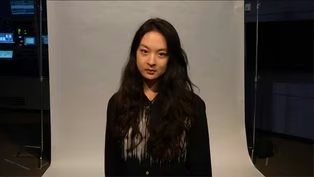
Preview: S20 Ep5 | 33s | Pianist Serena shares her artistry and journey at Curtis. (33s)
Providing Support for PBS.org
Learn Moreabout PBS online sponsorship

- Arts and Music
The Best of the Joy of Painting with Bob Ross
A pop icon, Bob Ross offers soothing words of wisdom as he paints captivating landscapes.





 New Episode
 New Episode


Support for PBS provided by:
On Stage at Curtis is a local public television program presented by WHYY