On Stage at Curtis
Hannah Chen | Harp Melodic Tune
Season 20 Episode 7 | 26m 46sVideo has Closed Captions
Award-winning harpist Hannah continues her journey at Curtis.
In this episode of On Stage at Curtis, meet Hannah, an accomplished harpist whose talent has earned top honors at major competitions, including the United States International Music Competition, the New York International Young Musician Competition, and the BACAHS Yvonne LaMothe Schwager Competition. With numerous national awards to her name, she now continues her artistic journey at Curtis.
Problems playing video? | Closed Captioning Feedback
Problems playing video? | Closed Captioning Feedback
On Stage at Curtis is a local public television program presented by WHYY
On Stage at Curtis
Hannah Chen | Harp Melodic Tune
Season 20 Episode 7 | 26m 46sVideo has Closed Captions
In this episode of On Stage at Curtis, meet Hannah, an accomplished harpist whose talent has earned top honors at major competitions, including the United States International Music Competition, the New York International Young Musician Competition, and the BACAHS Yvonne LaMothe Schwager Competition. With numerous national awards to her name, she now continues her artistic journey at Curtis.
Problems playing video? | Closed Captioning Feedback
Where to Watch On Stage at Curtis
On Stage at Curtis is available to stream on pbs.org and the PBS app.
Providing Support for PBS.org
Learn Moreabout PBS online sponsorshipIn partnership with the Curtis Institute of Music, WHYY presents the following program.
[upbeat music] [upbeat music] [upbeat music] My name is Hannah Chen.
I play the harp and I'm a second year student at Curtis.
[Harp music] Sometimes I think about playing classical music for classical musicians, for like a classical musician audience, is really valuable.
I also have a desire to just like take my classical music foundation and really work in like more of the mainstream media, like the Hollywood audience.
[Harp music] I was naturally very curious and very fascinated, but I also didn't have a lot of discipline.
I was a little bit of a wild child.
[Piano Music] So I would always end up like improvising off of the pieces that I was working on.
And I think it was a combination of lack of focus and also a desire to create something and compose.
[Harp music] Then I started composing formally and at the same time I also started playing the harp.
And when I started playing the harp I felt sort of like a connection to the instrument.
I felt like it was very much an extension of me.
It felt very expressive.
It felt very natural.
So throughout my early training, the three foundational pillars of my musical journey were harp, composition, and piano.
I don't have any musicians or artists in my family.
It's just me and I'm the oldest sibling.
So when I started playing music it was something that was really new to everyone.
(Harp music) A lot of the times they act impressed as if I was doing rocket science or something.
But I think with harp specifically, there's also another element of shock factor because it's so unique.
And so, like, even if I sounded really atrocious, I think just the fact that I was doing something that was so specific and unique was really jarring for some people, so they were impressed anyways.
I don't know.
When I look back at my videos when I'm seven years old, it sounds pretty atrocious to me, but overall, my family was pretty impressed, since I was the only one doing something like this.
(harp music) When I was younger, I didn't really know anyone who was playing music, let alone harp.
So it was kind of hard to connect with other peers when I was younger.
I felt very out of place sometimes, or just I didn't really have much in common with a lot of people.
And then I ended up going to an art school for high school.
I went to Oakland School for the Arts and that was the first opportunity where I was surrounded by other artists and other creative minds.
And then simultaneously I enrolled in the San Francisco Conservatory of Music Pre-College where I had a community of classical musicians for the first time.
And it was such a valuable experience and I think what I've really took from that is that being around other artists and musicians or creative people is really inspiring and really pushes me to challenge myself to new goals, new projects, and I've learned that I really value being in that kind of environment.
[Piano playing] I play piano recreationally.
I continued with piano, harp, and composition pretty evenly throughout my high school training and even before.
And I didn't really prioritize one over the other.
I was trying to make it sort of equally prioritized.
In hindsight, harp was always the thing that took a little bit more priority than everything else.
But overall, I was really focused on building these three different but interconnected musical skills.
And I think they all sort of helps me shape my overall artistic identity and my artistic voice.
And now that I'm just doing harp as a major, I'm kind of in this transitional phase where I have these other interests, but I don't need to pursue them through a curriculum or through any sort of rigorous course load and I'm sort of in this environment where I'm free to be able to pursue what I want when I want to and I think that's really freeing and really liberating almost creatively to be able to pursue this at my own pace.
This performance is an etude by Godefroid.
[Harp music] It's a very technically challenging piece, so I think the hardest part about this was getting my technique solid enough to be able to phrase freely and musically.
And it's kind of like a very tedious piece, it's very repetitive.
(Harp music) Back in the Bay Area, I would curate a series of concerts at senior homes across the East Bay.
And I think those were the settings where I felt most comfortable and at home with performing.
I think in a lot of high pressure situations, sometimes I end up losing sight of why I actually enjoy performing and why I love playing music.
But in this sort of setting where the only intention is to bring some happiness to a fellow community, I feel like that's actually when my playing becomes the most expressive and precise.
There's no nerve, there's no judgment, it's just very pure intentions and it's always just the most rewarding experience.
(Harp music) I don't know if there was a particular moment where I decided to be a classical musician or that I knew that this was what I wanted to pursue.
I think like music was just a super foundational part of my upbringing and I started so young and I just can't picture myself not doing music.
I knew that wherever I went for college, whether that be a conservatory or a university, I knew I would be pursuing music to some extent.
I never really had a dream school growing up.
I definitely always knew about Curtis and it was kind of in the back of my mind of like, "Wow, this is an amazing school and if I could get in that would be really awesome.
I would love to go."
But I wasn't really set on it because I also had these other interests that I was pursuing musically and I didn't know if I wanted to zero in just on performance or on composition or take an academic route and do music on the side.
[Music] I was also considering possibly like triple concentrating in an academic field of harp and composition.
So it was a really tough decision for me because I didn't really know where my interests lie.
And I didn't know what kind of college environment would have been best for me.
So I was really contemplating between the conservatory path and the university path.
[Music] I was majoring in composition at the pre-college before I came to Curtis and I think a lot of my compositional foundations are really giving me other benefits even like through performance or through any sort of musical project I'm in.
[Music] Now I kind of just experiment on my own and I use summers and other opportunities to be able to compose at my own pace.
I composed a piece recently this summer for flute, harp, and viola which is one of my like dream ensembles.
It's such a great ensemble and it was really amazing to be able to compose again.
This was the first piece I've written since coming to Curtis and it was a really valuable experience to be able to work with performers live and it's always so amazing to see your music come to life and see the process that comes with that.
[Music] Some of the top qualities that make great classical musicians are empathy, curiosity, and humility.
I think these three qualities complement each other really well and create for very deep connections to the music and I think that's the most important thing to be able to both connect with a piece of music and also an ensemble that you're working with.
[Music] When I'm preparing for something or learning a new piece, I definitely have to have like a specific goal in mind, whether it be more tangible or just more of a conceptual goal.
I think that having a goal and being able to visualize it really helps me, not only motivate me, but also with my nerves so that when the event or the performance actually rolls around, I've thought about it so much that it almost seems comfortable.
[Music] Through this piece I tried to capture the blurred imagery of sunlight dancing on water [sound of water splashing] to create sort of like an atmospheric sound world that just flows and stays stagnant and then moves again and transitions between those two things.
I genuinely love performing everything.
I don't really have like anything that I don't like because I think each experience or each piece that I'm learning gives me a different set of skills that I possibly didn't have before.
So like right now I'm really focused on just expanding my repertoire of the standard harp classical works.
And there's a lot of range within that repertoire, but at the same time I really love new music and playing new music, especially with my background as a composer.
Before coming to Curtis, I was really exploring like specifically film music.
I wanted to be a film composer for a really long time.
And you know, that's definitely something I'm still sort of interested in.
But I was really sort of immersed in learning how to score for picture, learning how to use electronic elements to accompany that.
That's definitely still something that I'm interested in and really love to play around with.
I mean, I'm not studying it right now and I'm not really actively pursuing it, but it's definitely something that I'm really interested in.
I would love to collaborate with Chapel Rhone or Beyonce.
That would be really cool, just to have a cool little solo moment or like even write something and like a little snippet of a song or something.
I don't know, I think it's always fun when like classical music like bleeds over into the mainstream media or if like L.A.
Phil plays at Coachella or something like that.
I always think that's so exciting and it's so valuable to you know play classical music for a classical music audience but I think it's also really valuable to be able to play it for this more like normal people like a mainstream audience where you know maybe they've never seen an orchestra before and this can be their first time being able to see it and it can be a lot more digestible if it's like in the realms of something they're already familiar with like pop music and pop music is I enjoy it I think it's great [Harp music] There's a lot of things that I would want to do after graduation.
I think one of my main goals is I would love to do a big recording project and create sort of like a portfolio of new works and you know just like some of my favorite things and some of my favorite works for harp I think that's a project that can really combine my interests in a lot of these different facets including performance, composition, music technology and so I would really love to work on a project like that.
I think in 10 years my idea of where I'll be is a little bit blurred.
When I was younger I liked to plan it out really really specifically and methodically and now that I'm here and I'm kind of just in this immersive environment with so many wonderful opportunities and musicians I'm sort of trying to like let go of that a little bit and just see what opportunities arise as they come.
[Harp music] I would tell my future self, I hope that I haven't lost sight of why I am pursuing music and why I enjoy it so much.
I would remind my future self of just like the little girl who was so interested and fascinated and couldn't get enough of all these different musical outlets.
And I hope that in 10 years time or even longer, that I will still hold that joy for music and that passion.
(soft harp music) When I was younger, I was a little bit like scatterbrained and I was really loud and a little bit weird and very expressive.
You know, that's totally fine and that's totally okay.
But at the same time, I also had like a lot of focus issues.
And I think I would tell my younger self, try to prioritize focusing on one thing a little bit more.
It's always great to have separate interests, but I think especially coming to Curtis now, I've realized that really immersing yourself and zeroing in on one specific skill for a certain period of time is the way that you achieve excellence in that skill.
And so that sort of dedication and discipline is extremely important in achieving success in any particular field.
[harp music] [harp music] [harp music] [Harp music] {appluase} [applause] [music]
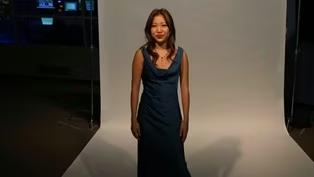
Hannah Chen | Harp Melodic Tune
Preview: S20 Ep7 | 34s | Award-winning harpist Hannah continues her journey at Curtis. (34s)
Providing Support for PBS.org
Learn Moreabout PBS online sponsorship
- Arts and Music

Innovative musicians from every genre perform live in the longest-running music series.





 New Episode




Support for PBS provided by:
On Stage at Curtis is a local public television program presented by WHYY