
Malala Yousafzai: In Conversation with Terry Gross
Special | 1h 26m 46sVideo has Closed Captions
Nobel Peace Prize laureate Malala Yousafzai accepts WHYY's 2026 Lifelong Learning Award.
WHYY honors Nobel Peace Prize laureate Malala Yousafzai with the 2026 Lifelong Learning Award. This special event features an interview between Malala Yousafzai and Terry Gross, host of Fresh Air.
Problems playing video? | Closed Captioning Feedback
Problems playing video? | Closed Captioning Feedback
WHYY Presents is a local public television program presented by WHYY
Malala Yousafzai: In Conversation with Terry Gross
Special | 1h 26m 46sVideo has Closed Captions
WHYY honors Nobel Peace Prize laureate Malala Yousafzai with the 2026 Lifelong Learning Award. This special event features an interview between Malala Yousafzai and Terry Gross, host of Fresh Air.
Problems playing video? | Closed Captioning Feedback
Where to Watch WHYY Presents
WHYY Presents is available to stream on pbs.org and the PBS app.
More from This Collection
The WHYY Lifelong Learning Award recognizes an honoree who has demonstrated a passion for lifelong learning for themselves and for all those they can inspire. Previous recipients include President Joseph R. Biden, Dr. Anthony Fauci, Dr. Henry Louis Gates Jr., Gwen Ifill, Coach Dawn Staley, Lidia Bastianich and more.
James Patterson in Conversation with Terry Gross
Video has Closed Captions
Renowned author James Patterson accepts WHYY's 23rd Lifelong Learning Award. (27m 19s)
Yo-Yo Ma in Conversation with Terry Gross
Video has Closed Captions
Renowned cellist Yo-Yo Ma accepts WHYY's 22nd Lifelong Learning Award. (58m 45s)
Lidia Bastianich: WHYY Lifelong Learning Award 2023
Video has Closed Captions
Chef, television host, and restaurateur, Lidia Bastianich accepts WHYY's 21st LLA. (28m 45s)
Terry Gross in Conversation with Dawn Staley: Full Version
Honoring Olympic gold medalist, NCAA-winning coach & Basketball Hall of Famer Dawn Staley (1h 27m 4s)
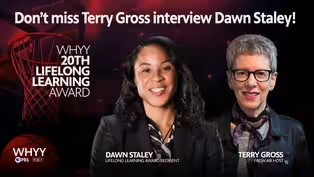
Terry Gross in Conversation with Dawn Staley
Video has Closed Captions
WHYY 20th Lifelong Learning Award recipient Dawn Staley interviewed by Terry Gross (28m 45s)
WHYY’s Lifelong Learning Award honoring Dr. Anthony S. Fauci
Special virtual event honoring Dr. Fauci. (1h 6m 50s)

WHYY’s Lifelong Learning Award: Dr. Anthony S. Fauci VIP Q&A
Special virtual event honoring Dr. Fauci. (1h 35m 4s)
WHYY’s 17th Annual President’s Dinner
Video has Closed Captions
WHYY’s 17th Annual President’s Dinner featuring Dr. Henry Louis Gates Jr. (28m 47s)
Video has Closed Captions
The 2017 WHYY President's Dinner honoring Joseph R. Biden, Jr. (56m 46s)
WHYY's 15th Annual President's Dinner
Video has Closed Captions
WHYYs 15th Annual Presidents Dinner Honoring Joseph Neubauer (28m 47s)
WHYY's 2014 President's Dinner, Honoring Kenneth Gamble
Video has Closed Captions
Proceeds from this distinctive event support WHYY's extensive educational initiatives (27m 20s)
WHYY's 2013 President's Dinner, Honoring Terry Gross
Video has Closed Captions
WHYY turns the tables this year and honors Fresh Air host Terry Gross. (23m 13s)
Providing Support for PBS.org
Learn Moreabout PBS online sponsorship[ Music ] >> Some breaking news out of Pakistan.
>> So that girls could go to school.
>> The attack has shaken the country.
>> Citizens around the world are standing.
>> Right to the highest levels of power.
>> They thought that the bullet would silence us, but they failed.
>> Nobel Peace Prize for 2014 is to be awarded to Malala Yousafzai.
When Yousafzai herself took the podium, she underscored her message that education is a fundamental right which comes with responsibility.
I'm Peter Crimmins, WHYY News.
>> I was covering the 2014 Liberty Medal Award for the news.
This is a really highly produced and very formal ceremony.
And so everyone comes on, all these signatories come on, take their seat on stage.
And then the president and CEO of the Constitution Center, Jeffrey Rosen, comes on and says, "Tonight we're honoring Malala Yousafzai."
And everyone applauds.
And she's there with her speech in her hand, her papers of her speech.
And she gets up out of her chair and she approaches the podium.
And then Jeffrey Rosen has to say, no, no, no, not yet.
We have an hour of of praise to give you.
And then she goes, she gives a little sign.
Well, it stuck out at me because this was a 17 year old girl who just about a week or so earlier had been announced to be the Nobel Prize winner.
A year before, when she was 16, she's addressing the UN.
She's been thrust onto the world stage and people are eager to know what she's going to say, what she has to tell them about education and about peace and about freedom.
She's this teenager and she had an articulation.
She knew how to speak powerfully, that she could use those powers to do something, something extraordinary.
I'm here to speak for my unheard sisters of Somalia.
I want to see every girl decide their future.
I want every girl to have access to quality education.
Our nation's promised every girl should go to school for 12 years.
I know that politicians cannot keep every promise they make, but this is the one you must honor.
Today, her message of hope resounded among the refugee and immigrant community right here in Lancaster.
Malala was on her girl power trip in Lancaster PA.
That's my hometown.
That's where I was brought when I came from Zambia as a refugee and I love it.
While I was speaking I talked about where I came from.
I talked about the struggles of education.
Talked about losing my mom and that's how Malala picked interest in me.
I received an email saying can you come and speak at the United Nations with me.
I was full of emotions.
I was also excited that my voice, you know, Malala helped me put my voice out there.
That's what it takes to help another girl go to school.
Malala Fund is always there.
They have so many ways you can contribute and feel like you're part of the reasons why people get the opportunity to have a better life.
They motivate girls.
They ask people to be kind to refugees or be kind to girls that haven't got the education.
There was a very important moment when I was in nursing school, when I was struggling.
All that I've been through, I've skipped grades, I didn't start from the foundation.
So all these things were in my head and after the meeting I was like, "Can I talk to you?"
And she's like, "Oh yeah, of course."
So everybody left and it was just me and Malala on Zoom.
And I told her what I was feeling.
I'm like, "I'm scared.
I'm going to fail my exams.
I'm about to graduate nursing school, but if I don't pass this exam, that's it for me."
And she was like, "Marie Claire, you've come this far.
I have no doubt that you're going to do it.
I know you're scared, but I know you're going to make it."
And hearing that from her in that moment in a personal conversation was amazing.
It put me through and I definitely did make it.
But I needed somebody to talk to, somebody that has been through something similar to what I've been through.
So that was great.
Malala is one of the most inspiring and surprising people that I've ever met.
I've worked with a lot of authors over the course of my career.
In working on her book, it was really interesting because she used a personal lens to describe her own educational journey going through Oxford, her trials as a student, maybe got into some misadventures along the way.
You're talking about staying out late, you're talking about crushing on boys, dancing, poker, trespassing on school property, and drugs.
Wow.
To show that the perspective that someone who's as, as remarked upon and as, as, as beloved as Malala is really human.
She is someone who, you know, she she got ghosted by her first crush.
I was giving advice to my friends.
You know, like if a guy is not replying to your texts for three days, it means... That's happening to me, but what do you think it means?
He doesn't want to talk, like, you know, and I don't think he deserves you, like, it's... Hear that?
Yeah.
I absolutely would recommend that young people today seek out Malala's story.
I think that her story is so empowering and I really believe that readers will see something of themselves in her story as well.
I'm Leela.
My name is Kai Johansson.
I'm Alicia Siddiqui.
My name is Libby Matz.
My name is Raven Campbell.
My name is Adiba Noshin.
I'm in seventh grade and I'm reading Malala Yousafzai's Finding My Way.
Well, I can't pinpoint a specific time that I first heard about Malala, but the first time I really learned about her was when I started reading I Am Malala.
I discovered that she is an advocate for peace and she's a very inspirational and interesting The book, it was really fun to read when I saw the cover.
I was like, oh my god She's also hijabi and she's also Muslim and when my teacher Like said a little summary about the book It got me very interested because I'm also very passionate about like equality women's rights and education I feel like Malala kind of has two messages in this book Not only just get the education that you deserve but also fight for it and fight for what's right Something that surprised me was how rebellious she was and so there was one bell tower in Oxford and at night She would climb up it Specifically her father never gave up on Malala's ideas even when neighbors would come by and ask like don't you think?
Like you should tell your daughter to kind of like calm down on all these like actions and stuff like aren't you scared for her?
But her father always stood by her side no matter what and always supported all of Malala's ideas and that really like touched me.
And I'm really happy that she stood up because it showed millions of people that children also have power and so do girls.
Her story is really important because it's really inspiring.
It really teaches people how they can fight for what they believe in and it like it could help some people start to advocate for something that's also really important and help start another big change somewhere.
It's kind of like her quote, "One child, one teacher, one pen, and one book can change the world."
Please welcome Terry Gross, the host of Fresh Air with Terry Gross and Tanya Mosley, and tonight's honoree, Malala Yousafzai.
Malala, it is such an honor to have you here tonight.
I'm so excited to have the opportunity to talk with you.
And as we talk, I want you to keep two more images in your mind.
If you only know Malala through her Nobel Peace Prize, through getting shot by the Taliban, think about her growing up in Pakistan in a fairly remote region, removed from popular culture, but able to occasionally see things that were popular around the world like the WWE, and especially loving watching John Cena wrestling and trying out his moves on her younger brother.
Also think about her climbing the bell tower and just to elaborate on that story a little bit, I know a famous story about Malala.
So when she was living in a four story dorm at Oxford University, she went to the roof of the dorm, jumped three feet across, remember it's four stories, jumped three feet across to the bell tower, climbed the bell tower in her sandals, and then on the way down realized, oops, in order to get back to the dorm roof, she had to jump onto a narrow ledge where there was nothing to hold on to.
Would you like to add an image to that?
I'm just grateful I'm alive and I'm here with you all.
You know, I've made it.
Yeah.
And so nice to be here.
Thank you so much.
Thank you for the honor and good evening, everyone.
It's always so nice to be in this beautiful, warm, welcoming city.
So you and I are we're different generations, we're from very different cultures.
There's so much in your book that I really related to in a much more insignificant way than your life.
But one of the things I really related to was if you're lucky enough to go to college and it's away from home, you have a chance to figure out who you are independent of your family, independent of the friends who knew you when you were a child.
You can grow and transform and take risks, try out different selves and figure it out.
But that can mean defying your parents' expectations, which I had to do in my own little insignificant way and you had to do in a pretty major way because you were in a different culture and you were young you were a teenager and when you defy your parents there's there's a price you pay so my question is which is more difficult defying your parents or standing up to the Taliban I think it wasn't just the pressure of my parents it was the pressure of this whole community that they feel they represent even though we were thousands of miles away from Pakistan but they were still worried about what would our relatives think if they see me having fun in college if they see me wearing jeans in college if they see me with some friends enjoying some music in college or climbing a rooftop in college and for them it was always this anxiety that you know when rumors start about women it is it is like the biggest dishonor you can face in a community and we know the consequences of the dishonor for women and girls like a man's ego and a man's honor lies in a woman's body that she's killed for it.
Honor killing is a real thing that happens in a lot of very patriarchal communities.
Of course, things are changing and I'm very grateful that my parents have stood up for me many, many times.
But just to you know, share one story, which is something I shared in the book.
One day, you know, I went rowing in college, I was trying new things.
And I said, let's give rowing a try.
That was my first and last experience trying rowing, never went back to it.
But I was just wearing jeans and a nice bomber jacket.
And somebody took a photo and uploaded it.
And that photo went viral.
And it caused this huge social media backlash where people were criticizing me from the Pakistani South Asian diaspora for wearing jeans.
They thought it was not Islamic enough.
This was against our culture that I was wasn't wearing traditional clothes that somehow I wasn't just an ambassador for girls education, but I was also an ambassador of the culture, the faith and everything else that I had to meet everyone's expectation that I was somehow upsetting everybody.
And I remember my parents panicking.
They saw us in college.
I'm like, what is happening?
And then I get a call from my parents, and they are asking me if I would issue a statement, defending myself, I would say something.
And I told my parents, no, I'm not going to respond to this at all.
I said that when my brothers moved to the UK, they switched to jeans right away.
My father wears a suit all the time.
Nobody had any problem with it.
But as soon as a girl decided to wear a pair of jeans, it became a whole issue.
So I said, the best way for me to respond to this is to keep wearing jeans.
And yeah, and it's also about women making choices for themselves.
So this is something that I-- it's a difficult battle.
It's not an easy battle.
It's always like a very fine line.
You don't want to cross the line because there are certain voices in the community that are finding an opportunity to say, look, we told you so.
Like an educated woman is a threat to our culture, is a threat to our community.
So I do embrace my culture.
I am proud of what I wear.
I'm proud of my shawl.
I want girls in my community to know that they can also be educated.
They can also be empowered, just like me.
So when they see me in clothes that look like their clothes, I'm sure they can relate to it.
But at the same time, I also want to give this message to girls that it should be their choice.
It should not be someone else deciding it for them.
And you also write in your book, and this is something I also related to, that you felt with your parents, if you didn't draw the line, that you would always be compromising and giving in.
And I'm sure a lot of people listening to this relate to that as well.
But again, we didn't have a whole culture attacking us for it.
Yeah, I mean, it was hard.
And sometimes the best protection for me was that my parents were just not with me at college.
You know, it's like, they just don't know.
And that's the best thing ever.
I loved my college time because I was away from home.
And this was the first time that I had been on my own.
And I was so curious about life.
And I know that these things sound quite basic, like climbing a rooftop, or hanging out with friends or staying up late.
These are not like some big crazy things.
But to me, it felt like I was climbing a mountain, that this was something huge that I was doing in my life because I was making my own choices and I felt that nobody was watching me and that was such a relief.
But yeah, when my parents read the book, then they found out that there was quite a lot happening.
- Another thing I really related to in your book, it's figuring out how to integrate different parts of your life into a whole person as opposed to just having a before and after.
How do you integrate growing up in a village in Afghanistan with two parents who were from a very remote village where there was, I mean, the only internet connection you had was one computer at school when you were growing up.
How do you integrate that with the person you were becoming at Oxford University, this like really important British school, British like major scholarship, privileged students mostly from England and around the world.
Oxford really means how do you integrate those two cells?
You had trouble with that for a while.
I felt really like proud and really happy that I made it to Oxford.
It was my dream college growing up that I could go to Oxford and study there.
And I was living my dream.
And, you know, I, I would sort of walk through the libraries of these beautiful colleges, some of the colleges were 600 to 800 years old.
In America, they tell you that, you know, a college was built in like the 1800 or something, and it's very old, and I'm like, that's a very new college.
That was just built yesterday.
If you go to Oxford, those are pretty new.
You have colleges that have a whole history of how women for centuries were not allowed to study.
The college I went to, Lady Margaret Hall, was the first women's college, and it started with nine women.
The women were not even allowed to access the libraries of all of these men's colleges.
So, they started collecting books for women separately.
So, when I would go to that library, it would feel like, you know, we are witnessing such an important moment in history where women are getting access to education.
It's still a long way to go because we are still advocating for 120 million girls who are out of school or girls in Afghanistan who are banned from education beyond grade six.
But just looking back and seeing how far we have come.
So I really felt privileged that I made it to Oxford.
And of course, it was a dream for me in Pakistan, growing up in this beautiful valley in the north.
I had no idea I would ever make it to Oxford.
So tell us a little bit about what your education was like and I'll preface this by saying You describe your father as a feminist before he knew the word feminism Yes, and he believed in girls education and he wanted to teach so he created a school that started with three students That's the school you went to when you were a girl.
What was your education like?
So my father is a very passionate Educationist teacher.
He was the principal.
He was doing everything.
He ran that school with so much passion to help educate girls.
I valued my education in that valley because there were not that many girls like me who could make it to school.
I already knew that it was very different for me because I had a supportive father.
And when the Taliban took control of our valley, that was when I was just 10 years old.
It was in 2007, they appeared, they claimed that they were the Taliban.
They started imposing these restrictions on women that a woman can't go to a market and she can't go to work.
And then they eventually announced that girls would be banned from school, that no girl is allowed to be in a classroom.
And that was such a big setback for me because I was already feeling so lucky that I had a supportive father and then to imagine that I could, I could never continue my education.
And that scared me because I knew what life is like for women and girls without an education in our community.
They're married off.
They have children by the time that they're 20 and they have like no control, no choice of what they want to do with their life.
And that scared me.
So that's why I became an activist.
I did not even know what activism is supposed to be like.
I just thought that I want to find an opportunity to share my story.
So whenever I saw a person with a camera person with a mic, I stepped forward because I wanted to tell my story.
And I was hoping that somebody out there would hear us and would do something the leaders would do something.
I blocked for the BBC volunteered for the New York Times documentary participated in protests and gave interviews on TV.
And I was just hoping that my voice could be heard somewhere and that things would change for girls in my hometown.
But what was your education like?
What did you learn?
Because you say that when you got to England and went to high school there and then college, that you were taught to memorize facts and not critical thinking.
It's suddenly you were being asked to do critical thinking.
So what what did you learn?
Like what was what was your education like when you were young?
In Pakistan, it's very focused on sciences and then learning English and math.
A lot of it is like Islamic studies, social studies, Pakistan studies, but that was about it.
It's very textbook focused and you don't read books outside your like textbooks.
So in Pakistan by age like 15, I had only read eight or nine books outside my school curriculum and it's only because somebody gifted those books to me.
So I read the Alchemist and like you know one or two other books like that and I was so proud of myself.
When I moved to the UK I realized that kids have big libraries in their schools and they're encouraged to read fiction and you know books outside their school curriculum.
I also found out in the UK that they actually had science labs so they were not just learning about an experiment by just reading about the experiment.
Like this chemical meets this chemical and then this thing happens and you're like, I wonder what that looks like.
Kids here can actually see what it looks like.
So when I would be in a biology class in the UK and in a chemistry class and I could see these things happening right in front of my eyes, I just wish like more and more kids in Pakistan can also see that experiments and like, you know, it's it's like such a privilege.
The other thing which I really appreciated in the UK education system was how they were teaching subjects outside just, you know, sciences and maths, like humanities and arts.
So I realized that wait a second, they teach arts, they teach cooking, there was like a cooking class and a physical health class you would be running around and I was like that counts too.
Music, you're playing, you know, you're singing and it was incredible and that made me realize that education is actually beyond just, you know, what we have thought about, you know, like a few decades ago, you know, the whole industrial times and all of that.
I think we've, it's, it's so important for us to keep thinking about how do we make the right reforms and ensure that it is really preparing the next generation for their future and it encourages critical thinking, it pushes them to have experiences and these experiments so it, you know, helps them really think, like, you know, outside the box, that it's not about what road memorization and I, you know, I was lucky that I got to see the education in Pakistan but also the education in the UK.
So your mother didn't go to school.
She went to school I think for one day and decided her friends weren't in school and she'd rather play with her friends than go to school.
And she was illiterate.
How did she feel about you becoming an education activist on behalf of girls' education when she never went to school herself?
- Of course my mother is very proud of the work that I am doing and that my father is doing.
And I do believe that it is her support and her strength behind us that helped both my father and I to keep on fighting.
But I saw her real resilience and commitment to education when we moved to the UK because now she was in a completely different country, a new culture, a new language, and she suddenly became a dependent on others.
If she had to call a cab, if she had to see a doctor, if she had to speak to somebody at the grocery store, she needed somebody with her to speak in English and she felt very helpless.
She felt like she was just like losing that self of hers, you know, where she could she felt comfortable with with with who she was.
So she started taking English classes, and she's been learning English for the past seven or eight years.
And it's always such a beautiful moment for me at home, when I'm helping my mom with her homework, because usually it is parents helping their kids.
But in our house, it's a daughter helping her mother and it's such a beautiful moment.
She loves her education.
I mean, she's like a role model to students out there.
She never misses her homework.
She impresses her teachers.
And now she can call a cab on her own.
She can go to a grocery store on her own.
She can manage a doctor's appointment.
She's no longer dependent on any family member and that's because of her education.
- So, you know, your father, as I mentioned, founded a school, it was a school you went to.
So he was passionate about education and passionate about it for girls.
And when the Taliban came and took over your area, a journalist, they had a deadline for when they were going to close down the schools.
It was the 15th of January 2009.
And you attended school until the last day, even though I think you're only allowed to go up to fourth grade and you were in fifth grade.
Yes, and we were you know, we would wear just our home clothes.
We could no longer wear our school uniform.
It would give you away.
Yeah, we said like the Taliban should never know that girls are daring to go to a school.
We would wear these long hefty like scarves and just you know, wrap them around our body so we could hide our school bag like any bag will sort of hide so there's no proof of us daring to walk to a school.
And we said that if they ever ask us what grade we were in, let's say they found out, we'll just tell them we're in fourth grade.
They could never prove it.
So we said, you know, we're just we're still like, you know, little girls and but girls were risking their lives to be in a classroom.
Right.
So during that period, I think it was during this period, a journalist from the BBC asked a girl, asked for a volunteer from your school to keep a journal that the BBC could draw on or publish, I'm not sure which.
And one girl volunteered and then her father came the next day and said, "I'm not allowing her to do this.
It's too risky.
She could get killed."
And then your father says to you, "Malala, would you like to volunteer?"
How did you feel about that?
Him asking you to volunteer when you knew it was a great risk.
I mean, it was an anonymous, a pseudonymous blog.
You wrote it under a journal.
You wrote it under a pseudonym.
But how did you feel knowing you were taking on this risk?
And this is before you got shot by a Taliban.
Yeah, so I was 11 years old.
And when I heard that so young, yes, yes.
How could you even know?
How could you even comprehend the risk that you were taking?
You know, my my honest reaction to a question like this is that, like, I wish I was a child.
I wish I knew nothing about these things.
I wish like I didn't have to write a blog.
I wish I didn't have to become an activist.
But that was the lived reality of girls at 11 years old.
They're telling you that just because you are a girl, you cannot step into a classroom.
You cannot have an education.
And I know that, you know, like when when I look back, I'm like, yes, that was a crazy thing that I did.
I put my life at risk.
But at the time, what scared me more was a life without an education as a girl.
It terrified me.
And I, you know, like think about women's struggle for equality, for justice everywhere around the world.
You know, we are we are fighting to protect ourselves against violence against oppression.
Women are literally being murdered and killed.
You know, that's how extreme it is.
Women are denied the opportunity to decide what they want to do with their lives.
So those things scared me a lot more.
And I said, you know, education is that pathway, that hope that I can have, that I can have a better future.
So I said, you know, either way, even if I stay silent, like, I cannot see a future without an education.
So the best thing I can do is actually speak out and see if there is, you know, some hope that things would change for us.
Looking back at your 11-year-old self and your father back then, do you think he did the right thing in asking you to volunteer?
Or should he have been more like the other father who said, it's too risky, I have to protect her.
I think he did the right thing.
I am I am so grateful to have a father who never stopped me from doing what I wanted to do.
And it wasn't just one BBC blog, I wanted to speak to every media platform, I wanted to speak to every journalist.
And I remember that my father would always tell me before every interview that don't mention the Taliban, don't name anybody and just focus on talking points about going to school.
And I'd be like, "Yes, dad."
And then I would go and speak to the journalist and say everything.
I'm like, "It is the Taliban.
They're not letting us to be in school."
And I would name them.
I would name them.
I'm like, what are our leaders doing about this Taliban leader and that Taliban leader?
So there's always something there, you know, that you have to listen to your heart.
And I actually looked up to my father because my father is somebody who has always spoken the truth and he's never been scared.
So sometimes you don't listen to what your father's tell you, you actually see what they do and what they say and you follow that.
Tell the story of how you got your name Malala.
So Malala is the name of this famous Afghan heroine.
She was in the late 1800s.
And she is participating in the second Anglo-Afghan war.
The Afghan soldiers are about to walk away.
They're losing the battle.
And she walks up to the top of this mountain and she raises her voice and tells the soldiers that if you do not struggle today, you will live the rest of your life in shame.
So she encourages the soldiers that this is truly a day where they can prove their honor and they can fight for their freedom.
And supposedly that's, you know, how the story goes that the soldiers fight back and they, and her, and you know, she loses her life at that battle.
So the name of Malalai of Maywan, so she's a heroine from Afghanistan, is very famous in our Pashtun community.
And my father was always very keen on like women having their own names.
Because it was very common at the time in our community where you would go to a doctor and if you were a woman like a female patient and you were asked like, what's your name?
The doctor would write it as like, you know, I would be referred to as Ziauddin's daughter or my mom would be referred to as Ziauddin's wife.
So you were always like someone, something.
You were never yourself.
And my dad was always reflecting on this thing, and he wished that his daughter could have her own name.
So he named me after Malala Yafmaiwand.
The actual literal meaning of the name is grief stricken or sad.
But we don't go with that.
We just go with the good meaning.
Yeah.
What message did it send to you that you were named after a martyr, after a teenage girl who inspired fighters to keep fighting and died herself in that battle?
I was just imagining that battle happening today.
And this is a battle that we are fighting for children to have access to education.
We're not fighting through swords.
We're not fighting through weapons.
This is a fight through books and pens.
And we want every child to have the opportunity to be able to go to school.
So this is different.
And my goal is that the soldiers of today are like all of us, all of us, to come together and ensure that we help every child have access to education.
I will remind you, she dies in the battle.
So far, I'm doing OK.
And yeah, and I, you know, my story didn't go that way, and I'm very grateful for that.
You came really close.
Yes.
And so you had seen some of the horrors that the Taliban were committing.
Do you mind describing some of the things that you witnessed or your friends told you that they witnessed?
It was a very terrible time under the Taliban.
We would hear bomb blasts almost every day.
You would hear shells fired and gunfires because there was the military, there were the Taliban fighters and there's always this firing.
And we would not hear, we would not get even 10 minutes of silence where we could be living peace.
Peace became so precious to us.
We wondered what that day would feel like when you don't hear about somebody being killed or slaughtered by the Taliban.
Somebody's, you know, bodies found at the, at the square, which was initially called Green Square.
And then the Taliban would leave a, you know, a beheaded body there every morning, that it became known as the Bloody Square.
And it was like one of the most difficult times for us because everybody was just praying that you know, I hope this night is not that terrible night that the Taliban walk into their home.
I was always scared about the Taliban walking into our house and then targeting my father.
I was, I did not expect them that they would target like a child.
Because of the girls school?
Because of the school because he was also vocal.
And I thought, you know, they wouldn't be scared of a little girl, but I thought, you know, they would be very frightened about what my dad is saying.
So they might target my father because they were targeting activists.
They were beating women if they dare to step outside their homes.
And a lot of these women are like the breadwinners of their families.
They have to take their kids to a hospital.
Women were not allowed to go shopping anymore.
I mean, like the men who had no idea how to do shopping, were now supposed to go shopping for women because all of the clothes anything shoes you want to buy the Taliban said well a woman cannot step outside our home.
She cannot go to a shop she can't buy anything.
And these men now had to figure out how to do shopping.
It was like an insane time and the Taliban's reasoning was that this is their so called version of Islam, that this was their Sharia law.
And they said that you know, they want to spread it spread it in the whole country of Pakistan and Pakistan is already an Islamic country.
I'm like, I don't know what else to do.
What else do you guys want to do because the laws that you are bringing are actually just cruel things you want to do to women and girls, nothing more than that.
They would they had flogged women if a woman was a dancer, a musician and artists, they were targeting any forms of entertainers as well.
It was a very, very terrible time.
But the military was doing all of these military operations against them.
And then the last military operation that they did, that was in May 2009, that became successful.
But for that military operation, the people of Swat Valley had to be internally displaced.
So we had to go to these different cities, these different villages in the neighboring areas.
People welcomed us with open hearts and they opened their doors and relatives, strangers, there were camps as well that were set up.
And after like three, four months of this military operation, then people started returning back to Swat Valley.
We also, my family also got displaced and we were staying at like different friends and relatives houses.
So it has costs, it did cost our valley a lot from our rights to just peace and our homes.
And it's sort of the trauma also stays with you for a long time.
But after that, when we went back, I was so grateful that they were no longer in our valley.
I was very grateful for that.
- Right, but I think it's when you were living in the area where your parents grew up, which is very remote and very mountainous.
I think it was then that you were on a school bus when you were shot.
- Yeah, so this was like a few years later.
So, you know, 2009, the Taliban, you know, worst time of the Taliban, but then after the military operation, they're cleared out.
So we hear that they are in the mountains somewhere far away but they're not in the main valley anymore.
And I continue to do activism for girls education because I knew that there were so many girls in my community who could not go to school because of cultural issues like child marriage or just social norms.
And it was in 2012, like, you know, two, three years later that that they, you know, attempted to kill me.
And you weren't you weren't expecting that, right?
You you didn't think that you would be a target.
No, I was I was I was I was still concerned about my father.
It wasn't that I never pictured it.
I had pictured it many times that this could happen.
I had pictured it at school.
I had pictured it in my school bus.
I had pictured it on the street where I used to walk to school.
I knew that the Taliban could do anything.
And I used to wonder, like, could I save myself?
Like, you know, how, how could I, how could I make them understand that I'm actually not a threat?
I actually want education for myself, for girls, even for their children.
I'm here advocating for peace.
I'm here against harm and against violence.
Well, when the day arrived, it was the 9th of October, 2012.
It was a normal school day for me.
And when we were driving back to our home in our school bus, that's when everything pauses in my memory.
I don't remember anything.
I have different visuals, different flashbacks, but I'm never sure what I really saw and what I'm sort of picturing because of what I heard.
But my best friends tell me that story because they were on the school bus with me.
And my very best friend Muniba, she was sitting on my right.
And she tells me this story that two gunmen stopped the school bus.
And this one guy, he walks to the back of the bus and asks, "Who is Malala?"
and I was not covering my face and he looked at me and then he pointed a gun at my head and pulled the trigger and I asked my friend, I said like, "Did I scream?
Did I say anything?
How was I reacting in that moment?"
and she said, "You just held my hand really tight.
You were silent.
You just, you were looking at that person but you were not saying anything and you just held my hand really tight, that I could feel the pain for days.
And then you fell into my lap.
So that's, you know, they also went through a lot of trauma.
Because, you know, I was recovering from the Taliban bullet injury.
It had caused facial paralysis, hearing loss, and swelling in my head as well.
So I had to, you know, replace the skull piece with the titanium plate, I had to go through a lot of recovery things, and surgeries, many, many surgeries.
But my friends actually saw what happened.
And I could never compare the two like I was carrying the pen and the pain and they were carrying the memories.
So I always talk to my friends, you know, I ask her for the same story again and again.
And I'm like, tell me what happened that day.
And every time I hear it, I I'm like, you know, I just I can't believe we we all saw it that day.
So I also really admired their resilience and how, you know, what your friend Moniba, who was the one sitting next to you on the bus.
She later told you she was covered in blood after you got shot.
She really thought that she must have gotten shot too 'cause there was so much blood on her.
And she was traumatized.
She had nightmares all the time.
And we'll later talk about how your nightmares caught up with you.
Do you know who the shooter was and what happened to him?
- No.
There were sort of reports of who that person could be.
And later on, we were told that they were arrested, that 10 people supposedly were arrested who were sort of involved and linked.
And then, you know, they were, so eight of them were released and then two of them were still kept in prison.
And I think last year, the two people who were still kept in prison were, because they completed their sentence, so they were released.
And they paid like, you know, a few hundred dollars fine.
And we donated that money to help this local girl school in Swat Valley.
But that's it.
You know, they supposedly they're like they're free now.
Does that scare you?
I wish I could say no, but it's it's you know, it's really difficult because at the time I thought 10-15 years in prison is a very long time and you know today I'm like I can't believe that they are out roaming freely but it has never been about those you know young sort of men or boys who targeted me you know the Taliban are back in control in Afghanistan now so that worries me more because you know it's if we never address the issue it's a cycle it keeps going because the ideology is still there and I think we can really challenge that ideology by investing in education by challenging religious leaders to like say that what the Taliban are saying is against our religion and and just keep empowering girls because keep empowering girls and women is also a very powerful way to defeat that ideology.
Your father has said and there's a documentary about you called My Name is Malala.
No, I'm sorry.
It's called He Named Me Malala.
It was made by Davis Guggenheim who also made that documentary about Al Gore and climate change.
And in that documentary he says that he felt like you and he were so close.
It's as if you shared a soul, that you had the same soul.
And I'm wondering, as we were discussing earlier, when you tried to become independent, if it was especially hard to become independent of your father, knowing how profoundly close you were, so close that he felt that you shared the same soul.
And knowing that he felt that way for you to become independent of him, what you need to do when you grow up, not to stop loving him, not to have him stop loving you, but to be your own person, to practice activism your own way, to be a woman and not just a daughter.
That transition has happened.
Like I remember my first flight without my dad, there were like so many moments, like my first trip without my dad.
And, you know, he's been he's been watching me, he's been very supportive.
And when I got married, so he was speaking to my husband, Asser, and he was telling my husband that now I am assigning this role of like, you know, looking after my daughter to you.
And he said, Just remember, like, one thing, here's her lip balm, just carry her lip balm with you all the time.
That's all you need.
So, you know, and and I, you know, in in these recent years, I have also felt a lot closer to my mom, which wasn't the case when I was growing up.
I was very much closer to my dad because, of course, he was supportive and all of that.
But in our community, if you are a girl, you wanted to be like a man because you had more rights, more privilege.
So I thought like I would, I don't want a life like my mom's.
Look, she is so dependent on everybody else.
But my dad, he's living this ideal life where he makes choices for himself.
And he's an activist and he can do whatever he wants.
And that was an ideal world for me, like just being like your father.
As I got older in college, you know, I was falling in love.
I was thinking about marriage.
I had a billion questions.
That's when I suddenly started thinking about my mom and I started putting myself in her shoes.
And I was like, who was this young woman?
My mom, who decided to get married to this guy who is now my father.
And I love him.
But I said it must have been as terrifying for her as it is for me right now thinking about should I get married?
Do I trust this man or not?
Do I know him enough?
Do I love him?
Does he love me?
And I was just wondering, like, what, what was my mom's life like when she was this young woman when she was still a girl?
Did she have dreams for herself?
I actually asked her one day that what was her dream growing up?
And she said, Oh, you know, I just wanted to find the right man, get married into this nice family and go into the city and enjoy nice food and drives.
I was like, No, mom, like, what was your dream for yourself?
She did not have an answer.
That's what life had been like for this generation before us.
We did not even fathom this idea that a woman could even have a dream for herself.
So for them, it was always about the safety net, like, hopefully, they'll find the right husband so they can have some sort of safety.
So I can have been very close to my mom now.
And we're sort of like becoming friends.
She was very strict when I was growing up.
So I'm still recovering from that.
But yeah, we're getting closer and closer.
- Yeah, I think we can't talk about education without also talking about marriage.
Because part of the reason why you wanted to be educated is you didn't want to be given away to a man at a young age.
And especially when the Taliban took over, they were looking for wives.
And so families were marrying off their daughters very early, like 10, 11, 12, to prevent them from being taken for a wife by a member of the Taliban.
And you say that at age nine, you refused to learn how to cook because you thought like, what kind of crazy man would want a wife who can't cook?
Yeah.
So you were determined not to.
Disappointment for the mother-in-law.
Yeah.
What did Mary day one?
What did marriage mean to you?
What had you what had you seen?
Among your own peers honestly, I wasn't temporary.
I wasn't thinking about marriage.
I just wanted to be with us I just wanted to live with him and I realized as your husband But when you were when you were still in Afghanistan, I mean in Pakistan.
Yes, and you saw friends getting married I'm engaged.
I hated it and I said that I would never get married Like marriage was like out Completely out of my life and even in college I was telling my friends that I will never get married at least till I'm like, you know, 30 40 of the college Just consider it later But like I'm not gonna even think about marriage and I discouraged all of my friends from getting married.
So I Was the first one in my friends group to get married So don't do that So when you fell in love with your husband Asser who was um he had co-founded a an amateur cricket team yes in Pakistan managed the team you loved cricket so that's one of the first ways that you bonded that was the reason why you got excited and he was visiting at the time you were introduced by a mutual friend and you you fell in love with each other but you were terrified of getting married you quizzed him to make sure that he'd be a good husband and not try to control you including questions like promise me like would you take other wives yeah would you tell me what to wear yeah and would you have a problem if I earn more than you and he was like if what if I if I earn more than him like if his wife earns more than him and he said like I would be the best husband like you know like that would be such an ideal situation he always had like the perfect answer he's like you know you are like all the multiple wives in one it's like you know you have all of these personalities and so he he was he was prepared he was prepared he crammed yes before your exam like my concerns about marriage didn't go away and they're still there like if I if a girl if a young woman asks me for advice on marriage I will still share all of these concerns with her that you need to make sure you really know that person you have this mutual understanding about what this relationship means but you know in my case and Asser's case it's because we had that mutual understanding you know he understood it the same way as I did and we have been best friends to each other we love each other we take care of each other so it's been like an amazing life so far it's it will be five years this year of our marriage like five years anniversary which is crazy yeah but yeah but you had to keep the relationship a secret what were you afraid of if it became public yeah so I announced it when we got married I could I wanted to make sure that when I shared this news that I share it myself because in in our culture or even in general like you know when you are seen on when you're seen together people take photos and then they take it out of context and I mean people had problem with me wearing jeans imagine the backlash if they see me with a guy and I'm you know supposedly dating this guy so I was like that would be I don't know a nightmare it's even worse than having fun yes so I just wanted to avoid that and I and even after marriage I was so anxious so when we were deciding to post wedding photos we were looking at all of the options and I saw this photo where Asser is holding my hand and he's kissing my hand it's a beautiful photo and I was like wow this photo is so beautiful but I was like we can't post it and but I kind of wanted to post it and then my parents were also getting very anxious they said we shouldn't post it because it would cause a whole controversy in the community and then I you know I talked to my husband and he said like it should be very normal for a husband and wife to express love to each other and we should like really encourage it in our communities where sort of like people do people just talk about marriage as a tradition like you know you two are married but you never really show love to each other and your job is just to like make kids and that's it so and then I posted that photo and I was like so happy that we did that um yeah so it was a nice moment for us.
When your parents found out that you were going to get married your father was okay your mother was really upset she insisted that you had to marry somebody who was Pashtun who spoke Pashto and your husband although he's from Afghanistan is not Pashtun.
So he's from Punjab in Pakistan so they speak Punjabi language and Urdu language.
And I'm from this other side of Pakistan from Khyber Pakhtunkhwa and we speak Pashto language and we have more languages in Pakistan like Sindhi, Balochi and you know, we are a very diverse country.
But my mom said, I, you know, I'm just very upset.
I don't like this guy.
Why can't he speak our language?
And I said, Mom, I'm supposed to speak with him every day, you know, like, and I said, It would be a good opportunity for you to practice your English.
You know, you can you can practice your English with him.
And yeah, then she eventually agreed.
Yeah, she suggested that she and your father or could give you a list of Pashtun men who you could marry.
What did you say to her after that?
It was a no from the start.
Yeah.
Yes.
Were you like angry?
No, or just like, no, not going to do that.
Yeah.
I, you know, I knew I just wanted to be with this one person.
And that was us.
So at some point.
People found out that you were in a relationship and there was so much controversy in in Pakistan that you were getting married in a way that showed equality which was like anti-tradition anti-islam I mean this wasn't everybody who thought that but this was what social media was was giving back to you what was the occasion for all that?
That was a British Vogue piece yes and it happened six months before our marriage yeah so I was interviewed by this journalist and you know I had just graduated from college I'm still dating us her and I'm still very confused about marriage and this journalist asked me from British Vogue what do you think about marriage do you want to get married I was like no I was like I don't want to get mad I was like in my head I'm like who told you I'm thinking about it so I got really defensive and I said I was like I don't know why people have to get married you know can it just be like an open relationship you didn't mean like an open marriage where you both have multiple partners you meant you meant like I had no idea what I meant I just said it because I was like just why marriage why these traditions why these ceremonies why are we expected to take these roles and why these expectations and it can't we just be together can you just be together you know technically you know it was it was just me saying out loud what was on my mind and then when that interview came out it was a brilliant interview but some people just highlighted those lines and they started this whole debate that I am against marriage I am against Islamic marriage I'm against Nikah all of these traditions and the culture and everything I'm like I never said that I Literally never said that I'm just asking a question and any 23 year old should be allowed to ask these questions about anything in life marriage boyfriends relationships and Then six months later.
I got married so they got that answer So has well you already answered this that the marriage is good Yes, it's and he's not controlling you I Think from my side like no, it's all good.
I know you need to ask him how he's feeling.
I don't know Okay, so he just nods he smiles and nods that's yeah, so let's get to The flashback so one of the things you did in college is you took some Hits from a bong at the encouragement of your friends I said come on take another one take another hit and you said no and they said no no come on So they really encouraged you to do it And then you had this really bad flashback to something you didn't even remember in the first place which was getting shot by the Taliban gunmen.
And would it be triggering if I asked you to describe it?
No, not at all.
And I want to share this story because I wish somebody had told me that this is something that could have happened.
That post-traumatic stress?
Yes, that this was a thing.
And it happened to me seven years after the attack.
That's something that I could not fathom.
I said I was OK this whole time.
Why is it happening to me now?
So when I, you know, tried that bong, like time slowed down and I felt like I was stuck.
I couldn't move.
And I was reliving the Taliban attack once again.
I thought it was all happening.
And I couldn't understand if I was alive or not.
And it was it was a really terrible experience.
And I started getting panic attacks after that.
I did not feel this, you know, it did not feel normal after that.
Like life has, it's, it's just that turn and you were like, I can never be the same way as I was before.
And that's when I realized that I actually need help.
So I started sharing with my friends as well that I was not feeling okay.
I was not enjoying the social events or anything.
And then it still took me a few months.
And then a friend of mine suggested that I start seeing a therapist.
And that's when I started getting therapy.
I had I had never received therapy before.
Well, you said that even in the Pashto language, there's no word for anxiety.
I can't imagine that.
Yeah.
Yes.
So it must have been really terrifying.
And also, did it challenge your own identity?
You'd always thought of yourself as like, I'm really brave.
Everybody tells me I'm brave.
I don't, I don't think, I don't remember the experience of being shot.
I'm still not afraid.
And suddenly you were afraid to go to sleep.
You were afraid to dream.
You were afraid of a lot of things.
How did it challenge your sense of yourself?
I did feel very disappointed with myself that I was no longer living up to the expectation of being brave and courageous.
But I had to unlearn a lot this whole time, that actually true bravery is when you keep fighting for what you believe in, even when you are scared.
So it helped me think very differently.
Who taught you that?
The whole experience, it took a very, very long time.
And you know, you spend time with yourself.
You write, you talk to your friends.
And, you know, when I got out of it, I think that's when I was able to look back and reflect.
It was it was the December 2023.
I was in South Africa and I talked about what's happening in Afghanistan, and you highlighted the fact that the Taliban have imposed a system of segregation and domination, which is a gender apartheid on Afghan women and girls, where if a woman dares to go to school or walks out of the house to get something like groceries, they're threatened, they're beaten up, they're being punished.
You know, a woman learning is a crime.
A girl being in school is a crime.
So it is very much like systemic discrimination against women and girls.
I gave that whole speech at the Nelson Mandela lecture.
We had supporters from South Africa.
They were sharing their solidarity and they were talking about how, you know, now it's sort of a same systemic discrimination, but based on your gender.
Just because you're a girl, you are discriminated.
Everything was all fine.
But that evening when I was trying to go to sleep, I had another panic attack.
And it was again, very traumatic.
I just could not breathe and all of that.
And in those moments, I just realized that it's okay.
It's okay to feel scared at times.
It's okay to feel anxious at times, but it doesn't stop me from doing what I do.
So I keep speaking out about the situation of women and girls in Afghanistan.
I know that the Taliban are in power now.
They are even being welcomed by countries and leaders.
They are rolling these red carpets for them, and some countries are even normalizing relationships with the Taliban.
But this is just reminding me that the fight is more important than ever.
It is a wake up call to all of us that what happens in Afghanistan is unjust and we need to address it.
We need to hold the Taliban and their sympathizers accountable.
And we need to make sure that it doesn't happen to Afghan girls and it doesn't happen to girls anywhere in the world.
(audience applauding) - Do you still have flashbacks and panic attacks?
- Yes.
And I think, I try to look after myself.
And it has just helped me understand that if I want to do my work in the best way possible, I have to make sure that I look after my mental health and my physical health.
I'm raising awareness about therapy as well, that, you know, we should get therapy.
And especially for, you know, women from communities, you know, where I come from, like the South Asian community, Muslim community, Pashtun community, encouraging it in those places as well.
In therapy sessions, like, of course, like those things really help you.
But then I also thought it's also about the physical health.
I thought if you are an activist, you're not allowed to get sleep or you're not allowed to eat well or not allowed to look after yourself because it's just all about work, work, and work.
And then I realized I was actually not doing that job well because I was not in the best shape.
So when I started looking after my physical health as well, I started going to the gym now.
I do weightlifting and running.
- Yeah, and when it's leg day, my husband and I go together, so leg day is my favorite day.
And he's literally crying because, you know, I'm like, we have to lift heavier weights.
He doesn't like it, but I love it, yeah.
- So I found this kind of troubling.
So you go to Oxford University, you're still recovering from surgeries, there's still more surgeries to come.
You've gone to schools that, you know, you were schooled at first in your father's school in a fairly remote region of Pakistan.
You didn't get the kind of education that most Oxford students get.
And yet you were held to the same standard.
And I understand why the leaders of the university would not want to make like you a special student with a different standard and you probably wouldn't have wanted that for yourself either.
However, it seems to me so unfair that you who were you know nearly killed, who was still recovering from that psychologically, emotionally, physically, and who didn't have the same education as the other students, were held to the same standard and the same timetable.
And you were falling behind.
You were used to being like really smart.
And that was part of your identity.
And you were like the girl activist standing up for education.
And suddenly you were in the lower tier of, there were like, I think, three different tiers of grade levels.
And you were in the lowest one.
You were barely passing your classes.
Yeah, what do you think they maybe could have done to help you during that time or to better understand what you were going through?
It just strikes me as being very unfair.
I wish I had spoken to you back then so we could have written it to the university.
At the time I had a lot of work that I needed to do for Malala Funds Girls Education Advocacy.
So I remember in just like a week or so... Because let me just say you had donated your, with your Nobel Prize money, you and your father created a fund to support girls schools.
Yes.
So, you know, you had to keep vigilant about that in addition to all the other stuff that I mentioned.
Yeah, so like I remember that week and a half in college when one day I was in Lebanon with Tim Cook where they announced grants to support Malala Fund's work, which was very important because with those grants we could then help girls in Lebanon and Pakistan and Afghanistan and Nigeria.
And then in a few days I was at Davos and I had, you know, shared the stage with Justin Trudeau and from those conversations we helped secure like, you know, more than $2 billion for girls education, you know, like it was a it was a big commitment for financing for girls education.
And then a week later, it was like another event where I was, you know, sharing my story and all of that.
So to me, it felt like all of these things were important, and I thought I could manage it.
But when my teacher saw my performance, she was very concerned.
She said, You are behind on your essays, you're not attending the lectures, and you will literally fail if you keep doing it like this.
So then after that, I changed my approach.
Because the first year exams, I nearly failed them.
So she wrote a letter to everybody in my circle and said, "Malala will not be allowed to travel "during college time."
It's like, you have to be in college.
Just because you don't take your attendance doesn't mean you can travel to Lebanon or all of these places.
And I also realized that there was a whole academic support system at college.
I was hesitant to consider it because I thought I might be the imposter here.
I might be the only one who's getting it.
But when I reached out, they told me that students have challenges because of different reasons.
And it's completely OK to ask for help because this college is help is built to help you learn.
So what do they do to help?
Like just help me understand how to better prepare for my essays, how to divide my time, how to do the reading in a way that's more efficient, plan the essay before jumping into the reading, all of these small tips that really helped me.
Then I improved.
I improved in my studies.
I did not become like an excellent top students right away.
I didn't really become that student, but I was doing okay.
I was just happy with doing okay where I was having good time with my friends, I was socializing and I was also managing my studies as well.
I was in the end very happy with that.
- Well, you managed to graduate by 0.1%.
Like 2.0 is the average that you need and you had 2.1 out of how many numbers?
- So they do like first class degrees and then a 2.1 and a 2.2 and a third class.
So I just, I got a 2.1 but like, was very close to, a bit lower than that, but I managed it.
Yeah, kind of made my way into it.
Yes.
And how hard were you on yourself?
Did you accept the fact that you weren't like, in the upper tier of the ultra smart academic students?
Honestly, I wasn't being hard on myself, even though like I wished.
In an ideal world, you want all of it.
You want to be that unicorn who's just good at everything, is getting the top grades and having a social life and getting good sleep and all of that.
But in Oxford, they tell you, you can't have it all.
You have to really choose.
And I thought, if there's one thing I were to pick in these college years, that would be to have a social life.
I did not have friends in high school.
I had only made one friend, and that's because she fell out with her best friend.
So I just filled in the gap.
Because I was so new to the culture, even though I could communicate in English, but it wasn't my first language.
I was still speaking the textbook English.
I was still familiarizing myself with the phrases and the and any of these like trended trending words that they use and I you know, I sort of felt like I was I was not cool enough to make friends.
I thought my story was very boring, boring, and I thought a Nobel Prize can't get you friends.
So yeah, and I also even at school, I ran for the head girl position, because I was working really hard.
I wanted to be part of every club, every society.
So when I heard about the school head girl position, I ran for that.
And I lost.
And that like made me so upset.
Because you know, you like you want to be embraced and accepted by your college students and you know like by your school friends.
It means so much because I was still young.
I was still very young even though I received the Nobel Prize before I had even completed my high school.
Like when I was at high school I just wanted to be a good student.
I wanted to have as many friends and because you know I'm yes I'm living a very different life and I'm with serious people and I'm talking about politics but in the end I'm I'm still 17 and you know you just you just want to be in the cool friends group at the same time.
You were 15 when you won the Nobel.
No 17.
17 okay.
Yeah a bit a bit too late.
Were you expecting that as a possibility?
No.
Did you know that you were like among the people being considered?
Of course it was in the news but I remember that day when the announcement was supposed to be made and my father said that I should skip my school day because what if they announce and I said dad like everybody who thinks that I'm gonna win this is crazy and I said I am going to win this.
And I said I am going to go to my school and I was in my chemistry class and my school's deputy head teacher walked in and she called me outside and she usually calls you when you are in trouble.
So I was praying for myself and then she told me that I had won the Nobel Peace Prize and it was like the most insane thing I could ever hear from a school head, from a school teacher.
In that moment, because everybody was then hearing the news, I gave a speech in my school and just reminded the girls there that how privileged they are, that they have the opportunity to be in school.
There are 120 million girls in the world who do not have access to education right now.
And then I was told that, oh, so you should go and do a press conference and go home.
And I said, no.
I went back to a physics class, and I finished my school day.
And I said, if you get a Nobel Peace Prize for education, you have to finish your school day.
[LAUGHTER] [APPLAUSE] Did that make you cool in school?
Because you said you weren't cool.
Just for a day.
[LAUGHTER] Seriously, didn't know what-- Sort of died down the next day.
I was like, give me another award, a Grammy next or something, the Oscars, who knows?
One of the times when you were in the hospital, and I forget which surgery this was, 'cause you had so many, it's when the US was pulling out of Afghanistan.
And you had a lot of people in Afghanistan who had been affiliated with schools that you had set up in Pakistan.
And they were all potential targets for the Taliban because your schools were just like, they were no-goes.
And so you're in the hospital trying to help figure out how to get your people to safety.
Can you describe what that experience was like for you?
Being incapacitated and having this incredible responsibility to people who had stuck, you know, who put their lives on the line for girls education.
So it was August 2021.
I was receiving my last surgery to repair the facial paralysis.
I suffered after the Taliban attack.
And I was, you know, at the hospital, I am, I'm recovering and I pick up my phone and I see that the Taliban had taken control of Afghanistan.
And in that moment, I was in a complete shock.
I just could not fathom what was happening.
And I thought that, you know, we were like heading in the right direction, that things were going to get better for women and girls.
And just to suddenly imagine that the Taliban, who are known for oppressing women, are now controlling a whole country, it just stunned me.
And I talked to the Afghan women activists who we were supporting in the country.
They were frightened.
We were so focused on helping them in their evacuation as well, because the Taliban were threatening them.
They had to hide every proof that they had ever worked for girls and women.
And in that moment, I remember that on television, there were experts and politicians who were saying that these Taliban are like the Taliban 2.0, and they will be different and they won't stop girls from school and they won't oppress women.
But the Afghan women who had lived the Taliban's cruelty before knew that these Taliban are the same old Taliban.
Oppressing women is at the heart of their ideology.
So I was you know I was I was very stunned at the time but now we have seen in the past few years who they are.
The Taliban are oppressing women, they're systemically erasing them but the Afghan women are not giving up.
They are doing everything they can to resist the Taliban and I'm doing everything I can to support the Afghan women showing themselves.
They're speaking, singing, standing up for their rights.
I'm supporting the Afghan women's soccer team.
I'm supporting Afghan women storytellers.
There's a documentary called Bread and Roses and then another one Champions of the Golden Valley which is which are like the stories of these incredible Afghan people.
Bread and Roses is on Apple TV plus and then Champions of the Golden Valley is on the Olympics website olympics.com so everyone can watch it but it shows you how they are this the strongest force against the Taliban right now.
Getting back to the Taliban I feel like you've won and you've lost.
You've lost in the sense that the Taliban are back in power in Afghanistan and that's very upsetting.
And you've also lost faith in political leaders because as you say like they all wanted to photo ops with you and praise your work and your bravery and so on.
But when you called them, when you were trying to get your people to safety, it was only women leaders who helped you and the men didn't.
And it made you more cynical.
And you learn that change is harder than it seems.
Yeah, it's especially like you have changed, like the Taliban are thrown out of power in Afghanistan.
And then years later, they're back.
So what is the lesson for you about how difficult change really is in terms of what you can contribute to change?
Witnessing the the Taliban's takeover of Afghanistan has been the most difficult experience I have ever had, because I just could not imagine what an 11 year old Afghan girl is going through, when she cannot imagine entering a classroom.
But in this time, I have also learned that giving up is not an option.
You have to keep fighting.
And for me, it was just like starting with something I thought, just do whatever you can.
We have been supporting underground secret schools for girls because Afghan girls are not giving up on learning and they're risking their lives, but they're there to listen to lessons on the radio.
They're secretly passing cassette tapes to each other.
It is the resilience of these Afghan girls that inspires me.
I also work together with these incredible Afghan women activists who are leading these campaigns from like the Afghan women's soccer team who are pushing FIFA to allow them to compete in exile to also these incredible documentaries that I'm a part of.
They're telling the stories of Afghan women.
And then the last thing that I'm working on right now, which is something that gives me hope because I know it has been really upsetting to see the Taliban back in power.
But I have also seen it as a clear reminder that we are vulnerable.
There is less protection for women and girls in our international laws.
Because what the Taliban are doing, like it's nothing new.
They were doing it a decade earlier in parts of Pakistan.
They tried to silence me.
And before I was even born, back in the late 1990s, they were stopping girls from school and oppressing women in parts of Afghanistan.
But when we look at our international laws, there is no recognition of gender apartheid, no laws to hold perpetrators like the Taliban or their sympathizers accountable.
So that is why I have joined the Afghan Women's Activist Campaign to add these abuses, to add gender apartheid to the UN's Crime Against Humanity Treaty and to ensure that they hold the Taliban accountable, that there's a system for justice for Afghan women.
And I care about this because it is important, not just for women in Afghanistan, but women everywhere.
You know, the Taliban are erasing women from public life, we need to do everything we can to make them visible and ensuring that there is a protection for women in the international law.
It gives me hope that these crimes that the Taliban are committed would not be repeated against women and girls anywhere in the world.
So I said you lost in the sense that the Taliban took over again in Afghanistan, but you won in the sense that they didn't kill you.
You survived and you've gone on to oppose them in so many ways, many of which you've enumerated during this conversation, and you've raised billions of dollars to support what they're against.
Girls education.
Rights for women.
So like you won.
And the guy who pulled the trigger, he spent 15 years in prison.
I mean, he's out now and probably shouldn't be.
Yeah.
But, you know, I wish I could agree with you.
But for me, when I think about millions of Afghan women and girls who still have to live under the Taliban and an 11 year old girl is terrified just as I was.
And they are not just like limiting them.
They're they're threatening them.
They're punishing them.
They're putting them in prisons.
It scares me.
And for me, true win is when it doesn't happen to me and to any girl in the world.
I will qualify what I said and say it wasn't a complete victory.
Yes.
But your survival and your activism is a victory.
Yes, I always say they shot the wrong person.
They made a big mistake.
So we are on this journey to ensure that we change the world for girls.
And now you and your husband have set up something called the Recess Fund.
Yes.
Which is raising money to support girls sports.
How did sports become part of your mission?
I am very passionate about sports.
Partly because sports has really helped me with my mental health.
I love playing paddle tennis and golf.
I didn't know, but I'm actually good at it.
It was a pure coincidence, I bumped into Rory McIlroy.
Pure coincidence.
And I said, "Take this moment."
And I told him, "I am very good at golf.
You should play with me one day."
So I hope he never plays with me one day, but that was my moment.
It -- I love sports for women and girls because it can help you feel so empowered.
Sports is part of education as well.
It can help build confidence and self-esteem among girls.
And when I think about teenage girls who face so much pressure, sports can really help them keeping that confidence within them and keep aiming high.
And even if they don't go into the sports career options, it helps them no matter what field that they pick for themselves.
Because there was a research that was done a few years ago that said that 94% of women's C-suite executives had played sports at school or college level.
So it's a really powerful investment in this fight for equality for women.
That's why my husband and I launched Recess, which is an investment platform where we're looking at women's sports opportunities in the US, in Europe, and around the world.
And we want to support women's teams like in soccer and basketball and all of these amazing things like volleyball.
We want to make sure that we promote it, we support it, we tell more and more people to come in and put more capital into women's sports and create opportunities for women and girls through sports globally.
Do you have a mental map of the world in which you have mentally encircled, I'm safe here, I'm not safe here, I can travel here, I can't travel there, I can get security here, I can't get security there.
Yes, I can't go to Australia because they have sharks and spiders and snakes.
They don't have guns.
I'm just kidding.
I love Australia.
If you have any Australians here, that was just a joke.
Um, you know, safety is important.
And I always think about safety wherever I go.
But I also think about the work that we do, it is so important.
And, you know, if we can make a difference, I would go anywhere.
So you're still willing to take risks.
I have been to Iraq, I have been to my hometown in Pakistan, I have been to Lebanon and Jordan and the north of Nigeria and so many parts of the world.
All of those visits were really important because I met with the girls who live there, who have faced so many challenges and those girls are resilient, they are so brave and I want people to hear their stories.
When I think about what's happening in the world, the situation of women and girls in Gaza, where every school and university is decimated and bombed.
When I think about the situation of women and girls in Sudan and Congo, when I think about girls in Afghanistan who are not allowed to step into a classroom, I worry and I want all of us to keep expressing our support and solidarity with those who oftentimes do not get a chance to share their story or to advocate for themselves.
It is our role to step up and do everything that we can.
And I hope that we make access to education for girls, that every girl has the opportunity to learn, to play sports, and to choose her own future.
So I want to thank you all for your support, and it's truly an honor to be here and to share the stage with you as well, and to receive this prestigious award.
It's truly a huge, huge honor for me.
And I just want to say one thing to Philly, go birds.
Yeah.
I hope I get free tickets after this, because I've never seen the Eagles game.
So who can promise me?
Thank you.
There was one person in the crowd who did.
So thank you.
Malala, I just want to say, I think you're really an inspiration for the work that you do, for the risks that you take.
But also believing in living a full life that welcomes joy and love and fun and sports and being a full human being while participating in your activism.
Thank you.
Thank you so much.
Thank you.
Thank you so much.
Thank you.
Thank you.
[applause] [music] [applause] [music] [applause] [music playing] [applause] [music playing]
 New Episode
- News and Public Affairs

Top journalists deliver compelling original analysis of the hour's headlines.

 New Episode


 New Season




Support for PBS provided by:
WHYY Presents is a local public television program presented by WHYY