
Wild Horse Refuge
6/1/2026 | 26m 30sVideo has Closed Captions
Refuge saves wild horses. Hi-tech wheat grower. Preserving the tall grass prairie in Kansas.
Saddle up to ride the high country in California with a program to save wild mustangs. We’ll introduce you to a South Dakota farm family using technology to bring wheat to your dinner table. A look back at a California winery once owned by a famous film director who was dedicated to sustainable growing. And travel back in time in efforts to save the tall grass prairie in Kansas.
Problems playing video? | Closed Captioning Feedback
Problems playing video? | Closed Captioning Feedback
America's Heartland is presented by your local public television station.
Funding for America’s Heartland is provided by US Soy, Sustainable Agriculture Research and Education, Rural Development Partners, and a Specialty Crop Grant from the California Department of Food and Agriculture.
Wild Horse Refuge
6/1/2026 | 26m 30sVideo has Closed Captions
Saddle up to ride the high country in California with a program to save wild mustangs. We’ll introduce you to a South Dakota farm family using technology to bring wheat to your dinner table. A look back at a California winery once owned by a famous film director who was dedicated to sustainable growing. And travel back in time in efforts to save the tall grass prairie in Kansas.
Problems playing video? | Closed Captioning Feedback
How to Watch America's Heartland
America's Heartland is available to stream on pbs.org and the free PBS App, available on iPhone, Apple TV, Android TV, Android smartphones, Amazon Fire TV, Amazon Fire Tablet, Roku, Samsung Smart TV, LG TV, and Vizio.
Providing Support for PBS.org
Learn Moreabout PBS online sponsorship>> Hi there, I'm Rob Stewart.
We're taking you all across the country on America's Heartland this time with some stories on water, wheat, historic prairie grass and spectacular wild mustangs.
We'll saddle up for a trip to California's high country where wild mustangs run free on land set aside to protect them.
Then, travel with us to South Dakota where one farm family is counting on new technologies to get wheat from their farm fields to your dinner table.
We'll take you to Kansas for a story on saving the tall prairie grass that's generated the rich soil prized by heartland farmers today.
And come along to California wine country where growers and winemakers accelerate their approach to sustainable farming on environmental issues and water conservation.
It's all coming up on America's Heartland.
>> America's Heartland is made possible by >> America never stops.
Neither do the farmers and ranchers who call her home.
And as rural America grows further, Farm Credit will be there, just as we have for 100 years.
>> CropLife America and its member companies and associations in the crop protection industry including: The Fund for Agriculture Education.
A fund created by KVIE to support America's Heartland programming.
Contributors include the following.
♪ You can see it in the eyes of every woman and man ♪ ♪ in America's Heartland living close to the land.
♪ ♪ There's a love for the country ♪ ♪ and a pride in the brand ♪ in America's Heartland living close, ♪ ♪ close to the land.
♪♪ >> We're glad you could join us on America's Heartland.
If you make your living in agriculture today, your focus has to be on more than just tending your livestock or getting a crop into and out of the ground.
Scientific advancements in seed choices, equipment, technology, animal welfare and environmental issues all play a part.
And regardless of your product, sustainability is the watch-word for everyone involved, protecting the land and preserving the natural resources that make farming possible.
In California wine country, sustainability involves issues that center on soil conditions, water conservation and energy efficiency.
All to turn out award winning wines.
>> It's a region famous for its scenery as well as the beverages it produces.
And protecting these spectacular hills and valleys of California's wine country has taken on new urgency in light of a statewide drought and a higher profile of environmental concerns.
>> Perhaps fitting to its famous name, the Francis Ford Coppola Winery has the look of a sumptuous Hollywood set.
The Coppola winery produces dozens of award winning vintages on a site with its own Hollywood-esque museum and famous restaurant.
But key to the operation here is sustaining the land which provides the essential ingredients for great grapes and exceptional wine.
>> You know, sustainability is such a buzz word now, but what does it really mean?
>> In a nutshell it's doing the right thing, right?
And so what I mean by that is, is that looking at things in terms of your, your waste, okay?
And what we're doing with waste water, and using that in the vineyard instead of just putting it back into, into the ground, and now using that to irrigate what we can do.
So, it's looking at things differently.
Bee colonies, you know, that's another aspect and we have bee colonies on the property as well.
The wine growers of Sonoma County have made a pledge to become certified sustainable in 5 years.
So that means the entire county being certified, every single grower.
>> As you might expect conserving water is at the heart of sustainability here.
Every drop that goes to every vine.
>> Wine grapes need a lot less water than you would presume they do.
And every year that goes by we learn more about technology, we learn more about vine physiology, and how much water we don't really need to put on.
>> Even in a time of drought!
>> Even in the time of drought.
In fact you know what?
The drought probably made us better because it required us to get better.
>> Some of that same innovation takes place at the nearby Rodney Strong Vineyards.
The focus here includes wildlife protection and soil conservation as well as targeted watering in the vineyards.
This winery began more than 50 years ago, when celebrated American dancer Rodney Strong fulfilled a lifelong dream of creating distinctive wines.
On this afternoon, the tasting room is bustling with visitors and, outside, wine grower Ryan Decker is checking his crop.
>> Part of the sustainability program is, is not only doing the best that you can, but also, you know, it has to be economically feasible, you know, as far as fungicides go, or pesticides, we make sure that we absolutely have to use that tool, it's called the economic threshold.
Drip irrigation on every single vine helps control runoff and excessive watering.
>> And cutting edge technology also plays a role.
At the Coppola Winery, aerial overviews even give growers pinpoint information on water needs for specific fields and planting areas.
For vintners that kind of detail enhances environmental choices.
>> There's a lot of really neat technology that's coming down the pike that's a lot of really exciting things, We participate in a fish family farming program that has more to do with sediment control, erosion control, and keeping it all out of our rivers and streams that we have around here.
>> Growers and winemakers recognize that production changes like these can not only improve their products but show consumers that they are good stewards of the land.
Hundreds of California vineyards have signed up to take part in certified sustainability efforts.
>> Certification really is important if you want to be talking about your sustainability in the marketplace or with your stakeholders because it really adds that third-party credibility.
Self-assessment is really important too, just really taking a step back and looking at every aspect of your operations.
So in the vineyard you're looking at things like soil and water.
>> Back at Francis Ford Coppola Winery, even waste water is being purified to the highest levels.
This machine purifies and recycles an astounding 2 million gallons of waste water each year.
>> There's sort of three stages where you can see the water comes in, the water gets treated, it looks kind of a little bit dirty, soily, and then this is what it looks like in the final stage.
>> Oh wow, that's clear!
>> Yes.
>> And that goes on the vines.
>> So this is what goes on the vines.
>> Sustaining a resource that's critical to the image of a world famous industry.
>> In the past 2 years the amount of improvement we've been able to do is mind blowing, I never thought we could do it, and I can't wait for the next two, three, ten years to come and see what we can do in the future.
>> Californians like their wine!
Not only does the Golden State produce more than 80% of the wine made in America.
Californians drink a lot of it as well, enjoying, on average one of every five bottles consumed in the U.S.
But what about those calories?
Well, a four ounce glass contains about 80 to 100 calories.
Here's the good news.
Wine is fat free and cholesterol free.
>> When you talk about the field crop stars in American agriculture, wheat is one of the top three players right behind corn and soybeans.
One particular variety, winter wheat, is a crop used in dozens of products that you buy at the supermarket.
And you can thank farmers in North and South Dakota for a large share of the winter wheat produced for America and the world.
Our Sarah Gardner says that these days bringing in a winter wheat crop demands computers as well as combines.
>> Bill Ferguson begins his farming day not in the fields but on his computer, researching crop prices, weather patterns and satellite data critical to bringing in this year's winter wheat crop.
>> And we can use that information to make assessments of how the crops are growing, where the high productivity areas are, where the crop is doing better or poorer than others.
Using that kind of technology is second nature to Bill.
He didn't start out as a farmer, choosing instead to study electrical engineering.
>>And I found that I could apply the same kinds of processes, the same thought process and planning and that we could get more for less by applying those engineering principles to the agronomy of the cropping systems of of this area.
>> Spring and winter wheat are the primary crops for Bill and his wife Joan.
The couple farms on land originally planted by Bill's grandfather.
It was a farm that Bill worked on as a boy.
>> The Fergusons plant some seven thousand acres in southern South Dakota.
Bill and Joan contract with retired local farmers who own a large portion of that land, crop sharing under long term contracts.
>> I spend a lot my time doing book work because we have over thirteen landlords and we do a lot of crop share.
Most of our landlords are crop share.
So, I have to keep track of income and expense for them.
>> In addition to the information from his computer, Bill uses a global positioning system to direct his farm machinery, giving him detailed data on planting and harvesting.
>> He's also invested in new farm equipment that processes the wheat harvest more efficiently.
>> This part of the field to my left has already been harvested and you can see some of the strong visual difference.
But, it still has some of the heads on the straws.
The advantage of that is that is that it's more efficient harvesting because we're not taking all the straw through the machine.
That means it takes less power, less fuel.
>> Bill also saves fuel, and reduces erosion by not tilling his fields before planting new crops.
>> And he enjoys being on the cutting edge, which he has been.
He was the first one to begin no-till farming, and people said, "This guy is crazy."
And now he's been on the cutting edge of precision farming.
>> The water runs around that, goes down here, and this is that area where we saw all that dense red vegetation.
>> That approach to precision farming has Bill back on the computer studying the topography of his property as he plans his crop rotation.
>> This wheat that we're standing in right now was previously growing soybeans.
And what the soybeans did was put nitrogen into the soil.
Takes nitrogen out of the air, and puts it into the soil, uses some of the nitrogen that it produces to create its soybeans.
And that nitrogen that was put into the soil is available for this wheat crop.
>> All of the changes in technology and technique have provided environmental benefits as well.
Pheasants and ducks love to build nests in these wheat fields.
And so by having much more cover, vegetation growing on the landscape, produces a much more ideal habitat for nesting birds.
>> For many farm families the combination of tradition and new technology deliver challenges and opportunities not found elsewhere.
The couple's three children all work off the farm, but Bill and Joan say their rural lifestyle has been everything they imagined it to be.
>> Farming is a great life.
It's been great, for Bill and I are together 24-7.
But, we are also best friends.
And so, it's a good life.
And our children, I think, they had a good beginning.
They have had successful lives.
And we felt privileged that we were able to farm.
>> It's a great life.
Lot of blue skies, golden fields.
It's just a great way to live.
Proud to be an American wheat farmer.
>> Did you know that wheat is used in many non-food products?
Wheat can be found in everything from particle board, to paper, hair conditioners, even the adhesive in postage stamps.
>> Let's spend a little time in the Great Plains.
Kansas may be called the "Sunflower State", they do grow sunflowers, but Kansas is the number one wheat producing state in the nation.
It was the rich soil and wide open spaces that made it possible for Kansas farmers to produce exceptional yields.
The history of the soil itself involves the tall prairie grass that once covered the heartland.
Let's look back at a story from our Jason Shoultz on efforts to save this timeless landscape.
♪♪ >> In a world that never seems to slow down, where time is not measured in days, or even hours, but seconds.
A place where time has stood still for hundreds of years, might feel a million miles away.
It's not.
>> It's a place unlike anywhere else in the world.
>> The wind whispers through natural grasses here in the rolling hills of Kansas.
The same hills where Native Americans hunted roaming herds of bison, where pioneers journeyed to discover new homes.
>> There's not a lot of tall grass prairie left in the country.
>> Before Europeans arrived in North America, tall grass prairie stretched across the vast American Midwest.
Once it was measured in millions of acres, now just tens of thousands.
>>And that's what we are trying to do is protect it.
Not only for this generation, but for future generations to come.
>> Surveying the Tall Grass Prairie National Preserve is park ranger Heather Brown.
The preserve is part of an effort to save 11,000 acres of prairie grasses.
>> And it really takes you back in time.
>> It really does.
People understand, maybe what the pioneers felt when they were coming here and crossing this sea of grass.
>> Pioneers crossing the plains originally thought the prairie was worthless.
It was even called the "Great American Desert" by settlers who were used to the heavily forested lands east of the Mississippi River.
And the vast, open lands that today inspire calm, inspired something else in those early settlers.
>> In diaries that people would often feel very scared, lonely, often go mad, because the incessant winds constantly blowing, and being out in this open area.
>> But when those pioneers discovered that the natural grasses sprouted from soil rich in nutrients, they began farming this land.
Blue stem, switch and Indian grasses were replaced with crops like corn and wheat.
>> And so this became the breadbasket for the United States and actually for the world, because of this natural resource.
>> This area was originally settled in 1878 by a wealthy Colorado cattleman named Stephen Jones.
He brought his family here to Kansas, used the limestone from these hills to build a house and barn that today is used as a visitors' center.
>> They didn't get electricity here until 1943.
>> As guests tour the cattle barn, they learn that the flint hills may not be suitable farm ground, but generations have found success raising cattle here.
The reason, this soil is rich with organic nutrients, but it's also full of something else, rocks.
Planting crops here would be nearly impossible.
In fact, the area is known as the Flint Hills.
>> There's actually a couple of pieces right here.
>> This is flint?
>> This is flint.
It's interesting because flint is actually inside the limestone.
>> And what this prairie offers is more than quiet moments and majestic views.
Researchers from nearby Kansas State University are looking to the grasses and the soils for valuable insight.
It turns out, there's a lot to learn from an ecosystem that has survived 10,000 years.
>> The first decades that this area was put into agriculture they mined out nutrients that had been stored up for many thousands of years that had been in the prairie.
But as we have lost those nutrients over time, we've had to replace those nutrients with fertilizer.
>> Professor Charles Rice says they have discovered that through a natural process, the tall grass sustains itself, growing roots as much as ten feet deep, and enriching the soil with organic matter.
>> Researchers have also discovered the importance of fire on the prairie.
Annual controlled burns now actually help this habitat, not hurt it.
>> It turns out when you burn prairie, one of the main findings is that you have better quality grass.
It's good for the prairie.
But it also produces better grass or forage for the cattle.
>> And from an ecosystem thousands of years old, change is occurring in modern day agricultural practices.
>> Scientists have learned natural ways to return nutrients to the soil, using less fertilizer.
That means lower costs for the farmer, and potentially less harm to the environment.
And there may be environmental benefits that reach far beyond the Flint Hills.
These grasses absorb the greenhouse gas carbon dioxide from the air, and transfer it to the soil.
>>That will slow down the speed of global warming.
>> Just as settlers that crossed the great American plains discovered new frontiers here in these tall grass prairies.
Centuries later, other types of frontiers are being discovered.
>> Scientific frontiers that could shape our future, while restoring the link to a vital part of America's past.
>> It's just an amazing place.
>> It's very important, because once it's gone, it's gone.
You'll never get it back.
>> More than a half million square miles of prairie grass once extended over America's mid-section from the Canadian border to central Texas.
Dozens of tall, and short, grass varieties created rich, deep topsoil that extended, sometimes, several feet below the surface.
>> While we talk about history and the heartland, wild horses played a huge role in settling the Plains and the American West.
While most of the wild horses in America are gone now, they can still be found in sanctuaries in several western states.
One of those is located in Northern California.
It's a place that seeks to combine agritourism and education about this vanishing breed.
♪♪ >> Wild horses roam free at the wild horse sanctuary in Shingletown, California.
It's a safe haven and home to more than 300 rescued mustangs.
>> The wild horses, I think, have earned their place in America's history.
They've done us a good job, they've carried us west, they helped open up the west and so we do what we can for as many as we can and we tell the story.
>> The journey of saving horses began for rescuer Dianne Nelson when she was faced with a life altering decision.
>> Over thirty years ago, when the government first started catching wild horses, there were not enough people coming forward or even knew about the program, so at the end of one of our contracts to remove horses from the Monarch National Forest, eighty horses were going to be shot and buried.
And that was just more than we could stomach, so we said, "We'll take 'um."
We weren't sure what we were going to do with them we just didn't want them to be killed.
>> That's when Dianne created the wild horse sanctuary, 5,000 fenced in acres that sprawl across lush lava strewn mountains and forest land near Mt.
Lassen.
In three decades, Dianne has taken in almost a thousand wild horses to live out their lives in peaceful protection.
>> There are 30,000 wild horses roaming public lands across the western part of the U.S.
Each year, the government gathers wild horses to place for adoption.
>> Sometimes somebody comes to me with more horses that need a home or especially if it's large numbers, we really have to think about it.
And I go back to the beginning and I say, "We didn't have anything but eighty hungry horses to think about."
Well, now the sanctuary does have a home and we've got a support base.
We know people care.
Our big job has turned out to be telling the story.
>> Come over here, right in front of him and hold your speed.
>> Dianne is telling that story through opening her gates to tourists for day trips or week long horseback journeys through the hills of the wild horse sanctuary.
>> Come on up here!
>> Even in the pouring rain, 84 year old Elmo Butts and his daughter Peggy Benton are on horseback, headed on a three hour trek to our overnight campsite.
All along the way, we stop and watch horses in the wild.
>> I don't think a lot of people understand the plight of the wild mustangs, and this is beautiful.
They're out there, this is where they live, and I think it's great!
>> It's just something that most people don't get a chance to see, and I think everybody should get out here and see it.
I can't, I can't put into words what I feel.
>> Food's on.
The clouds clear, and it's time for a camp fire dinner, and some rest and relaxation.
And at dinner time, the wild horses get closer and closer.
>> This is our cabin here at the wild horse sanctuary and right outside of our door, look, two wild horses.
>> So what will you go back and tell people about this experience?
You know, once in a while, you take a little side trip and it's nice when you're out doing it, and a year or two later you don't remember it.
This one you'll remember.
>> I've had people say that it's as much a sanctuary for people too, though, because in today's hectic world, I think we all would like to be able to have a piece of life like they do.
You know some freedom to be themselves and just enough food.
They're not looking for more, they just need enough, and that's what we hope we can give them here.
>> Have you spent some time at our America's Heartland website lately?
You'll find us at AmericasHeartland.org.
You can access video and information from all of our shows.
And you can tap into recipes from our Farm to Fork segments.
And, of course, you can find us on Facebook.
And be sure to look for us on the America's Heartland channel on YouTube.
That's going to do for us.
We're glad you came along.
We'll look for you next time on America's Heartland.
♪ You can see it in the eyes of every woman and man ♪ ♪ in America's Heartland living close to the land.
♪ ♪ There's a love for the country ♪ ♪ and a pride in the brand ♪ in America's Heartland living close, ♪ ♪ close to the land.
>> America's Heartland is made possible by: >> America never stops.
Neither do the farmers and ranchers who call her home.
And as rural America grows further, Farm Credit will be there, just as we have for 100 years.
>> CropLife America and its member companies and associations in the crop protection industry including: >> The Fund for Agriculture Education.
A fund created by KVIE to support America's Heartland programming.
Contributors include the following:
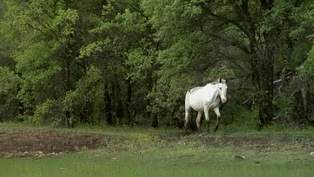 New
NewCalifornia Mustang Ranch Saves Wild Horses
Video has Closed Captions
Saddle up to ride the high country in California with a program to save wild mustangs. (4m 47s)
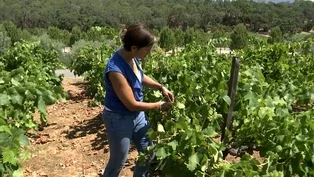 New
NewCalifornia Winemakers Work to Benefit the Environment
Video has Closed Captions
A look back at a California winery dedicated to sustainable growing. (6m 4s)
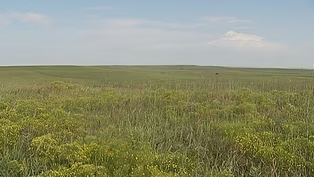 New
NewSaving Historic Kansas Prairie Grasslands
Video has Closed Captions
Travel back in time in efforts to save the tall grass prairie in Kansas. (6m 17s)
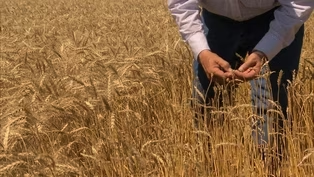 New
NewSouth Dakota Farmers Harvest Winter Wheat
Video has Closed Captions
We’ll introduce you to a South Dakota farm family using technology to bring wheat to your table. (5m 22s)
Providing Support for PBS.org
Learn Moreabout PBS online sponsorship

- Food
Christopher Kimball’s Milk Street Television
Transform home cooking with the editors of Christopher Kimball’s Milk Street Magazine.









Support for PBS provided by:
America's Heartland is presented by your local public television station.
Funding for America’s Heartland is provided by US Soy, Sustainable Agriculture Research and Education, Rural Development Partners, and a Specialty Crop Grant from the California Department of Food and Agriculture.